
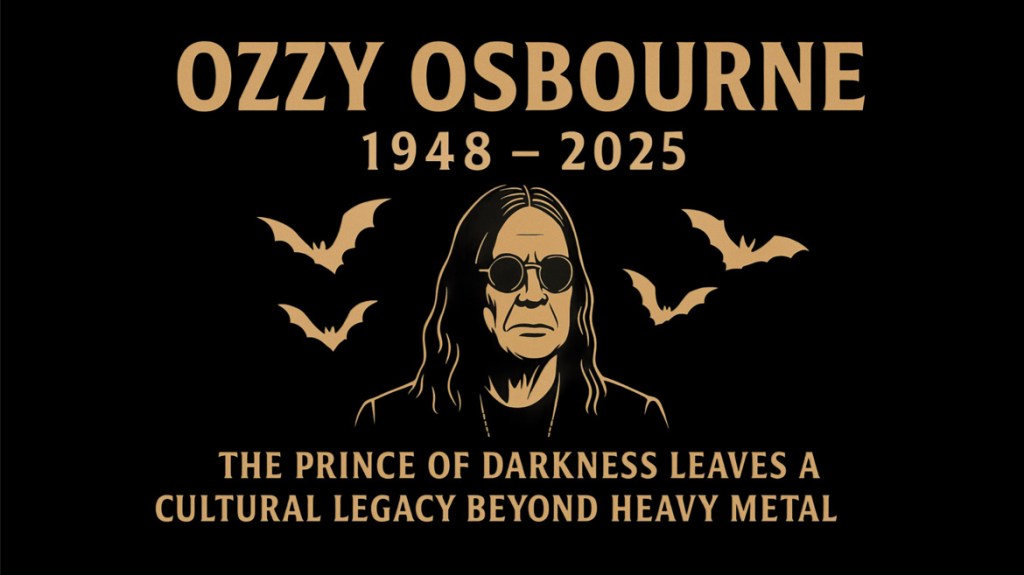
London — The world of music has lost one of its most iconic and enigmatic figures. Ozzy Osbourne, the legendary frontman of Black Sabbath and a towering figure in the pantheon of heavy metal, passed away this morning at the age of 76. His family released a heartfelt statement: “It is with more sadness than mere words can convey that we have to report that our beloved Ozzy Osbourne has passed away this morning. He was with his family and surrounded by love.”
Ozzy’s death follows just weeks after a monumental reunion concert in Birmingham, where he shared the stage one final time with his Black Sabbath bandmates before a sea of tearful fans, closing the book on an era that forever changed music — and, arguably, Western culture.
🎸 From Birmingham’s Shadows to Global Reverence
Born John Michael Osbourne in 1949 in Aston, Birmingham, Ozzy’s early life was marked by working-class grit, juvenile scrapes, and an unshakable love for The Beatles. That love for melody, married with a fascination for darkness and spectacle, would ultimately give birth to Black Sabbath — the band that defined a genre.
With Tony Iommi’s haunting guitar riffs, Geezer Butler’s provocative lyrics, and Bill Ward’s thundering drums, Black Sabbath’s self-titled debut album in 1970 introduced the world to something radically new: heavy metal as a dark and rebellious language. The band followed up with monumental records like Paranoid, Master of Reality, and Vol. 4, solidifying themselves as icons and establishing Ozzy as the genre’s unmistakable voice.
Advertisement

🚂 The Solo Ascent and Enduring Reinvention
After his departure from Black Sabbath in 1979 — a consequence of excess and volatility — many thought Ozzy’s career had reached its twilight. Instead, Blizzard of Ozz (1980) proved he was just getting started. With tracks like Crazy Train and Mr. Crowley, Ozzy launched a solo legacy that was just as influential as his work with Sabbath.
His collaboration with guitar virtuoso Randy Rhoads brought neoclassical flare to metal, and later albums like Bark at the Moon, No More Tears, and Ozzmosis added emotional depth, experimentation, and mass appeal. Ozzy’s voice remained a haunting constant: nasal, vulnerable, and mysteriously magnetic.
Notably, his music evolved with time — addressing themes of addiction, depression, mortality, and love. In his later years, albums such as Ordinary Man and Patient Number 9 included collaborations with Elton John, Post Malone, and Eric Clapton, showcasing an artist deeply reflective yet still willing to push boundaries.
📺 Ozzy in the Eyes of Pop Culture
Ozzy Osbourne wasn’t just a music icon — he was a cultural archetype. His 2002–2005 reality show The Osbournes changed how audiences perceived rockstars. The “Prince of Darkness” became a relatable family man, fumbling with remote controls and offering dry British wit while navigating domestic life with wife Sharon and children Kelly and Jack.
The show broke taboos, normalized mental health discussions, and presented rock music’s most feared figure as authentically flawed and tender. It arguably paved the way for a generation of celebrity-centered reality television, making Ozzy a fixture in homes far beyond metal fandom.
Fashion, film, video games — Ozzy’s reach extended into multiple sectors. His look (leather trench coats, crucifixes, smeared eyeliner) became a goth-metal uniform, emulated worldwide. His infamous bat-biting incident in 1982 lives on as both lore and branding, symbolizing reckless rebellion with a touch of theatrical surrealism.

🎪 A Festival Architect and Guardian of Metal
The 1996 creation of Ozzfest further cemented Ozzy’s legacy as not just a performer, but a patron of the metal world. The festival gave emerging and underground metal acts a stage, and exposed younger audiences to the roots of the genre.
“Ozzfest brought metal out of the shadows,” says Lars Ulrich of Metallica. “Without Ozzy, the movement wouldn’t have had its godfather — the one who made it okay to be loud, dark, and emotional.”
Indeed, Ozzy’s mentorship and advocacy helped spawn generations of bands and preserve the genre’s evolution. Slipknot, System of a Down, Disturbed — all owe part of their ascendancy to the doors Ozzy opened.
🧠 A Vessel of Emotional Truth and Cultural Healing
Ozzy Osbourne’s greatest gift may have been his ability to articulate the unspoken. In songs like Mama, I’m Coming Home, Dreamer, and You Can’t Kill Rock and Roll, he exposed the human heart behind the amplifier.
His music offered catharsis — a way for fans to scream through pain, feel seen in their sadness, and escape a world that often felt too sanitized. “Ozzy made it okay to be broken,” one fan posted on social media today. “He gave us anthems that sounded like our inside voices.”
Academics have even examined his work in relation to Western identity formation — proposing that his exploration of taboo, alienation, and myth-making aligns with the postmodern movement. Ozzy wasn’t merely reacting to culture. He was shaping it, whispering through distortion the truths that polite society ignored.
🙏 A Farewell, But Not an End
Ozzy Osbourne’s passing marks the end of a physical presence — but his spirit remains embedded in guitar solos, eyeliner smears, and whispered lyrics beneath headphones in dim bedrooms across the globe.
He offered more than metal. He gave people a framework to process chaos, confront mortality, and laugh through existential dread. Whether you’re a fan from the Sabbath days or someone who discovered him through TikTok clips of The Osbournes, his impact is unmistakable.
In moments of confusion or catharsis, we’ll return to his music — not just to reminisce, but to be reminded of our capacity to feel deeply.
“I’m just a dreamer, I dream my life away.”
— Ozzy Osbourne, Dreamer (2002)
Rest well, Prince of Darkness. The echo of your music will never fade.


 Dutch Echo
Leave a comment