
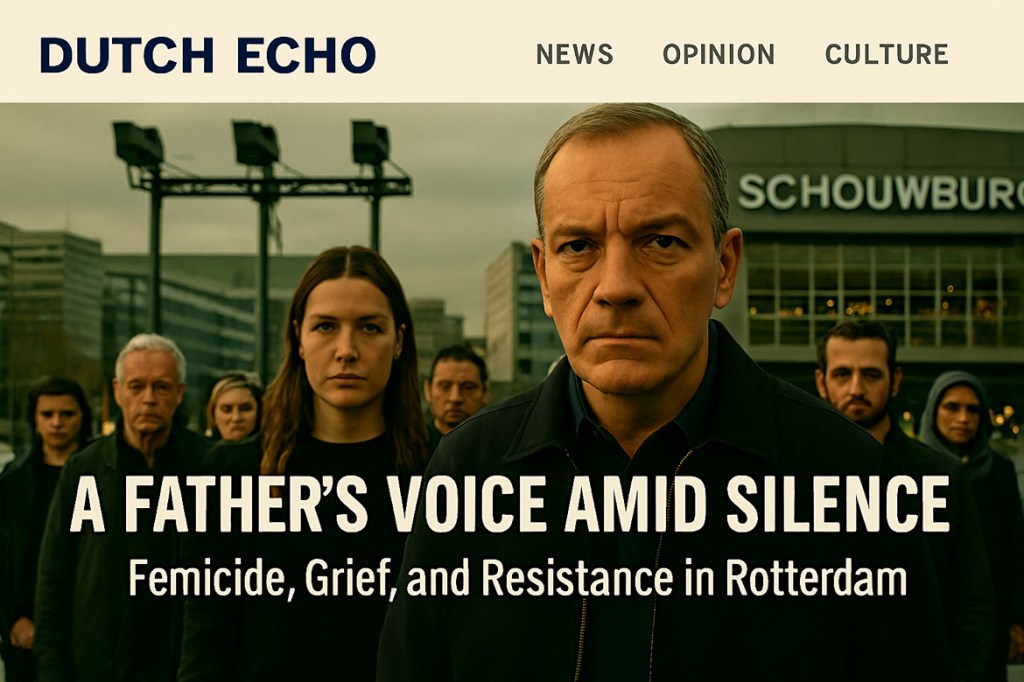
Rotterdam — On a quiet afternoon at Schouwburgplein, a crowd gathered not to celebrate, but to mourn, to protest, and to demand change. Among them stood Wim Hertgers, a man whose life was irrevocably altered in October 2023 when his daughter Sanne was murdered by her ex-husband. Now, he speaks not only as a grieving father, but as a public advocate against femicide—a form of gender-based violence that continues to claim lives across the Netherlands and beyond.
During his speech at the march against femicide, Hertgers was interrupted by a man who stormed the stage, seized the microphone, and shouted insults at the crowd. “Just act normal for once, you bunch of leftist lunatics. Go earn your own living,” the man yelled, followed by a vulgar curse. He was swiftly removed and arrested by police. Hertgers, however, remained composed. “I wasn’t frightened,” he said afterward. “This is exactly the kind of person I’m fighting against.”
🔍 The Tragedy of Sanne
Sanne Hertgers was 31 years old when she was killed by her ex-husband Frank, a police officer from Doetinchem. The couple had been married for ten years and were in the process of separating. Frank, unable to accept the end of the relationship, murdered Sanne with her own kitchen knife before taking his own life. It was Wim who discovered their bodies.
Sanne had worked in a forensic psychiatric clinic and was known for her strength, independence, and love of motorcycling and football. But after marrying Frank, her personality changed. She became withdrawn, quiet, and visibly distressed. According to her parents, Frank controlled every aspect of her life—from her bank account to her phone—and subjected her to sexual coercion. Despite the abuse, Sanne never reached out to authorities or support services.
Her parents now wonder whether a national emergency number for victims of partner violence could have saved her. In the wake of her death, Wim and his wife Monique have dedicated themselves to raising awareness about femicide, traveling with a mobile cinema that screens educational films and encourages dialogue.
📊 Femicide in the Netherlands: A Grim Reality
Femicide is defined as the intentional killing of women because they are women. It is often committed by current or former partners and is rooted in patterns of control, misogyny, and systemic inequality.
In the Netherlands, the statistics are alarming:
- On average, one woman is murdered every eight days.
- In 2022, 48 women were killed, 36 of them in domestic settings.
- The Netherlands ranks among the highest in Europe for femicide rates, alongside Sweden and Finland.
The most common scenarios include:
- Murder by (ex-)partner following a breakup or threat of separation.
- Use of knives or strangulation as the method of killing.
- Perpetrators with histories of controlling behavior, mental health issues, or suicidal ideation.
Advertisement

Experts emphasize that femicide rarely occurs without warning. Red flags include stalking, threats, sexual coercion, isolation, and obsessive jealousy. Yet these signs are often missed or dismissed—by friends, family, and even professionals.
🧠 Silent Suffering: Recognizing the Unspoken
One of the most insidious aspects of femicide is that many victims do not speak out. Fear, shame, and psychological manipulation keep them silent. But even when words are absent, behavior speaks volumes.
Warning signs in silent victims may include:
- Withdrawal from social circles and sudden changes in appearance.
- Reluctance to make decisions or express opinions.
- Unexplained injuries or vague excuses for physical harm.
- Financial dependence and lack of access to personal resources.
- Anxiety, depression, and signs of trauma.
Recognizing these signals requires sensitivity and awareness. A simple question—“Do you feel safe at home?”—can open the door to life-saving conversations.
🗣️ Why Speaking Out Matters
The attack on Hertgers during his speech is emblematic of a deeper societal resistance to confronting gender-based violence. Femicide is not just a personal tragedy; it is a systemic failure. It reflects the inability of institutions to protect vulnerable women, the normalization of controlling behavior, and the cultural discomfort with naming misogyny.
Bringing femicide into public discourse is essential:
- It saves lives by promoting early intervention.
- It breaks the silence and stigma surrounding abuse.
- It exposes flaws in legal and social systems.
- It empowers survivors and honors victims.
- It fosters solidarity and collective action.
Hertgers’ calm response to the disruption was not just dignified—it was defiant. His presence, his voice, and his grief are a call to action.
🕊️ A March for Sanne, A Movement for All
The march in Rotterdam was more than a protest. It was a gathering of voices—activists, survivors, families, and allies—united by a shared demand: stop femicide. With no fists raised and no slogans shouted, the atmosphere was one of solemn determination. Faces showed not rage, but resolve. The backdrop of Schouwburgplein, with its cultural landmarks and modern architecture, framed a moment of collective mourning and hope.
As Hertgers continues his journey, he carries Sanne’s story not as a burden, but as a beacon. “She can’t be saved,” he says. “But if her story helps even one woman escape, then her death has meaning.”

 Dutch Echo
Leave a comment