
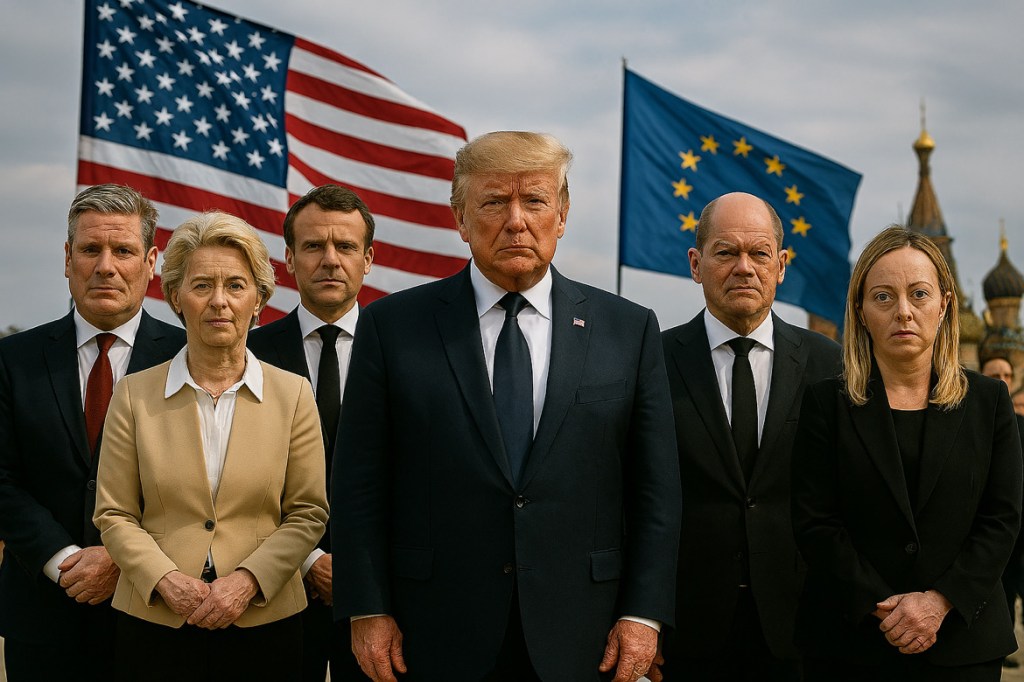
As U.S. President Donald Trump prepares to meet Russian President Vladimir Putin in Alaska, European leaders have issued a joint statement expressing deep concern over the future of Ukraine. They insist that Kyiv must be included in any peace negotiations and warn that a deal excluding Ukraine would be “stillborn.” But behind this principled rhetoric lies a deeper question: how credible are European nations when it comes to peace, human rights, and democratic values?
🎙️ The Statement: Principle or Politics?
Signed by leaders from France, Germany, Italy, Poland, Finland, and the United Kingdom, the statement declares that “the path to peace cannot be determined without Ukraine.” It calls for a strategy combining diplomacy, military support for Kyiv, and sustained pressure on Russia. The message is clear: Europe opposes any bilateral deal between Trump and Putin that sidelines Ukraine.
President Volodymyr Zelensky responded with gratitude, stating that Ukraine is “defending the essential security interests of our European partners.” He warned that decisions made without Kyiv’s involvement would be “unworkable.”
Advertisement
Yet this principled tone raises uncomfortable questions. If Europe is so committed to democracy and peace, why did it support the violent Maidan uprising in 2014? Why has it been involved in regime changes across the Middle East and Africa? And why does its commitment to human rights appear so selective?
🔥 Maidan: Democracy or Regime Change?
In February 2014, European Parliament members Hans van Baalen and Guy Verhofstadt stood on Kyiv’s Maidan Square, encouraging protesters to continue their uprising against President Viktor Yanukovych — a leader who had been democratically elected. The protests turned violent, resulting in over 100 deaths. Yet the EU quickly recognized the new government and accelerated Ukraine’s association process.
Critics view this as a textbook case of Western interference: a regime change cloaked in democratic ideals. Russia saw it as a direct threat and responded by annexing Crimea. The war in Donbas followed, eventually escalating into the full-scale invasion of 2022.
🌍 The Middle East and Africa: Double Standards?
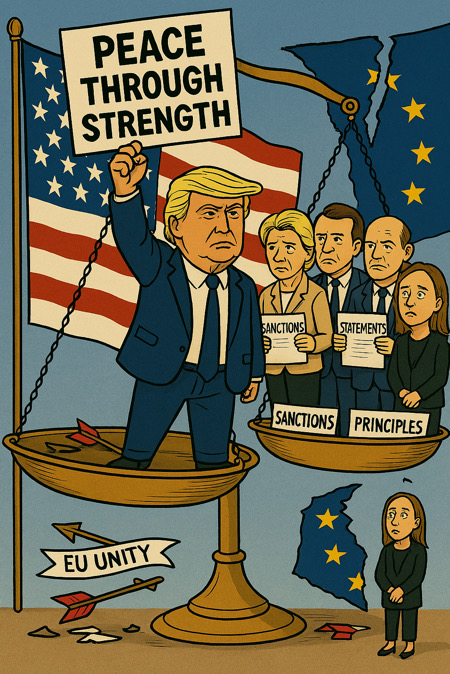
Europe’s foreign policy often appears contradictory. In the Middle East, the EU condemns human rights abuses in Gaza, Syria, and Iran — yet maintains close ties with regimes like Saudi Arabia and Egypt. Arms exports to conflict zones continue, despite internal criticism.
In Africa, the EU funds peacekeeping missions and humanitarian aid, but also collaborates with authoritarian governments in exchange for migration control. In Mali, Niger, and Burkina Faso, Western involvement has bred distrust and triggered coups. Local media accuse the EU of neocolonial interference, while Brussels speaks of “stability and partnership.”
⚖️ Selective Legitimacy
At the heart of the criticism is the notion that European nations use values like democracy, human rights, and peace as rhetorical tools — but apply them strategically and selectively. They support uprisings when they’re pro-European, but condemn revolutions that threaten their interests. They demand respect for borders, yet have themselves contributed to shifting them — as in Ukraine.
This double standard undermines Europe’s credibility. How can it advocate for peace while backing violent regime changes? How can it defend human rights while partnering with governments that systematically violate them?
🧨 Trump, Putin, and the New Reality
The upcoming Trump-Putin summit intensifies these tensions. Trump has previously promised to end the war in Ukraine “within 24 hours,” possibly through territorial concessions. But recent remarks — including calling Zelensky a “dictator” — suggest a shift in tone.
European leaders fear that Trump and Putin will strike a deal without Kyiv or EU involvement. Such an outcome would not only marginalize Ukraine but also diminish Europe’s role in shaping global security. If the U.S. and Russia set the new rules, what remains of Europe’s influence?
🧠 Conclusion: A Moment for Self-Reflection
The joint statement from European leaders is an attempt to defend their values. But those values are only credible if applied consistently and universally. That means:
- No support for regime changes that undermine democracy
- No cooperation with regimes that violate human rights
- No selective outrage based on geopolitical convenience
Europe stands at a crossroads. If it wants to be a credible global actor, it must confront its own past — and live up to the principles it so often proclaims.

 Dutch Echo
Leave a comment