

Let’s be real: most of us don’t wake up thinking about 17th-century philosophers. Between work stress, climate anxiety, and figuring out what the hell we’re doing with our lives, dusty old thinkers aren’t exactly top of mind. But what if I told you that one of the most radical, forward-thinking minds in history lived just a few hours from Rotterdam — and that his ideas are still shaping how we think, speak, and live today?
His name? Baruch Spinoza. No TikTok. No TED Talk. Just pure, unapologetic philosophy that challenged religion, politics, and the very idea of free will. And somehow, it still hits hard in 2025.
🧠 Who Was Spinoza?
Born in 1632 in Amsterdam, Spinoza came from a Portuguese-Jewish family that had fled religious persecution. His community was tight-knit, religious, and deeply rooted in tradition. But Spinoza? He was different. He asked questions — big ones. About God, the Bible, human nature, and the universe. And when his answers didn’t line up with what the rabbis were preaching, he got excommunicated at just 23.
Advertisement

Imagine being cut off from your entire community — family, friends, business contacts — because you dared to think differently. That was Spinoza’s reality. But instead of backing down, he leaned in. He spent the rest of his life writing, thinking, and grinding lenses (literally — that was his job) while crafting some of the most revolutionary ideas Europe had ever seen.
📚 His Two Major Works: Ethica & Tractatus
Spinoza didn’t write for clout. He wrote to understand the world — and to help others do the same. His two most famous works are Ethica and the Tractatus Theologico-Politicus. Let’s break them down.
1. Ethica (1677)
This book is wild. It’s written like a geometry textbook — with definitions, axioms, and theorems — but instead of triangles and circles, it’s about God, emotions, freedom, and the human mind.
Here’s what Spinoza argues:
- God isn’t a person sitting on a cloud. God is nature. Everything that exists is part of God.
- Free will? Nah. Everything happens out of necessity. Even your thoughts and choices are part of nature’s flow.
- Emotions aren’t random. They’re changes in your ability to act. Understanding them gives you power.
- Freedom isn’t doing whatever you want. It’s understanding why you do what you do — and acting from that insight.
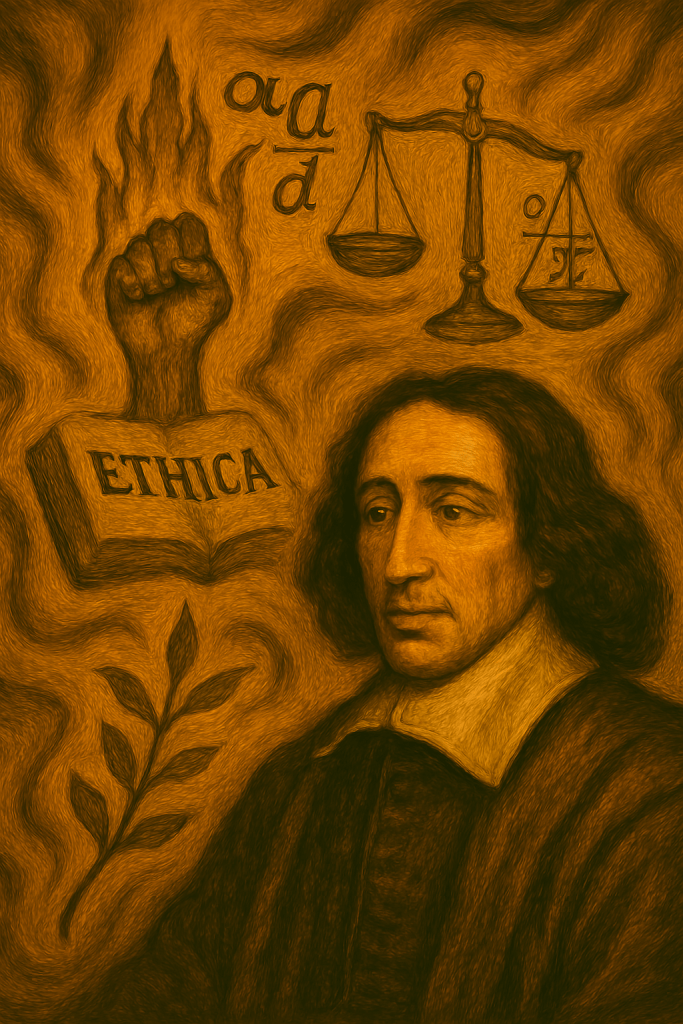
In short: Spinoza believed that true freedom comes from self-awareness and rational understanding. Not from impulse, not from tradition, but from clarity.
2. Tractatus Theologico-Politicus (1670)
This one’s a bombshell. Spinoza published it anonymously, with a fake publisher and a fake city, because he knew it would piss people off. And it did.
In the Tractatus, Spinoza says:
- The Bible isn’t divine revelation. It’s a collection of texts written by humans, with human agendas.
- Religion shouldn’t control politics. The state should be secular and protect freedom of thought.
- Freedom of speech is essential. People must be allowed to think and speak freely, even if their ideas challenge religious norms.
In a time when church and state were basically married, this was pure rebellion. But it laid the groundwork for modern democracy, freedom of expression, and secular governance.
🏙️ The World He Lived In
Spinoza lived during the Dutch Golden Age — a time of booming trade, art, and science. Amsterdam was a global hub, and the Netherlands was one of the most progressive places in Europe. But it wasn’t all tulips and tolerance.
- Religion was dominant, and dissent was dangerous.
- Politics were unstable, with constant wars and internal power struggles.
- Social inequality was real, despite the wealth.
Spinoza chose a life of quiet resistance. He turned down prestigious university offers, avoided fame, and lived simply. He didn’t want power — he wanted truth.
⚰️ His Death and What Came After
Spinoza died in 1677, at just 44 years old. Likely from a lung disease caused by inhaling glass dust while grinding lenses. But his ideas didn’t die with him.
His friends published his works posthumously, and although they were banned in many places, they spread like wildfire among Europe’s intellectuals. He became a secret hero of the Enlightenment, influencing thinkers like:
- Kant (who wrestled with Spinoza’s determinism)
- Hegel (who saw him as a philosophical giant)
- Nietzsche (who admired his rejection of moral dogma)
- Einstein (who called Spinoza’s view of God “his own”)
🌍 Why Spinoza Still Matters in Rotterdam Today
Okay, cool history. But what does this have to do with your life in 2025?
Advertisement

1. Freedom of Thought
Spinoza’s defense of free speech is more relevant than ever. In a world of cancel culture, algorithmic echo chambers, and political polarization, the ability to think freely — and express those thoughts — is under pressure.
Spinoza reminds us: freedom isn’t just a right. It’s a responsibility.
2. Questioning Dogma
Whether it’s religion, politics, or social norms, Spinoza teaches us to question everything. Not to be contrarian for the sake of it, but to seek truth. To ask: Why do I believe this? Where does this idea come from?
That mindset is gold in a world flooded with misinformation.
3. Emotional Intelligence
Spinoza’s view of emotions — as changes in our power to act — is surprisingly modern. He basically anticipated psychology and self-help centuries before they existed.
He’d say: Don’t suppress your feelings. Understand them. That’s how you grow.
4. Spirituality Without Religion
For many young adults today, traditional religion doesn’t resonate. But Spinoza offers a spiritual vision that’s grounded in nature, reason, and interconnectedness.
God isn’t a judge. God is the universe. And we’re all part of it.
5. Ecological Awareness
If God = nature, then harming nature is harming the divine. Spinoza’s philosophy aligns perfectly with climate ethics and ecological responsibility. It’s not just about saving the planet — it’s about honoring our place in the whole.
🗣️ Final Thoughts: Spinoza Isn’t Just History — He’s a Vibe
Baruch Spinoza isn’t some dusty relic. He’s a philosopher who dared to think differently — and paid the price. But his ideas have shaped the world we live in. And if you’re someone who values freedom, truth, and self-awareness, then you’re already walking in his footsteps.
So next time you’re sipping coffee at a café in Rotterdam, scrolling through your feed, wondering what it all means — remember Spinoza. Not as a guru, but as a fellow seeker. Someone who believed that understanding is liberation, and that freedom begins in the mind.
Because in the end, as Spinoza said:
“The free person thinks of nothing less than death, and his wisdom is a meditation on life.”
And that, friends, is a philosophy worth living.

 Dutch Echo
Leave a comment