
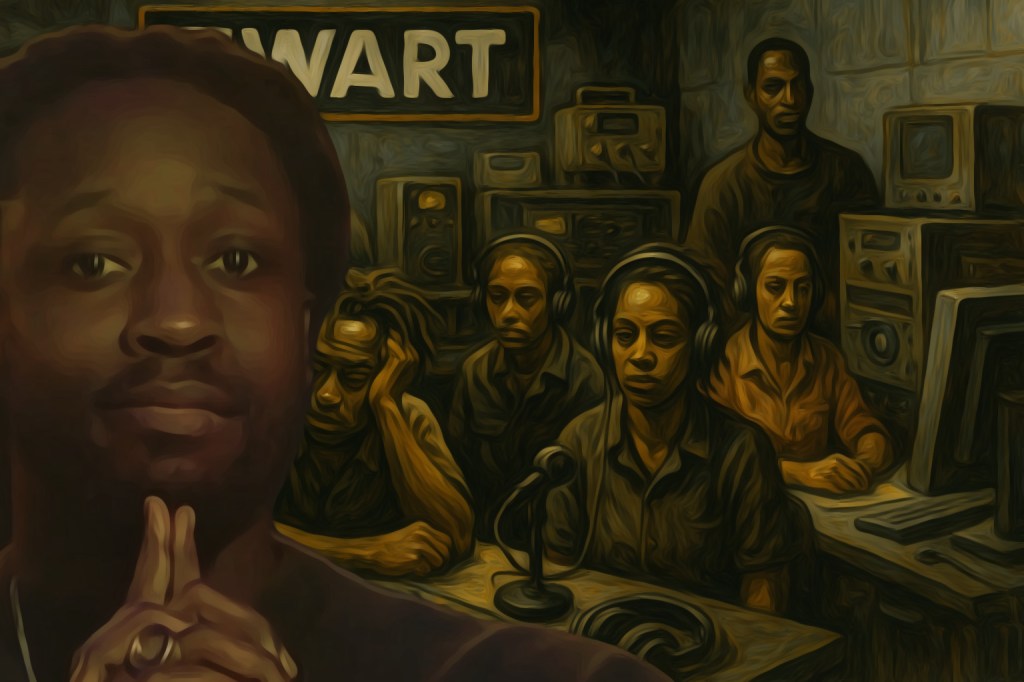
You’re scrolling through your feed. Someone sends you a BIJ1 poster and says, “Share this.” You ask, “Why?” They reply, “White people are racist by nature.” You pause. Wait, what? Suddenly you’re in a conversation that’s not about justice anymore — it’s about blame, identity, and who gets to speak.
Welcome to Rotterdam, now. But to understand how we got here, we need to go back. Back to the football fields of West in the late ’70s. Back to the slap from uncle Piet. Back to the heroin crisis. To Bouterse. To ROOTS on TV. Because what’s happening today isn’t new — it’s an echo of what’s been simmering for decades.
⚽ Rotterdam-West, Summer 1978
World Cup fever. Two TV channels. Everyone’s watching. Kids flood the streets to play football. But something’s off: Afro-Surinamese kids don’t play with Hindustani kids. They do play with Turkish and Moroccan kids — even though they barely speak Dutch yet.
That’s not coincidence. That’s racism. Not the loud kind, but the quiet kind. Kids repeat what they hear at home. Words like “koelie” and “blakaman” fly around. White Dutch kids stand by, confused. They don’t see race, but they feel the tension.
Advertisement

👊 The Slap from Uncle Piet
As a Javanese kid in Rotterdam, I once said I was a foreigner because of my brown skin. My uncle slapped me.
“You’re Dutch. A Dutchman from the overseas province!”
To him, that wasn’t up for debate. We were Dutch. Foreigners? That was the guest workers — Turks, Moroccans, Spaniards. Not us.
But that slap wasn’t just discipline. It was a colonial echo: loyalty over skin color, as long as you behaved.
📺 ROOTS and the National Guilt Trip
Late ’70s, Alex Haley’s ROOTS hits Dutch TV. Kunta Kinte’s story — slavery, resistance, survival — hits hard. For the first time, Dutch viewers see slavery not as a footnote, but as lived trauma. Suddenly, “black people” aren’t lazy and dumb — they’re victims.
That guilt was real. But short-lived. Empathy without action is like rain on concrete — it doesn’t soak in. Meanwhile, Afro-Surinamese communities in Rotterdam face unemployment, addiction, and stigma. And the heroin crisis hits them hardest.
💉 Crack, the CIA and Gary Webb
Fast forward to the ’80s. Crack devastates Black communities in the U.S. Ten years later, journalist Gary Webb drops a bomb: the CIA knew. Worse — they helped. To fund the Contras in Nicaragua, they let cocaine flood American streets. Crack was born. Black neighborhoods burned.
That’s institutional racism on a global scale. But in the Netherlands? Silence. No mention on Omroep ZWART. No word from Akwasi. Why not? Why does the conversation stop at Zwarte Piet, while the real machinery stays hidden?
🏛️ What Is Institutional Racism, Really?

It’s not about hate — it’s about systems. Rules, algorithms, habits that exclude people without anyone needing to say “I hate you.” Think:
- The childcare benefits scandal
- Ethnic profiling by police
- Discrimination in housing and jobs
- Lower school advice for kids of color
And yes, the CIA is an institution too. But Dutch activism rarely looks beyond its own borders. As if racism stops at Schiphol.
🇸🇷 Suriname, Bouterse and the Diaspora
After independence in 1975, Suriname’s politics were deeply ethnic. The Creole-led NPS took power. Hindustani and Javanese Surinamese fled — scared of instability, war, and racial violence like in Guyana. Bouterse tried to unify:
“We are all Surinamese. Then Creole, Hindustani, Javanese.”
But in the Netherlands, the government treated migrants as separate groups. “Minorities” needed help to “emancipate.” Integration wasn’t the goal. You were first an “allochtoon,” then maybe Dutch.
🧠 Racism at Home
My mother once said:
“If you bring home a girl, let her be Javanese. Or Dutch. Not a black girl — they’re into drugs. Not Hindustani — they call alcohol ‘daroe.’”
That’s racism. But I’d never call her a racist. She was shaped by a colonial society where ethnic hierarchy was survival. She wanted to protect me — using exclusion as a tool.
📣 BIJ1, Akwasi and the New Language
Five years ago, someone asked me to share a BIJ1 poster. I asked why.
“White people are racist by nature,” they said.
That’s not activism. That’s essentialism. That’s the thief yelling “thief!” while pointing at the victim — as Kenneth Slooten would say. The conversation’s been hijacked. Nuance is gone. Bridges are burned.
📺 Omroep ZWART: Whose Side Are They On?
They say they want connection. But what do we see?
- Identity politics without depth
- Emotional hype over historical insight
- No mention of global structures like the CIA or IMF
So I don’t feel represented. Not because I’m against equality — but because I’m for clarity. For connection. For history that makes sense.
🔄 So What Now?
We live in a time where activism is a brand. Media rewards outrage. Religion is discussed by haters. Antiracism by people who exclude.
But you, me, us — we can do better. By remembering. By connecting. By asking: How does this help? And by refusing to follow ideological shortcuts.
🎥 A Proposal
Let’s document this. In images. In words. In dialogue. From the football fields of West to the benefits scandal. From ROOTS to Rotterdam. We’re not a footnote. We’re the story.


 Dutch Echo
Leave a comment