
📘 Introduction

Sigmund Freud (1856–1939) is widely regarded as the founder of psychoanalysis and one of the most influential thinkers in the history of psychology. Though many of his theories have been revised, challenged, or rejected by contemporary science, Freud’s conceptual framework continues to shape how we understand the human mind, especially in care professions where emotional depth, unconscious processes, and relational dynamics are central.
This chapter offers a comprehensive overview of Freud’s core ideas, including his model of the psyche, psychosexual development, defense mechanisms, and the role of unconscious processes. It also explores how these concepts remain relevant in today’s care settings—from trauma-informed practice to therapeutic dialogue and cultural sensitivity.
🧠 Freud’s Model of the Psyche: Es, Ich, and Über-Ich
Freud proposed that the human psyche is structured into three interacting systems:
1. Es (Id)
- The most primitive part of the psyche.
- Operates entirely unconsciously.
- Driven by instinctual desires (sexual, aggressive, survival).
- Follows the pleasure principle: seeks immediate gratification.
Advertisement


2. Ich (Ego)
- The conscious, rational part of the psyche.
- Mediates between the demands of the Id, the moral constraints of the Superego, and the realities of the external world.
- Follows the reality principle: delays gratification when necessary.
3. Über-Ich (Superego)
- The internalized moral standards and ideals acquired from parents and society.
- Functions as the conscience.
- Can produce guilt, shame, and pride.
🔄 Interaction and Conflict
The Ego constantly negotiates between the impulsive Id and the judgmental Superego. This dynamic creates internal tension, which can manifest as anxiety, repression, or neurotic symptoms. Freud believed that much of human behavior is shaped by these unconscious conflicts.
🧩 Psychosexual Development: The Five Stages
Freud theorized that personality develops through a series of stages centered on erogenous zones. Each stage presents a conflict that must be resolved for healthy psychological development.
1. Oral Stage (0–1.5 years)
- Focus: Mouth (sucking, biting).
- Key conflict: Dependence vs. independence.
- Fixation outcomes: Overeating, smoking, dependency, sarcasm.
2. Anal Stage (1.5–3 years)
- Focus: Anus (toilet training).
- Key conflict: Control vs. chaos.
- Fixation outcomes: Obsessive neatness (anal-retentive) or messiness (anal-expulsive).
3. Phallic Stage (3–6 years)
- Focus: Genitals.
- Key conflict: Oedipus/Electra complex.
- Resolution: Identification with same-sex parent.
- Fixation outcomes: Problems with authority, sexual identity confusion.
4. Latency Stage (6–12 years)
- Focus: Social and cognitive development.
- Sexual impulses are repressed.
- Children focus on school, friendships, and hobbies.
5. Genital Stage (12+ years)
- Focus: Mature sexual relationships.
- Successful navigation of earlier stages leads to healthy adult functioning.
⚖️ The Oedipus Complex
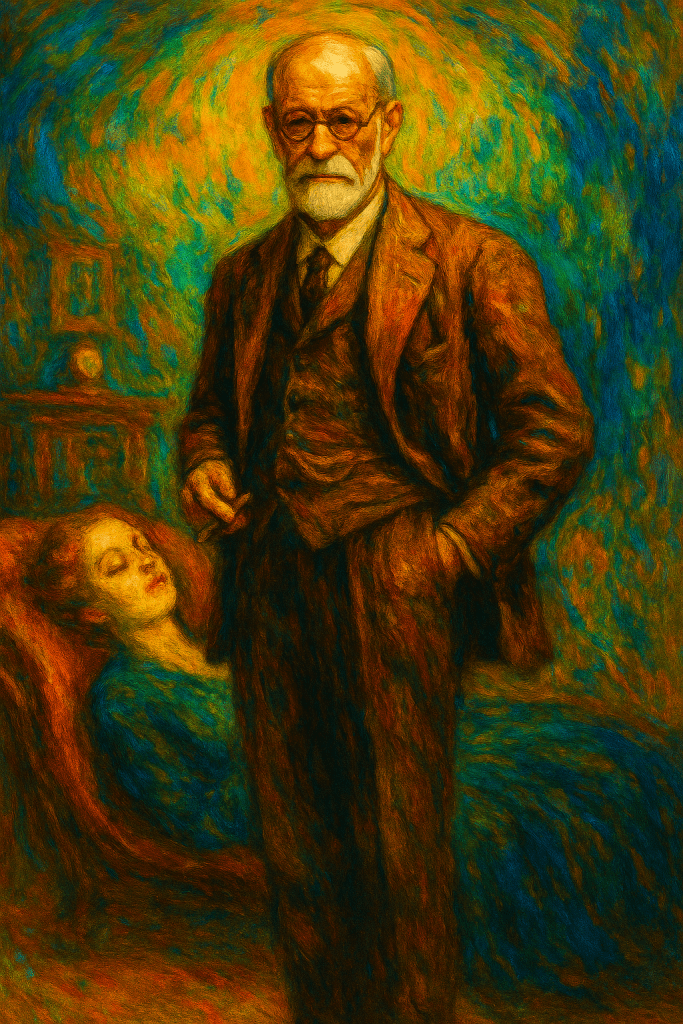
One of Freud’s most controversial ideas is the Oedipus complex, named after the Greek myth of Oedipus. Freud believed that during the phallic stage, children develop unconscious sexual desires for the opposite-sex parent and view the same-sex parent as a rival.
- Resolution: The child represses these desires and identifies with the same-sex parent, internalizing societal norms and forming the Superego.
- Impact: Freud saw this process as foundational for moral development and adult relationships.
Though modern psychology often critiques the literal interpretation of this theory, the concept remains influential in understanding family dynamics, identity formation, and unconscious relational patterns.
🛡️ Defense Mechanisms
To manage internal conflicts and anxiety, the Ego employs defense mechanisms—unconscious strategies that distort reality to protect the psyche.
The 10 Classic Defense Mechanisms:
| Mechanism | Description | Example 1 | Example 2 |
|---|---|---|---|
| Repression | Blocking painful thoughts from consciousness | Forgetting a traumatic event | Not recalling a failed relationship |
| Denial | Refusing to accept reality | Ignoring a diagnosis | Pretending a breakup didn’t happen |
| Projection | Attributing own feelings to others | Accusing others of jealousy | Blaming others for your anger |
| Rationalization | Justifying behavior with logical reasons | “I cheated because the test was unfair” | “I yelled because I care” |
| Regression | Reverting to earlier behavior | Throwing tantrums | Seeking comfort in childish habits |
| Reaction Formation | Expressing opposite feelings | Acting cold toward someone you’re attracted to | Overprotectiveness masking resentment |
| Sublimation | Channeling impulses into acceptable outlets | Turning anger into art | Using grief to fuel activism |
| Displacement | Redirecting emotions to safer targets | Yelling at a friend instead of your boss | Slamming a door after bad news |
| Fantasy | Escaping into imagination | Dreaming of success when feeling stuck | Imagining revenge instead of acting on it |
| Dissociation | Detaching from reality | Feeling numb during trauma | Saying “It felt like I wasn’t there” |
These mechanisms are not inherently pathological—they help people cope. But overreliance can hinder emotional growth and relational health.
🧠 The Unconscious Mind
Freud’s most enduring contribution is the idea of the unconscious—a vast reservoir of thoughts, memories, desires, and fears that influence behavior without our awareness.
- The unconscious is revealed through dreams, slips of the tongue, symptoms, and creative expression.
- Freud called dreams the “royal road to the unconscious,” and developed dream analysis as a therapeutic tool.
In care work, understanding the unconscious helps practitioners recognize non-verbal cues, symbolic behavior, and emotional undercurrents in clients.
🧬 Drives: Eros and Thanatos
Freud believed human behavior is driven by two fundamental forces:
1. Eros (Life Drive)
- Associated with survival, reproduction, creativity, and connection.
- Expressed through love, care, and artistic expression.
2. Thanatos (Death Drive)
- Associated with aggression, destruction, and a return to stillness.
- Expressed through self-sabotage, repetition compulsion, and violence.
These drives are in constant tension. Freud saw culture and civilization as attempts to sublimate these drives into socially acceptable forms.
🩺 Freud’s Relevance in Modern Care Settings
While Freud’s theories are not considered scientific by today’s standards, they remain deeply relevant in care professions:
1. Trauma-Informed Practice
- Concepts like repression, dissociation, and unconscious memory help explain trauma responses.
- Freud’s emphasis on early childhood experiences aligns with modern attachment theory.
2. Therapeutic Dialogue
- Freud pioneered the talking cure—the idea that speaking about inner experiences can heal.
- His methods laid the groundwork for psychodynamic therapy, still widely used today.
3. Cultural Sensitivity
- Freud’s model encourages practitioners to explore family history, cultural norms, and unconscious bias.
- In diverse cities like Rotterdam, this depth is essential for ethical care.
4. Symbolic Understanding
- Freud’s approach helps care workers interpret non-verbal communication, dreams, and creative expression.
- This is especially useful in working with children, neurodiverse clients, or those with trauma.
📚 Critiques and Legacy
Freud’s work has been critiqued for:
- Lack of empirical evidence.
- Gender bias (especially in theories about women).
- Overemphasis on sexuality.
Yet his legacy endures:
- He opened the door to depth psychology.
- He influenced art, literature, philosophy, and social theory.
- He gave us a language for inner life—one that still resonates in care, education, and community work.
🧭 Summary: Freud for Future Care Professionals
| Concept | Why It Matters in Care |
|---|---|
| Unconscious | Helps interpret behavior beyond surface level |
| Defense Mechanisms | Reveals coping strategies and emotional blocks |
| Psychosexual Stages | Offers insight into developmental patterns |
| Oedipus Complex | Explains relational dynamics and identity formation |
| Drives (Eros/Thanatos) | Illuminates tension between connection and destruction |
| Talk Therapy | Validates the healing power of dialogue |
| Symbolic Thinking | Enhances understanding of dreams, art, and behavior |
Page – 1 – 2 – 3


 Dutch Echo
Leave a comment