
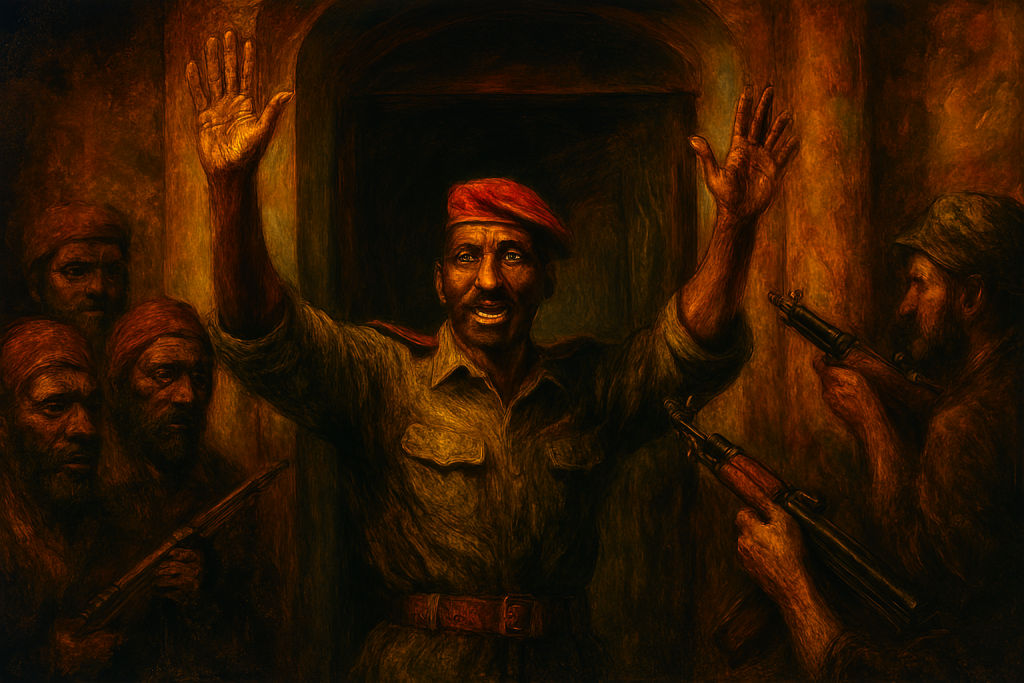
Ouagadougou, 1983. A young man steps out of a beat-up Renault 5. No bodyguards. No designer suit. No ego. He’s a captain in the army, but he speaks like a poet. “We must dare to invent the future,” he says. His name? Thomas Sankara. His mission? A revolution built not on slogans, but on radical honesty.
Fast forward to Rotterdam, 2025. We’re navigating burnout, climate collapse, algorithmic chaos, and political fatigue. We protest, we post, we question. But who do we look to when we ask: what does real leadership look like? Sankara’s story isn’t just African history — it’s a blueprint for integrity in an age of performance.
🧠 Who Was Thomas Sankara?
Born in 1949 in Yako, Burkina Faso (then called Upper Volta), Sankara grew up in a country still shackled by French colonialism. His father was a WWII veteran; his mother came from the Mossi ethnic majority. As a kid, Sankara organized symbolic protests — lowering the French flag and raising the national colors. He was 11.
Advertisement

He chose the military not to dominate, but to understand. In Madagascar, during his officer training, he witnessed peasant uprisings and a coup led by radical soldiers. He read Marx, Fanon, and Ratsiraka. He didn’t just study revolution — he internalized it.
🚲 Sober Leadership as Radical Practice
When Sankara became Minister of Information in 1981, he refused a government car. He cycled to work. As president, he drove a second-hand Renault 5. His personal assets? One bicycle, three guitars, a fridge. No foreign bank accounts. No palace.
He banned portraits of himself in public buildings. He refused applause at rallies. “Don’t look to my face for hope,” he said. “Look to each other.”
In a continent where leaders flaunted gold watches and foreign villas, Sankara’s simplicity was revolutionary. He didn’t just talk about equality — he lived it.
🌍 Anti-Imperialism Without Apology
Sankara didn’t mince words. He rejected IMF loans, calling them “economic colonization.” He publicly confronted French President François Mitterrand over France’s support for apartheid regimes. He gave Nelson Mandela a Burkinabè passport — a symbolic act of defiance.
He renamed his country from Upper Volta to Burkina Faso: “Land of Upright People.” He renamed streets after revolutionaries: Che Guevara Boulevard, Patrice Lumumba Avenue. He didn’t just decolonize policy — he decolonized imagination.
🚺 Women as the Backbone of Revolution
Sankara understood that no revolution could succeed without women. He outlawed child marriage, female genital mutilation, and polygamy. He appointed women to ministerial roles. He promoted women’s cooperatives and land ownership for widows.

“The revolution cannot succeed without the emancipation of women,” he declared. And he backed it up with laws, budgets, and visibility.
🌱 What Did He Actually Achieve?
In just four years (1983–1987), Sankara transformed Burkina Faso:
- Vaccinated 2 million children in two weeks — without WHO support.
- Planted over 10 million trees to fight desertification.
- Increased grain production by 75%.
- Built hundreds of schools and clinics.
- Launched mass literacy campaigns.
- Made ministers declare their assets publicly.
- Cut government salaries and redirected funds to rural communities.
All without foreign aid. All without corruption. All without compromise.
💔 The Betrayal
On October 15, 1987, Sankara was assassinated by commandos led by Gilbert Diendéré, under orders from Blaise Compaoré — his former ally. Twelve others were killed. His body was buried without ceremony.
Why? Because he was too principled. Too popular. Too dangerous to the status quo.
Compaoré took power, opened the economy to foreign mining companies, and ruled for 27 years. The country’s wealth grew — but inequality deepened. In 2014, when he tried to change the constitution to stay in power, the people rose up. He fled.
🔥 Ibrahim Traoré: Sankara’s Heir?
In 2022, Captain Ibrahim Traoré seized power. Young, idealistic, and outspoken, he calls Sankara his role model. He refuses his presidential salary. He drives modest cars. He opened a mausoleum at the site of Sankara’s murder.
His speeches echo Sankara’s: sovereignty, dignity, anti-imperialism. He’s aligned Burkina Faso with Mali and Niger in the Alliance of Sahel States — a bloc resisting Western influence.
But the question remains: can Traoré continue Sankara’s revolution without repeating its tragic end?
🧭 Why Should Rotterdam Care?
Because Sankara’s story isn’t just about Burkina Faso. It’s about what leadership could be — in Crooswijk, Delfshaven, or anywhere people feel unheard.
We live in a time of performative politics, influencer activism, and corporate greenwashing. Sankara reminds us that real change requires real sacrifice. That integrity isn’t a brand — it’s a practice.
He didn’t just speak truth to power. He lived truth in power.
🎤 What Do We Do With His Legacy?
Sankara said: “You can kill a man, but not his ideas.” His ideas live on in youth movements, protest art, and community organizing. In every person who refuses to sell out. In every leader who chooses service over status.
So the question isn’t: who was Sankara?
The question is: who dares to be Sankara today?
✍️ Final Thought
In a world drowning in noise, Sankara’s silence — his refusal to self-promote, to indulge, to betray — speaks louder than ever. His revolution wasn’t perfect. But it was honest. And that honesty is revolutionary.
For young adults in Rotterdam, his story is a reminder: you don’t need power to be powerful. You need principles. And the courage to live them.

 Dutch Echo
Leave a comment