
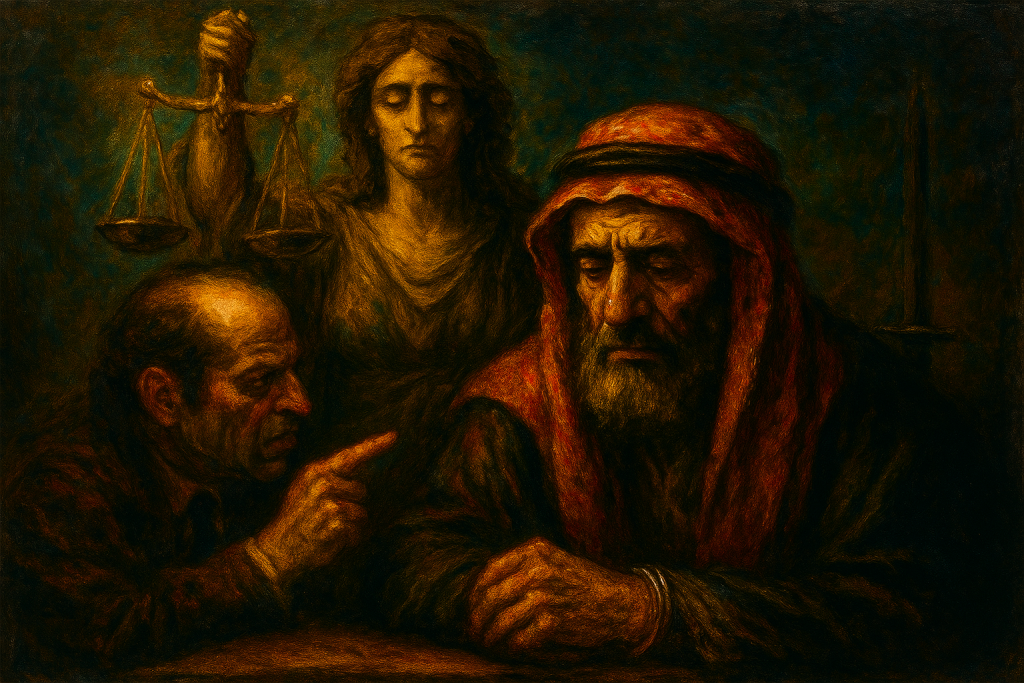
A Name That Never Lets Go
Rotterdam – Some names are so heavy they drag you down no matter what you do. For Hannibal Gaddafi, son of the infamous Libyan leader Moammar Gaddafi, his surname has been both a shield and a curse. He never held real political power, never commanded armies, never wrote ideological manifestos. Yet for nearly a decade he sat in a Lebanese prison cell, not for what he did, but for who he was.
In December 2015, Hannibal was kidnapped in Syria by an armed group and smuggled across the border into Lebanon. There, he was handed over to Lebanese authorities and detained. The official reason? To provide information about the disappearance of Imam Moussa al‑Sadr, a Lebanese Shiite cleric who vanished in Libya in 1978 after a meeting with Moammar Gaddafi. The problem: Hannibal was three years old at the time.
The Vanishing of Moussa al‑Sadr
To understand why Hannibal became a pawn, you have to rewind to the late 1970s. Moussa al‑Sadr was a charismatic Shiite leader in Lebanon, a country already fractured along sectarian lines. He championed the rights of Lebanon’s Shiite community, which had long felt marginalized. His speeches mixed theology with social justice, and he quickly became a symbol of empowerment.
Advertisement


In August 1978, al‑Sadr traveled to Libya to meet Moammar Gaddafi. The details of their conversation remain unknown. What is known is that al‑Sadr and two companions disappeared without a trace. Libya claimed he had flown to Italy, but Italian authorities denied it. For many Lebanese, especially Shiites, the conclusion was obvious: Gaddafi had him eliminated.
The disappearance of al‑Sadr became more than a mystery. It turned into a collective trauma, a wound that shaped Shiite identity in Lebanon for decades.
Gaddafi’s Dual Legacy
Moammar Gaddafi was already notorious by then. He seized power in 1969 at just 27 years old, overthrowing King Idris in a bloodless coup. He styled himself as the “Brother Leader” and “Guide of the Revolution,” rejecting formal titles but holding absolute control.
For ordinary Libyans, Gaddafi’s rule brought free healthcare, education, and subsidized housing. Libya’s oil wealth was redistributed in ways that raised living standards compared to much of Africa. But for anyone who opposed him, the story was different. Dissidents were jailed, tortured, or executed. Public hangings were broadcast on television. Abroad, Gaddafi funded militant groups from the IRA to Palestinian factions, earning him a reputation as both revolutionary and rogue.
The disappearance of Moussa al‑Sadr fit neatly into this pattern: a rival voice, silenced.
Lebanon’s Fragile Balance
Lebanon itself is a country where politics is built on sectarian compromise. The president must always be a Maronite Christian, the prime minister a Sunni Muslim, and the speaker of parliament a Shiite. Parliament and cabinet seats are divided among religious groups according to a delicate formula.
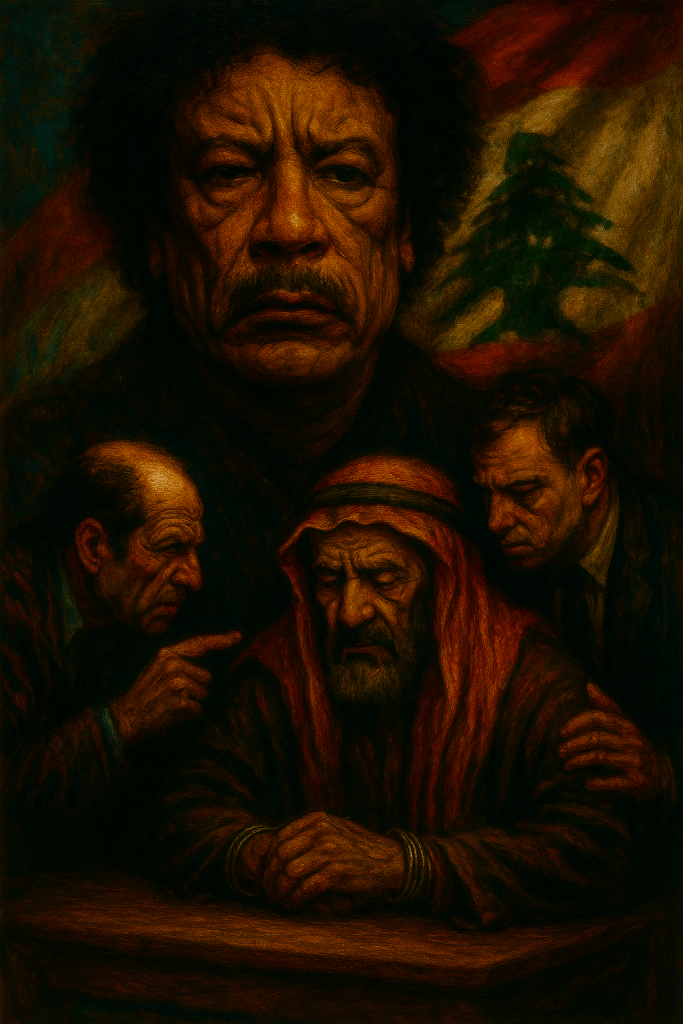
Within the Shiite community, two forces dominate: the Amal Movement and Hezbollah. Hezbollah, in particular, is both a political party and a powerful militia, often described as a “state within a state.” For these groups, the disappearance of al‑Sadr is not just history—it’s a rallying point, a symbol of injustice that still demands answers.
Hannibal as a Pawn
When Hannibal Gaddafi was abducted in Damascus in 2015 and delivered to Lebanon, Shiite factions saw an opportunity. Here was a son of the man they held responsible for al‑Sadr’s disappearance. He had no political role, no insider knowledge, but his surname carried weight.
Lebanese authorities detained him, officially to question him about al‑Sadr. In reality, his imprisonment was a form of leverage. If Moammar Gaddafi himself could no longer be held accountable—he was killed in 2011—then his son could serve as a proxy.
Ten Years, No Answers
For nearly a decade, Hannibal remained in custody. No charges were filed. No trial was held. No new evidence about al‑Sadr emerged. Human rights organizations described his detention as arbitrary, a violation of international law.
Hannibal’s health deteriorated. He staged hunger strikes to protest his imprisonment, but little changed. For Lebanese authorities, keeping him locked up was less about justice and more about symbolism: a reminder that the al‑Sadr case was not forgotten.
Justice or Revenge?
The question is whether Hannibal’s detention was about justice or revenge. For many Lebanese Shiites, holding him was a way to honor al‑Sadr’s memory, to show that the community would not let the past be buried. For others, it was clearly a vendetta: punishing a son for the sins of his father.
This tension—between justice and revenge, between history and the present—is at the heart of Hannibal’s story. He became a prisoner not of his own actions, but of a narrative larger than himself.
Lebanon’s Endless Wounds
Lebanon is a country haunted by unresolved conflicts. The civil war (1975–1990), Israeli invasions, Syrian occupation, the rise of Hezbollah—all of these layers of history remain raw. The disappearance of Moussa al‑Sadr is one of the deepest wounds, shaping Shiite identity and politics to this day.
In that context, Hannibal’s detention was less about him and more about what he represented. He was a living reminder of a crime that had never been solved, a way for Lebanese leaders to show their constituencies that they were still fighting for answers.
The Rotterdam Lens
For young people in Rotterdam, this story might feel distant. But the themes are surprisingly familiar.
- Generational burdens: children carrying the weight of their parents’ actions.
- Symbolism over facts: being judged not for what you did, but for what your name represents.
- Unresolved trauma: how events from decades ago can still shape lives today.
In a city like Rotterdam, where communities from across the world live side by side, these questions resonate. How do we deal with history? How do we balance memory with fairness? How much should the past dictate the present?
Gaddafi’s Shadow
Hannibal’s ordeal cannot be separated from his father’s legacy. Moammar Gaddafi remains one of the most polarizing figures of the 20th century: hailed by some as a visionary who gave dignity to Libyans, condemned by others as a tyrant who crushed dissent.
For his children, that legacy is inescapable. Even without political roles, they are defined by his name. Hannibal’s decade in a Lebanese cell is proof of how heavy that shadow can be.
A Prisoner of History
In the end, Hannibal Gaddafi’s story is less about him than about the forces around him. He was a pawn in a game of memory, justice, and revenge. A man imprisoned not for his deeds, but for his bloodline.
His case shows how history can trap individuals, how unresolved traumas can echo across generations, and how names can weigh more than truth.
For Lebanon, the disappearance of Moussa al‑Sadr remains an open wound. For Hannibal, it meant ten years behind bars for a crime he could never have committed.
And for the rest of us, it’s a reminder that history is never really past. It lingers, it shapes, it imprisons. Sometimes literally.


 Dutch Echo
Leave a comment