
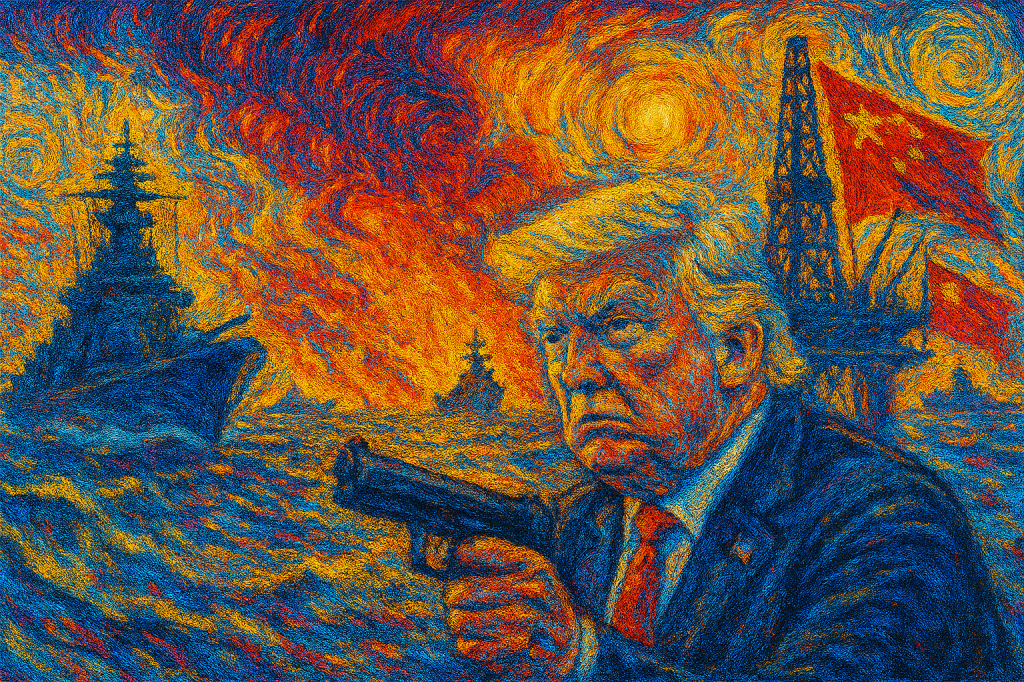
Rotterdam – You’re scrolling through TikTok and suddenly you see it: Chinese flags fluttering over oil rigs in Venezuela. American warships slicing through Caribbean waters. Trump promising to “kill people who bring drugs into the country.” And somewhere in the mix, a farmer in Zulia defending his land with a drone and a machete.
This isn’t just another distant conflict. It’s a geopolitical showdown with real consequences — for Venezuela, for global power dynamics, and yes, even for us here in Rotterdam, Paramaribo, and Brussels.
Welcome to the new front line of global influence. It’s not Ukraine. It’s not Taiwan. It’s Venezuela — and it’s where oil, ideology, and narrative collide.
Advertisement


🇻🇪 Venezuela: From Petrostate to Proxy Battlefield
Venezuela holds the largest proven oil reserves on Earth. But its crude is thick, sulfur-heavy, and notoriously difficult to refine. For years, production stagnated under sanctions, corruption, and crumbling infrastructure. That changed in 2025.
China’s Concord Resources Corp (CCRC) invested over $1 billion into two oil fields in Lake Maracaibo, installing a self-elevating offshore platform and ramping up production from 12,000 to 60,000 barrels per day.
Meanwhile, the United States deployed at least seven warships, including a nuclear-powered submarine and a guided missile cruiser, just off Venezuela’s coast. Officially, it’s about stopping drug trafficking. Unofficially? It’s about blocking China’s foothold in Latin America and pressuring President Maduro.
🛢️ Oil as a Strategic Weapon
Venezuelan oil isn’t like the light, sweet crude from Saudi Arabia or Texas. It’s dense, sticky, and needs to be diluted before it can even flow through pipelines. Still, it’s geopolitically priceless:
- China wants secure access to energy outside U.S. influence.
- The U.S. wants to prevent China from gaining strategic leverage in its own backyard.
- Venezuela wants survival — economically, politically, symbolically.
So these oil fields aren’t just economic zones. They’re chessboards. Whoever drills here doesn’t just extract fuel — they extract influence.
⚔️ Ships, Drones, and Militias
President Maduro has mobilized his people through 284 front-line positions, millions of Bolivarian militia members, and a hybrid force of military, police, and civilian defense. Chinese radar systems, Iranian drones, and Russian software bolster the country’s defenses.

The U.S. has already launched attacks on suspected drug boats, with fatalities reported. Trump recently declared that the U.S. would “kill people who bring drugs into the country,” and authorized CIA operations in Venezuela.
On TikTok, videos show Chinese tanks rolling through Zulia, military parades in Caracas, and American warships off La Guaira. Young people mock the drug narrative as a colonial throwback — a cover story for something much bigger.
🎭 The Drug Narrative: Still the Official Line?
Officially, the U.S. says its military presence is about counter-narcotics. But that story is wearing thin:
- The scale of the deployment is far beyond what’s needed for drug interdiction.
- There’s no transparent evidence linking the targeted boats to drug trafficking.
- The timing aligns with Chinese oil investments and election-year rhetoric.
Economist Jeffrey Sachs calls Venezuela a pivot point in the global order: where the U.S. imposes sanctions, China offers infrastructure and loans. The drug narrative? It’s a rhetorical tool — not the real reason.
🌍 What Does This Mean for the Netherlands?
This isn’t just a Latin American drama. The ripple effects are global — and they’re already reaching Dutch shores.
- Energy Prices Will Rise
If Venezuelan oil becomes harder to export, global supply tightens. That means higher fuel costs, more expensive transport, and rising production prices — from groceries to flights to heating.
- Global Trade Gets Messy
The Netherlands thrives on open trade. Escalation means tariffs, sanctions, and uncertainty, which hit Rotterdam’s port, Dutch exporters, and supply chains hard.
- Political Pressure on Europe
If the U.S. and China clash, Europe may be forced to pick sides. That could affect diplomacy, defense budgets, and trade agreements — including with Latin America and China.
- Cyber Threats and Logistics Disruption
War isn’t just physical. It’s digital. Expect cyberattacks on infrastructure, shipping delays, and shortages of key goods — from semiconductors to medicine.
🧠 The Battle for the Narrative
Beyond oil and warships, there’s a third front: the story itself. Who gets to define what’s happening?
- The U.S. uses CNN, X (formerly Twitter), and official briefings.
- China uses TikTok, diplomatic missions, and economic deals.
- Venezuela uses local media, diaspora networks, and symbolic gestures.
In Rotterdam, Paramaribo, and Brussels, young people are watching, sharing, remixing. The Venezuela story isn’t just being told — it’s being contested.
🔮 What If Things Escalate?
A full-blown war between China and the U.S. over Venezuela isn’t inevitable — but it’s no longer unthinkable. If it happens, here’s what to expect:
- Global Recession: Rabobank estimates Dutch economic growth could drop to 0.6%.
- Strategic Realignment: Companies will need to rebuild supply chains, avoiding conflict zones.
- Military Pressure: Europe may be asked to join or take a stand.
- Information Warfare: The fight over facts, framing, and perception will intensify.
📣 And Us?
We live in a world where oil rigs, TikTok clips, and missile cruisers are part of the same story. A story that unfolds in Venezuela — but touches all of us.
Not because we’re directly involved, but because we’re part of a global system where resources, power, and meaning are constantly in flux.
Whether you’re in Crooswijk, Paramaribo, or Antwerp — this isn’t just their story. It’s ours too.



 Dutch Echo
Leave a comment