
Setting the Scene
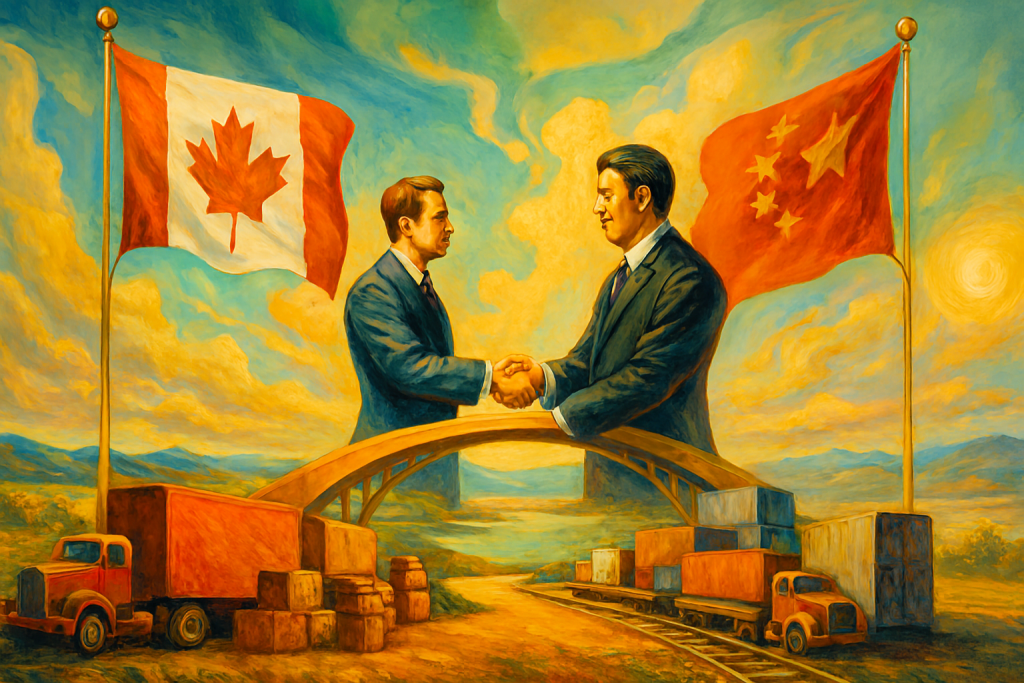
Rotterdam – If you’ve been following global headlines lately, you’ll know that Canada has been making some bold moves. For decades, the country’s identity in international politics was shaped by its close relationship with the United States. Think of it as the quiet neighbor who mostly went along with whatever Washington decided. But now, under Prime Minister Mark Carney, Canada is stepping out of that shadow.
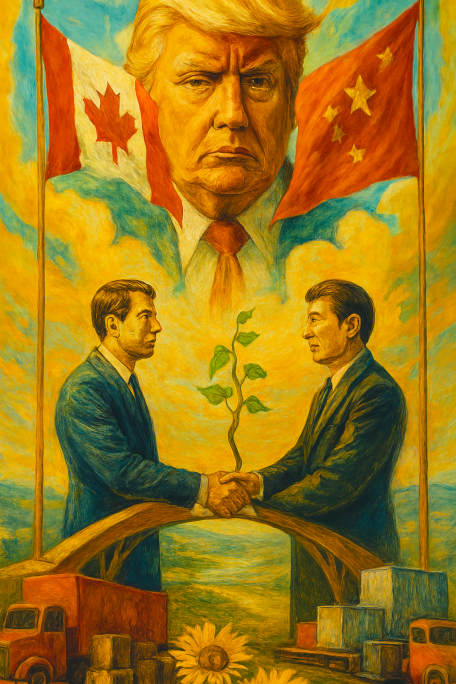
The big story? Canada is reopening ties with China, even as Donald Trump’s America doubles down on tariffs and protectionism. For young people in Rotterdam—or anywhere else in Europe—this might sound like distant geopolitics. But the ripple effects are real: they touch trade, security, and the way the West positions itself in a world where China is no longer just “rising,” but already a heavyweight.
Canada and China: A Reset
Earlier this year, Carney met Xi Jinping at a summit in South Korea. The handshake wasn’t just symbolic—it was the start of a reset. Soon after, China announced it would resume group tourism to Canada, a move that had been frozen since the Huawei affair years ago.
Tourists might not sound like a big deal, but in diplomacy they’re living proof of trust. When Chinese visitors return to Canadian cities, it signals that Beijing sees Canada as a safe and friendly destination again. For Canada, it’s also a way of saying: we’re not going to let Washington dictate all our choices anymore.
Advertisement


Why This Matters
Canada’s economy has always leaned heavily on the U.S. market. Roughly three-quarters of Canadian exports traditionally went south across the border. But Trump’s second term has changed the game. His administration slapped 25% tariffs on Canadian goods, lumping them together with China and Mexico.
For Canada, this was a wake-up call. If your biggest trading partner suddenly treats you like a rival, you need options. That’s where China comes in. By diversifying trade, Canada reduces its vulnerability to American pressure.
Mexico Joins the Story
It’s not just China. Canada and Mexico signed a new action plan for 2025–2028, focusing on agriculture, energy, and manufacturing. The idea is to create a corridor of cooperation stretching from Montreal to Mexico City.
This is huge because it reshapes North America’s economic map. Instead of everything revolving around Washington, Canada and Mexico are building their own axis. For the U.S., that’s a problem: it weakens their traditional dominance in the region.
The U.S. Reaction
Washington isn’t thrilled. For decades, the U.S. counted on Canada as a loyal partner—economically, militarily, and diplomatically. The two countries share NORAD, the defense alliance that monitors North American skies. They’re both in NATO.
But when Canada cozies up to China, alarm bells ring in Washington. The U.S. sees Chinese influence as a direct threat to its security. From 5G networks to critical minerals, anything that smells like Beijing makes American strategists nervous.
Trump’s tariffs were partly about punishing China, but Canada got caught in the crossfire. Now, by choosing pragmatism over loyalty, Canada is signaling that it won’t be bullied into isolation.
Is China Playing the West?
Here’s the bigger question: is China deliberately playing Western allies against each other?
From one angle, yes. By reopening tourism and trade with Canada, Beijing is exploiting cracks in the Western alliance. If Washington pushes too hard, countries like Canada will look for alternatives—and China is ready to offer them.
But it’s not just about China being clever. Trump’s policies are also pushing allies away. “America First” often feels like “America Alone.” When you treat your neighbors like competitors, don’t be surprised if they start shopping for new friends.
What This Means for Europe
So why should you, sitting in Rotterdam, care? Because Europe faces similar dilemmas. The EU has its own complicated relationship with China: massive trade flows, but also concerns about security, human rights, and dependence.
Canada’s pivot is a reminder that Western countries are being forced to make tough choices. Do you stick with Washington, even when its policies hurt your economy? Or do you carve out your own path, risking tension with your closest ally?
For the Netherlands, which thrives on global trade, this is more than theory. Rotterdam’s port is one of the busiest in the world, and Chinese goods flow through it daily. If Canada can balance pragmatism with principle, maybe Europe can too.
The Clash Factor
Let’s be real: this isn’t smooth sailing. Canada and the U.S. have clashed before. Remember the Huawei affair? Canada arrested Meng Wanzhou at Washington’s request, and China retaliated by detaining two Canadians. That episode showed how messy it gets when you’re caught between giants.
Now, with tariffs flying and alliances shifting, the risk of new clashes is high. Canada wants independence, but the U.S. still expects loyalty. China wants cooperation, but it also plays hardball when things don’t go its way.
Canada’s New Doctrine
Carney’s approach is pragmatic. He’s not trying to pick sides in a Cold War 2.0. Instead, he’s saying: Canada needs options. By diversifying trade and diplomacy, the country can survive in a world where superpowers are constantly flexing.
This doctrine is about flexibility. It’s about not being locked into one relationship that can turn sour overnight. For young adults in Rotterdam, it’s a bit like diversifying your playlists: you don’t want to rely on just one vibe, because moods change.
What It Means for the U.S.
For Washington, Canada’s independence is a warning sign. If even your closest allies start hedging, it means your influence is slipping.
Economically, the U.S. risks losing its grip on North American trade. Politically, it risks looking isolated. Strategically, it worries that Chinese influence could seep into its backyard.
In short: Canada’s choices highlight the limits of American power in 2025.
The Bigger Picture: A Multipolar World
What we’re seeing is the rise of a multipolar world. Instead of one dominant superpower, there are several: the U.S., China, the EU, and regional players like India.
Canada’s pivot is a microcosm of this shift. It shows that middle powers don’t have to be passive—they can make moves, build alliances, and shape their own destiny.
For young adults in Rotterdam, this matters because it’s the world you’re inheriting. The old rules of loyalty and hierarchy are fading. The new rules are about pragmatism, balance, and flexibility.
Rotterdam’s Lens
Let’s bring it home. Rotterdam is a city built on trade, diversity, and global connections. The port is a symbol of how interconnected the world really is.
When Canada diversifies its trade, it’s playing the same game Rotterdam has always played: keep your options open, don’t rely on just one partner, and embrace global flows.
That’s why this story resonates here. It’s not just about Canada, China, and the U.S. It’s about how countries—and cities—navigate a world where power is shifting and alliances are fluid.
Conclusion: Choosing Your Own Path
Canada’s decision to reopen ties with China and strengthen bonds with Mexico is more than a diplomatic headline. It’s a statement: we’re choosing our own path.
For the U.S., it’s a challenge. For China, it’s an opportunity. For Europe, it’s a lesson.
And for you, reading this in Rotterdam, it’s a reminder that the world is changing fast. The West is no longer a monolith. Countries are making independent choices, sometimes clashing, sometimes cooperating, but always adapting.
In the end, Canada’s story is about independence in a world of giants. And that’s something anyone can relate to.



 Dutch Echo
Leave a comment