
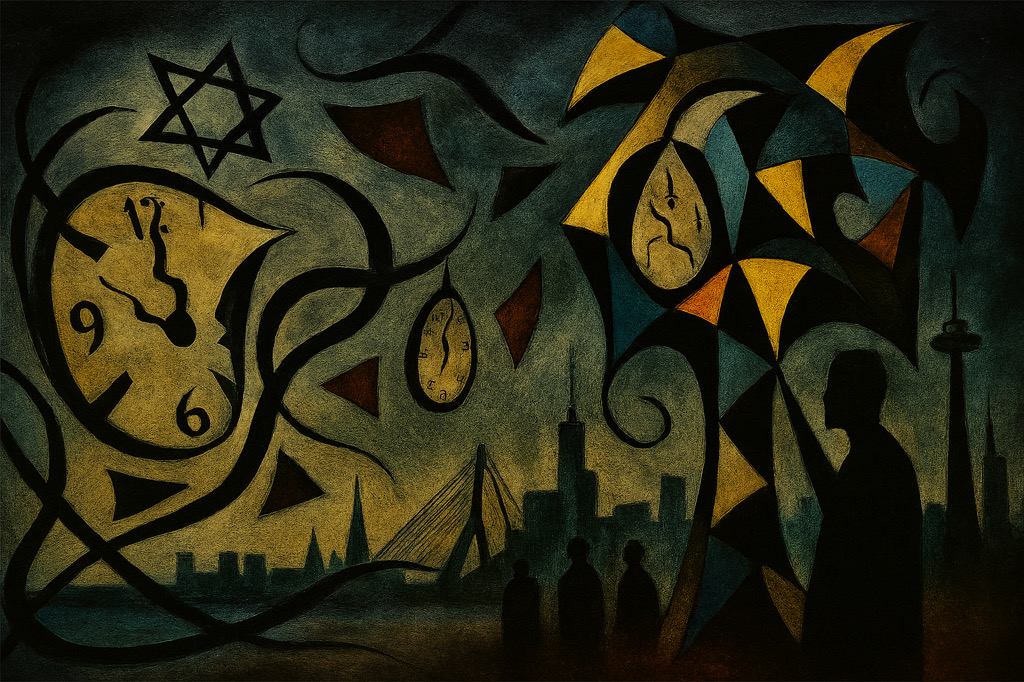
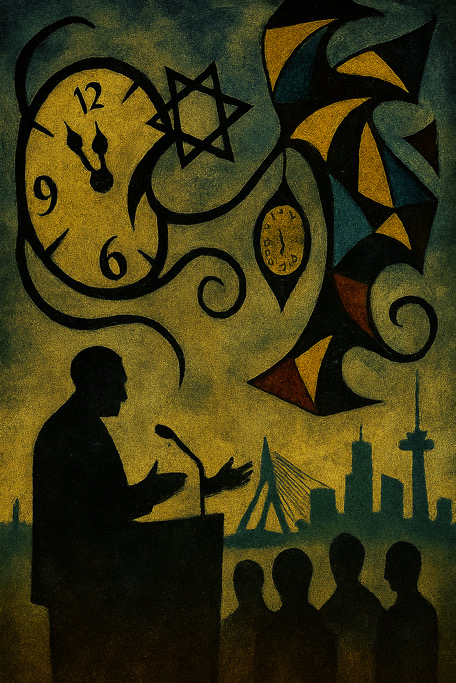
Rotterdam – There are nights when the world feels split open. Nights when a festival of light becomes a battlefield of shadows. Nights when the poison of centuries resurfaces, dressed in new clothes, carrying new excuses, but still the same old hatred. If you are in Rotterdam, Crooswijk, Delfshaven, or if you are reading this from abroad with plans to one day call the Netherlands home, you need to understand this story. Because it is not just about Jews, not just about Muslims, not just about Israel or Palestine. It is about how confusion, propaganda, and miseducation turn ordinary people into targets. It is about how the fire of one conflict travels across oceans and burns the wrong people. And it is about how we, in the Netherlands, must learn to see through the smoke.
Antisemitism Is Older Than Israel, But Today It Wears a New Mask
Antisemitism did not begin in 1948. It did not begin with the founding of the State of Israel. It is centuries old, born in Europe, sharpened through medieval myths, economic scapegoating, pogroms, and finally industrialized genocide. But in the twenty‑first century, antisemitism has found a new excuse: the conflict in the Middle East.
Extremists and opportunists now say: “I am angry at Israel, so I attack Jews in Paris.” “I am angry at Netanyahu, so I threaten Jewish families in Sydney.” “I am angry at occupation, so I vandalize synagogues in Los Angeles.” This is projection. This is confusion. This is the collapse of nuance. And it is deadly.
Advertisement

What we see today is Israel‑related antisemitism — hatred that pretends to be political critique but ends up targeting ordinary Jewish people who have nothing to do with the policies of a government thousands of kilometers away. It is the same poison, just poured into a new bottle.
The Collapse of Distinctions: When Everything Becomes One Target
Here lies the core problem: people no longer distinguish between Jews, Israelis, the Israeli government, Zionism, political Zionism, religious Judaism, diaspora communities, and Middle Eastern geopolitics. Everything gets thrown into one basket. Everything becomes one enemy. One symbol. One target.
When distinctions collapse, violence follows. If you cannot tell the difference between a Jewish grandmother lighting candles in Rotterdam and a government minister in Jerusalem, then suddenly any Jewish person becomes a stand‑in for a state. That is how antisemitism mutates into its modern form. That is how innocent families become collateral damage in wars they never chose.
Political Zionism: A Movement, Not a Religion
Political Zionism is a nineteenth‑century ideology. It sought a Jewish state, and it came in many forms: secular, religious, left, right, nationalist, colonial, liberal. It is not a religious obligation. It is not an ethnic identity. It is a political project.
Some Jews identify with it. Some do not. Some non‑Jews support it. Many Israelis are not religious at all and see Zionism purely as nationalism. Yet extremists collapse all these distinctions. They say: “All Jews are Zionists.” That is false. That is dangerous. That is the shortcut that leads to violence.
And here is the bitter irony: the political Zionism that produces victims in the Middle East also produces victims outside it. Palestinians suffer under occupation and displacement. Jews worldwide suffer under antisemitism triggered by that same conflict. Two communities, both with histories of trauma, both paying the price for decisions they did not make.
Islam Is Not the Enemy — Ignorance Is
Let’s say it straight, Rotterdam‑style: Islam does not permit antisemitism. Jews are “ahl al‑kitab” — people of the book. Protected. Respected. Recognized. The Qur’an, the hadith, the classical scholars — they all make this distinction.
But extremists do not care. And neither do the algorithms.
So you get a generation of young Muslims in the West who learn their religion not from their families, not from their communities, not from scholars, but from Google search results shaped by the War on Terror, by sensationalism, by political agendas, and by click‑driven economics. You get a generation of Westerners who think “Islam = extremism” because that is what the first 10,000 search results show them.
And you get a world where people can no longer distinguish faith from ideology, identity from nationalism, religion from geopolitics, people from governments. When you lose the ability to distinguish, you lose the ability to think. When you lose the ability to think, you lose the ability to act justly. And when you lose the ability to act justly, innocent people die.
The Algorithmic Trap: How Google Rewired the World’s Understanding of Islam
Here is the part most people do not want to touch. For the last twenty years, Google has been the imam, the rabbi, the professor, the journalist, the storyteller, the historian, the political educator — for millions of people. And Google has failed them.
Ask Google “What is Islam?” and the first 10,000 pages are dominated by salafism, wahabism, extremism, fundamentalism. A tiny minority of the Muslim world presented as the whole. In 1999, the internet was chaotic but diverse. You saw Sufi traditions, cultural Islam, Indonesian Islam, Senegalese Islam, Turkish Islam, Moroccan Islam — the real mosaic. Today you get the algorithmic caricature.
And here is the dangerous part: when people are miseducated about Islam, they are also miseducated about Judaism. When they are miseducated about Judaism, they are miseducated about Israel. When they are miseducated about Israel, they are miseducated about Zionism. And when they are miseducated about all of these, they become vulnerable to propaganda that collapses everything into one target. That is how global hatred spreads. Not through religion. Not through culture. But through misinformation pipelines.
The Double Tragedy: Two Peoples Paying the Price for One Conflict
The political conflict in the Middle East produces two sets of victims. Palestinians, suffering under occupation, displacement, and violence. Jews worldwide, suffering under antisemitism triggered by that same conflict. Two communities, both with histories of trauma, both paying the price for decisions of governments and ideologies they do not control.
This is the global tragedy of projection. A tragedy where a Palestinian child loses their home, a Jewish child loses their safety, and neither child had anything to do with the politics that harmed them. This is what happens when the world refuses nuance. When the world refuses complexity. When the world refuses to separate people from governments, faith from ideology, identity from geopolitics.
Understand the Landscape You’re Entering
If you are reading this from abroad, dreaming of a future in the Netherlands — or if you are already here, learning the language, finding your place — you need to understand something important. The Netherlands is diverse. Beautifully, chaotically, loudly diverse. Rotterdam especially — a city where 170 nationalities breathe the same air and argue in the same supermarkets.
But this diversity comes with responsibility. You cannot afford to be miseducated. You cannot afford to let Google teach you your religion. You cannot afford to let propaganda teach you your politics. You cannot afford to let extremists — of any background — define your worldview. Because in a city like Rotterdam, ignorance is explosive. Nuance is survival. And the ability to distinguish is freedom.
The Fire That Travels — And How We Stop It
The fire of hatred does not stay where it starts. It travels. It jumps borders. It crosses oceans. It lands in cities like Sydney, Paris, New York, Rotterdam. And it burns the wrong people.
The only way to stop it is to rebuild the distinctions the world has lost. Between Jews and Israelis. Between Israelis and their government. Between Judaism and Zionism. Between Islam and extremism. Between criticism and hatred. Between politics and people.
When we restore those distinctions, we restore humanity. And when we restore humanity, the fire loses its oxygen.
This is the task for Rotterdam. This is the task for the Netherlands. This is the task for anyone who wants to live free, dignified, and unafraid.
Conclusion: Rotterdam’s Voice in a World of Noise
This is not just analysis. This is not just commentary. This is a call from the street, from the city that knows what it means to rebuild from ashes, to rise from rubble, to carry scars and still keep moving. Rotterdam knows what it means to be diverse, to be loud, to be chaotic, to be free. And Rotterdam knows what it means to fight for justice.
So let this be clear: antisemitism is not critique of Israel. Islam is not extremism. Zionism is not Judaism. And ignorance is not an excuse.
If you are new to the Netherlands, if you are planning to come, if you are already here but still finding your place, remember this: the fight for clarity is the fight for freedom.
Rotterdam’s lesson is simple but hard: you cannot afford to be miseducated. You cannot afford to let algorithms define your worldview. You cannot afford to let extremists — of any background — hijack your identity. Because in this city, where 170 nationalities breathe the same air, ignorance is explosive. Nuance is survival. Distinction is freedom.
And freedom is not given. It is fought for, every day, in every street, in every conversation, in every refusal to collapse identities into symbols.
This is the voice of Rotterdam in a world of noise. This is the call to anyone who wants to live free, dignified, and unafraid: rebuild the distinctions, restore humanity, and refuse the shortcuts of hate.


 Dutch Echo
Leave a comment