
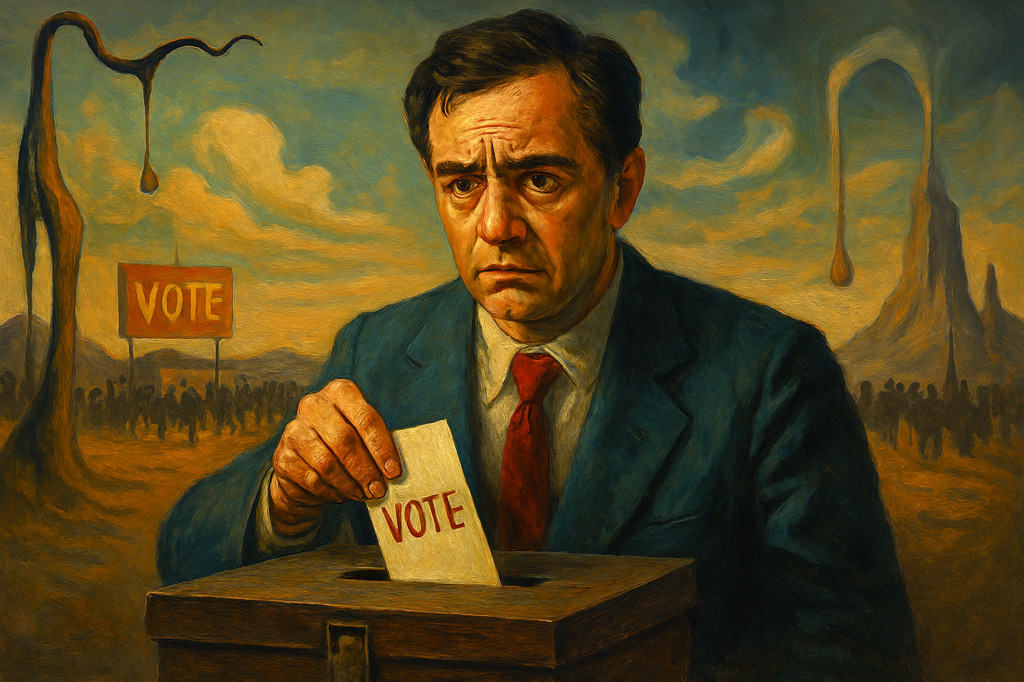
In the streets of Rotterdam, you hear the hum of trams, the rhythm of bikes, the pulse of a city that knows what freedom tastes like. That pulse is what makes the story of Myanmar so strange, so raw, so hard to swallow. A country that organizes elections while millions of its people cannot even reach a ballot box. A junta that dresses itself in the clothes of democracy, while underneath it wears the iron boots of repression. It is a façade, a hollow gesture, a performance staged for the world. And when you stand on the stones of Delfshaven or Crooswijk, you feel the absurdity of it in your bones.
Myanmar today is not a democracy in waiting. It is a battlefield disguised as a polling station. The military junta, the Tatmadaw, claims to be leading the nation back to civilian rule. But the reality is a war that has torn the land into fragments, a war that has silenced millions, a war that makes the very idea of voting a cruel joke.
The War That Defines the Nation
The war in Myanmar is not a distant skirmish. It is a full-scale civil war, born from the coup of February 2021. The generals seized power, toppled the elected government of Aung San Suu Kyi, and declared themselves the guardians of unity. But what they guard is their own privilege, their own wealth, their own grip on the nation’s veins.
Advertisement


Against them stands a mosaic of resistance. The People’s Defence Forces, young men and women who traded books for rifles, who turned their frustration into guerrilla warfare. The National Unity Government, a shadow cabinet of ousted politicians, trying to give shape to democracy in exile. And the ethnic armies, the Kachin, the Karen, the Chin, the Arakan, the Shan — groups that have fought for autonomy for decades, now finding common cause against the junta.
It is a war of asymmetry. The junta has jets, bombs, and the machinery of a state. The resistance has courage, improvisation, and the will of a people who refuse to kneel.
The Junta’s Short-Term Façade
What does the junta stand for? In the short term, it stands for survival. It organizes elections not to give power to the people, but to give legitimacy to itself. It lifts the state of emergency not to restore freedom, but to stage a performance. Only parties loyal to the military are allowed to participate. Opposition is banned, silenced, or imprisoned.
The junta’s short-term plan is simple: repress, intimidate, and pretend. It wants the world to see ballot boxes and believe in democracy. It wants to silence dissent with bombs and prisons. It wants to convince neighbors and partners that stability is possible under its rule.
The Junta’s Long-Term Grip
In the long term, the junta dreams of permanence. It wants a constitution that guarantees the military a seat at the table forever. It wants control over the economy — jade, timber, oil, gas — the veins of wealth that run through the land. It wants to neutralize opposition by locking away leaders like Aung San Suu Kyi for decades.
It wants to be more than a government. It wants to be the skeleton of the state, the permanent structure that cannot be removed. And yet, the war erodes this dream. The resistance grows, the land fractures, the legitimacy crumbles.
The Foreign Friends
No junta survives alone. Myanmar’s generals have friends. China, Russia, India — each with their own reasons, each with their own interests.
China frames the elections as “inclusive,” offers technical help, and invests in pipelines and ports. For Beijing, Myanmar is a corridor, a buffer, a piece of the Belt and Road puzzle. Stability matters, but democracy does not.
Russia sends weapons, drones, and training. It signs memoranda of cooperation on elections, giving the junta a stamp of legitimacy. For Moscow, Myanmar is a market, a partner against Western sanctions, a symbol of defiance.
India plays a double game. It worries about its borders, about refugees, about instability spilling into its northeast. But it also invests in roads and ports, trying to balance against China’s influence.
Thailand and Singapore provide trade and financial connections. Not ideological support, but pragmatic ties.
The junta is not idealistic. It is pragmatic, opportunistic, and dependent. Its foreign friends do not care about freedom. They care about corridors, markets, and influence.
The Resistance’s Ideals
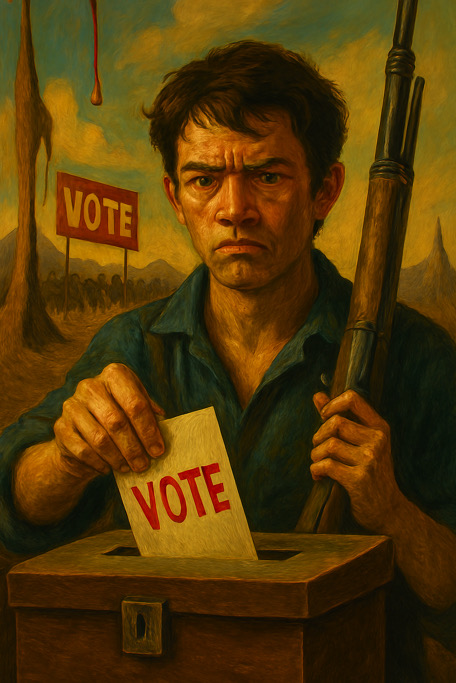
And yet, against this machinery of repression, the resistance carries ideals. The PDFs fight for democracy, for the restoration of a government chosen by the people. The ethnic armies fight for autonomy, for recognition of their cultures and rights. The young fighters, Generation Z, fight for a future where education, freedom, and dignity are not stolen by generals.
Their ideals are not abstract. They are lived. They are felt in the hunger of refugees, in the silence of villages bombed from the sky, in the courage of students who refuse to bow.
Yes, there are tensions. Autonomy sometimes clashes with unity. Ethnic interests sometimes diverge from national goals. But the common thread is resistance to dictatorship, resistance to exploitation, resistance to the idea that power belongs only to the military.
The Cost of Weapons
Weapons cost money. A rifle, a drone, a bullet — none of it is free. And the resistance is not rich. The junta controls the economy. The resistance relies on improvisation, on smuggling, on diaspora support.
PDFs build homemade rifles, craft explosives, adapt drones. Ethnic armies share their arsenals, built over decades of struggle. Smugglers bring weapons across borders, at high cost. Diaspora communities raise funds, small donations that together buy arms. And in battle, resistance fighters capture weapons from military posts, turning the junta’s own guns against it.
The people themselves cannot finance a war. They are too poor, too burdened. But they give what they can: food, shelter, information, legitimacy. Their contribution is not money, but survival.
The Diaspora’s Role
The diaspora is scattered, diverse, uneven. In Thailand and Malaysia, it is made of workers and refugees, poor and precarious. In Singapore, Europe, and the West, it is made of students, professionals, activists.
They are not all wealthy. Most are not. But together they form a network. They raise funds, lobby governments, spread information. They keep the resistance alive beyond the borders of Myanmar.
Their strength is not in wealth, but in numbers, in passion, in connection. They are the bridge between the war at home and the conscience abroad.
The Scale of Myanmar
To understand Myanmar, you must understand its scale. It is vast. Six hundred seventy-six thousand square kilometers. Sixteen times the size of the Netherlands.
It is a land of mountains, rivers, jungles, and cities. A land too large to be controlled by one hand, too diverse to be silenced by one voice. The junta may hold the cities, but the resistance holds the countryside. The war is not central. It is fragmented, scattered, a mosaic of fronts.
The Strange Story
Put it all together, and the story is strange. Elections without voters. Democracy without freedom. A junta that claims legitimacy while bombing its own people. Foreign powers that speak of stability while ignoring repression. A resistance that fights with ideals but struggles with resources.
It is a story of façades and realities, of symbols and truths. It is a story that feels absurd when told in Rotterdam, where freedom is lived in the rhythm of daily life. It is a story that exposes the gap between gesture and substance, between performance and reality.
The Rotterdam Pulse
From Crooswijk to Delfshaven, you feel the pulse of a city that knows struggle, that knows resilience, that knows what it means to fight for dignity. That pulse is what makes the story of Myanmar resonate. It is not just about a distant land. It is about the universal hunger for freedom, the universal fury against exploitation, the universal lust for life.
Myanmar is far away, but its story is close. It is the story of people who refuse to kneel, who refuse to be silenced, who refuse to accept a façade as reality. It is the story of a junta that clings to power, and a resistance that clings to ideals.
Conclusion: A Mosaic of Struggle
Myanmar today is a mosaic of struggle. A junta with short-term façades and long-term ambitions. A resistance with ideals and courage. A diaspora with networks and passion. Foreign powers with interests and pragmatism.
It is a story of war, of repression, of resistance, of hope. It is a story that feels strange, absurd, raw. But it is real. And it matters.


 Dutch Echo
Leave a comment