
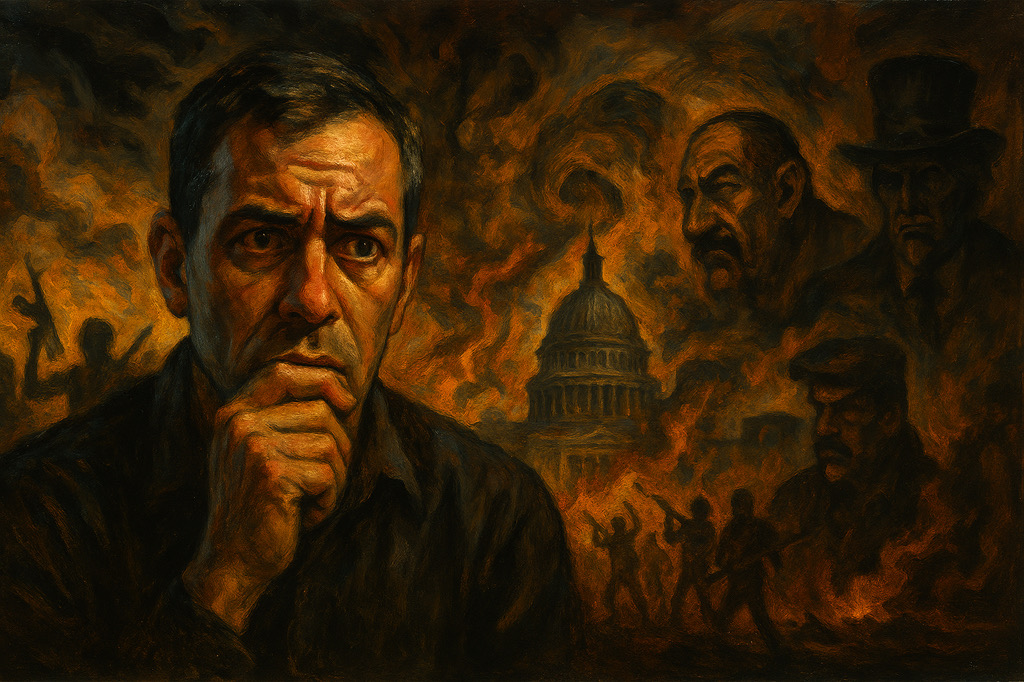
Rotterdam – The air in Caracas is heavy, not just with smoke from burning tires but with the weight of history repeating itself. When Nicolás Maduro was taken away, the cameras caught the cheers, the tears, the fists raised in celebration. Yet behind the joy, there was silence—an eerie silence of institutions that no longer speak. The national armed forces stood still, the police hesitated, and into that silence stepped the colectivos, the guerrillas, and the shadows of paramilitary groups.
It is a scene that feels familiar to anyone who has walked through Rotterdam’s Delfshaven at night, hearing the echoes of stories about power, betrayal, and survival. The rhythm of the street is the same: when the official voice disappears, the unofficial ones rise. And in Venezuela, those voices are armed.
Delcy Rodríguez: A Title Without Orders
Formally, Delcy Rodríguez was sworn in as the successor to Maduro. On paper, she is the president. But paper does not command soldiers. Paper does not send patrols into the barrios. Paper does not silence the colectivos who now march openly with rifles slung across their shoulders.
Rodríguez holds the title, but she does not give orders. The armed forces wait, divided between loyalty to the old Chavista line and uncertainty about the new American “regency” announced from Washington. The police, too, are fractured: SEBIN, the political police, continues its intimidation campaigns, while the national police remain passive, overshadowed by militias.
Advertisement

This is the essence of a vacuum: the form of authority without the substance. And in that vacuum, the street decides.
Guerrillas and Colectivos: Filling the Silence
The ELN, the guerrilla force straddling the Colombia‑Venezuela border, has long been a shadow power. With thousands of fighters, they thrive in the chaos of coca fields and clandestine routes. When Maduro fell, they pulled back, regrouped, and declared their resistance against “gringo aggression.”
In the cities, the colectivos emerged. These are not abstract forces; they are the men and women who have patrolled neighborhoods for years, enforcing loyalty to the revolution with intimidation and violence. Now, with the state paralyzed, they step forward as the de facto rulers of the streets.
And then there are the lesser‑known groups—the “Griezmannen,” the paramilitaries who work in the shadows, sometimes with the authorities, sometimes against them. Together, they form a mosaic of armed actors, each claiming a piece of the vacuum.
The Fear of Haiti: Weapons and Divide‑and‑Rule
Voices from Haiti echo loudly in this moment. Influencers from Port‑au‑Prince warn: beware the foreign weapons, beware the divide‑and‑rule. They know the script too well. In Haiti, external actors armed gangs, played factions against each other, and left the people trapped in endless cycles of violence.
The fear is that Venezuela will follow the same path. Guerrillas, colectivos, paramilitaries—each could become a proxy for foreign interests. The United States, already declaring its temporary regency, could choose to arm one group against another. And in the background, other powers—Russia, China, Iran—watch closely, ready to exploit the chaos.
The question is not whether weapons will flow, but who will receive them. And once they do, the vacuum becomes a battlefield.
Israel’s Shadow: From Caracas to Africa
In the speeches of Maduro and Rodríguez, the word “zionist” appears again and again. Israel is invoked as the hidden hand, the shadow behind the American intervention. Cartoons show Netanyahu alongside Trump, caricatures of power crushing Venezuela.
The reality is more symbolic than operational. Israel did not send troops to Caracas. But it did applaud. Netanyahu praised Trump’s “historic leadership,” and Israeli voices spoke of the chance to restore ties with Venezuela.
For critics like Lumumba Amin, son of Idi Amin Dada, Israel’s role is not confined to Venezuela. He speaks of Africa, of Israeli companies and intelligence services weaving themselves into the continent’s conflicts. He frames moslim fundamentalism not as a purely local phenomenon but as a project—western, Israeli, designed to divide and control.
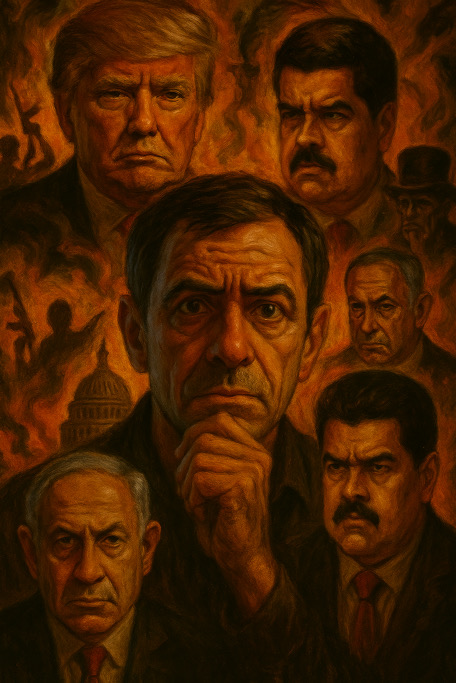
Whether one accepts this narrative or not, the symbolism is powerful. Israel is seen not just as a Middle Eastern state but as part of the western bloc, projecting influence into Latin America and Africa alike.
Netanyahu in Washington: Above the President
The images from Washington are striking. Netanyahu, standing before the American Congress, receives ovations from both Democrats and Republicans. The applause is not cautious, not partisan—it is unanimous, ritualistic, almost theatrical.
And then comes the tone. Netanyahu criticizes Trump, points out mistakes, speaks not as a dependent ally but as a superior. For many watching, it feels as if the roles are reversed: the Israeli leader above the American president, commanding respect from the entire political spectrum.
This is not the tone of dependency. It is the tone of dominance. And when combined with the reception in Congress, it paints a picture of Israel as more than a partner—an actor with direct influence over the heart of American politics.
Epstein’s Shadow: Networks Behind the Curtain
Into this mix enters another name: Epstein. His story is not about Venezuela, not about Israel directly, but about networks of power, compromise, and silence. For many, the absence of evidence in his case is itself proof. The missing documents, the silenced testimonies, the half‑forgotten connections—these are read as signs of a deeper machinery.
When people see Netanyahu above Trump, when they hear of Israel applauding the fall of Maduro, when they watch guerrillas mobilize in Caracas, they connect the dots. Epstein becomes the symbol of hidden power, of the networks that operate behind the curtain.
The logic is simple: if there is no evidence, it is because the evidence is too dangerous to show. And in that logic, absence becomes presence, silence becomes proof.
The Narrative of “Complexity”
In discussions of these events, one word appears often: “complex.” Analysts say the situation is complex, the history is complex, the geopolitics are complex. But for many, this word is a shield, a way to avoid clarity.
Calling something complex can be a rhetorical escape. It can mean: I do not want to take a position. It can mean: I cannot explain without losing authority.
Yet the street does not speak in complexity. The street speaks in directness, in hunger, in fear, in fury. In Rotterdam, when you walk through Crooswijk and hear the voices of those who distrust the media, you hear the same skepticism: complexity is a trick, a way to hide the truth.
Rotterdam Under the Feet
Why speak of Venezuela, Israel, Washington, and Haiti from Rotterdam? Because the rhythms are connected. The street in Caracas and the street in Rotterdam share the same heartbeat: distrust of official narratives, anger at cycles of poverty and exploitation, lust for life in the face of oppression.
Rotterdam is not Caracas, but the feeling is familiar. The sense that power is played above your head, that leaders applaud each other in distant halls while the street burns, that narratives are spun while the people live the consequences.
And in Rotterdam, there is also resilience. The warmth of Delfshaven, the stubbornness of Crooswijk, the energy of the Maas. These are not abstractions—they are lived realities, the ground beneath the feet of those who refuse to be silenced.
The Machinery of Silence and Proof
In the end, what remains is the machinery of silence. Guerrillas mobilize, colectivos patrol, generals hesitate, presidents applaud, and influencers speak. Evidence is missing, but the absence itself becomes evidence.
For some, this is paranoia. For others, it is clarity. The truth is not in documents but in patterns, in repetitions, in the way applause in Washington mirrors silence in Caracas.
The machinery is not hidden—it is visible in the ovations, in the uniforms, in the shadows of paramilitaries. But it is disguised as normality, as routine, as politics.
Conclusion: The Street Decides
In Venezuela, the successor does not command. The armed forces wait. The police hesitate. Guerrillas and colectivos step forward. Foreign powers applaud or protest. Israel is invoked as shadow and symbol. Netanyahu speaks above Trump. Epstein’s silence becomes proof. Analysts call it complex, but the street calls it survival.
And in Rotterdam, the echoes are heard. The street knows the rhythm. The street knows the fury. The street knows that in the end, when the paper titles fade, it is the street that decides.


 Dutch Echo
Leave a comment