
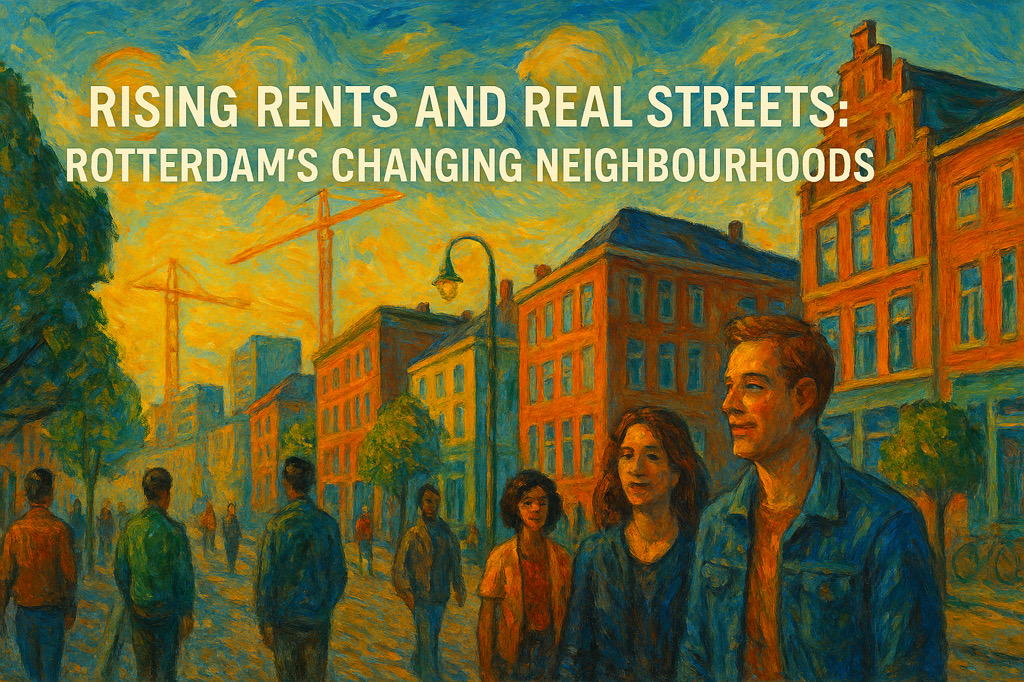
Rotterdam – You feel it the moment you step out your front door in Rotterdam. The air has that restless hum — the kind that tells you the city is shifting under your feet, even if the pavement looks the same. Maybe you live in Oud‑Crooswijk, maybe in Delfshaven, maybe somewhere along the Maas where the wind slaps your face awake. It doesn’t matter. The story is the same everywhere: the rents are climbing like they’ve got something to prove, the houses are getting shinier, and the people are trying to figure out what all of this means for them. This isn’t a story told from a distance. It’s not a drone shot of the skyline or a politician’s speech about “urban renewal.” This is the view from the stoop, the balcony, the tram stop, the late‑night walk home. This is Rotterdam as you feel it in your legs, your lungs, your rent bill, your street. And if you’re reading this from outside the Netherlands — maybe planning to move here, maybe dreaming of a life in this stubborn, muscular city — consider this your first lesson: Rotterdam doesn’t whisper. It talks with its chest. Let’s walk.
The Streets Don’t Lie
Take Oud‑Crooswijk, a neighborhood with bones older than most of the people walking through it, a place where the houses lean a little, where the foundations sink like tired shoulders, where the walls have seen more stories than any archive could hold. But also a place where the cranes never sleep anymore, where scaffolding grows like ivy, where the old bricks get replaced by new ones that look too clean, too smooth, too eager. The rents here aren’t just rising — they’re sprinting. A thousand euros used to be a shock; now it’s a warm‑up. Twelve hundred, fifteen hundred, two thousand — numbers that used to belong to the center now creep into Crooswijk like they own the place. And the question everyone asks, whether they say it out loud or not, is whether the neighborhood rises with the prices. Does the street get safer? Does the square get calmer? Do the nights get quieter? Do the people get kinder? Rotterdam’s answer is complicated, like everything in this city.
Advertisement

A City That Builds Faster Than It Breathes
Rotterdam is in a constant state of becoming. It’s the kind of place that tears down a building on Monday and has a plan for a new one by Wednesday. The cranes are part of the skyline now — as iconic as the Erasmusbrug, as permanent as the Maas. But the physical city is improving faster than the lived city. The houses get renovated, the streets get repaved, the parks get new benches, the buildings get new insulation, new windows, new facades. And yet the feeling of the neighborhood — the thing you can’t measure with a ruler or a spreadsheet — doesn’t always keep up. In Oud‑Crooswijk, the “physical index” is high. The houses look good. The streets look good. The city planners can pat themselves on the back. But the “living index,” the feeling of safety, the sense of belonging — that’s where the numbers sag. Because a neighborhood isn’t just bricks. It’s the people who walk between them.
The People Who Don’t Fit in the Brochure
Every city has them — the ones who slip through the cracks — and Rotterdam just happens to have a few more cracks than most. You’ve seen them: the man who sleeps under the awning of the supermarket, the woman who wanders the tram tracks talking to ghosts, the group of guys who hang around the corner long after the shops close, laughing too loud, moving too fast, taking up too much space. Some are homeless, some are addicted, some are restless, some are just young and bored and trying to look bigger than they feel. And the city — the government, the politicians, the people in suits — all have different ideas about what to do with them. But you just want to walk home without stepping over someone’s bad night.
The Two‑Track System: Help and Heat
Rotterdam’s official policy is simple on paper: help where possible, handcuffs where necessary. There are outreach workers who know every face on the street, shelters and clinics and care teams who try — really try — to pull others back from the edge. But there are also gebiedsverboden, boetes, and zero‑tolerance zones where the police don’t negotiate. The city has identified about seventy people who cause a disproportionate amount of chaos, seventy people who can turn a whole neighborhood’s mood sour. And the message to them is clear: take the help, or take the consequences. Some do, some don’t, some can’t. And the rest of the city keeps walking.
The Political Map of the Street
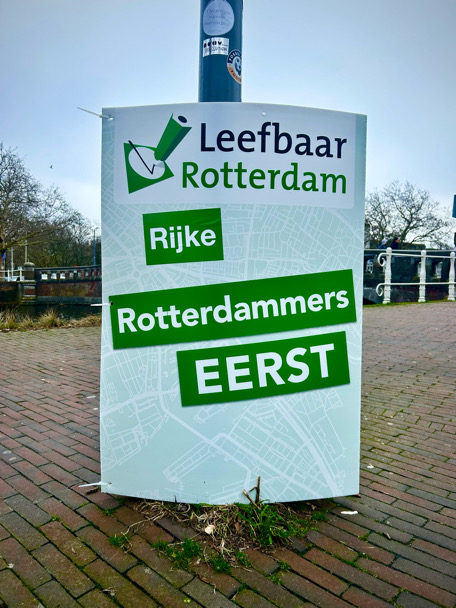
You can’t talk about Rotterdam without talking about politics — not the abstract kind, but the kind that shows up in your rent, your street, your daily life. Different parties see the same street and tell different stories about it. Some look at the man sleeping in the doorway and see someone who needs help; others see someone who needs to move along. Some see a symptom; others see a threat. Leefbaar Rotterdam wants the hardest line: zero‑tolerance, bans, fines, fast action. VVD stands close to them with more police and more enforcement. PVV pushes the same direction with order first and questions later. D66 tries to balance care and enforcement. GroenLinks/PvdA leans toward prevention and social support. DENK emphasizes protection of vulnerable people and less punishment. CDA wants a mix of community, cohesion, and some enforcement. Different philosophies, different streets in their heads, same city under their feet. And you — the one paying the rent, walking the street, living the reality — you’re the one who feels the result.
The Neighborhood That Changes Faster Than Its People
Here’s the truth no brochure will tell you: a neighborhood can get more expensive without getting better, a street can get renovated without getting safer, a building can get new windows while the same old problems stand outside smoking. Rotterdam is full of these contradictions. Oud‑Crooswijk is a perfect example. The houses are improving, the prices are rising, the cranes are working overtime, but the social fabric — the thing that makes a neighborhood feel like home — is still catching up. You can raise the rent in a street, but you can’t raise the soul of it with the same speed.
The People Who Will Live the Future
This article isn’t written about you; it’s written to you. To the ones who walk these streets every day, who feel the tension between old and new, who see the cranes and wonder if they’re building a future that includes them. And to the ones reading from abroad — thinking of coming here, imagining a life in Rotterdam — understand this: Rotterdam is not a postcard, not Amsterdam’s polished cousin, not a museum. It’s a working city, a building city, a city with scars and pride and noise and heart. It’s a place where the rent might shock you, where the streets might challenge you, where the people might surprise you. But it’s real, and it’s alive, and it’s honest in a way few cities dare to be.
The Final Turn in the Street
So what do you get when the rents rise? Do you get a better neighborhood, a safer one, a calmer one? Sometimes yes, sometimes no. Rotterdam doesn’t move in straight lines. But here’s what you do get: a front‑row seat to a city in motion, a chance to see how politics, policy, people, and pavement collide, a chance to understand a place not from the skyline but from the sidewalk. And maybe — if you stay long enough, walk far enough, listen close enough — you’ll start to feel what every Rotterdammer eventually feels: this city doesn’t promise you comfort; it promises you honesty. And sometimes, that’s worth more than a cheap rent.


 Dutch Echo
Leave a comment