
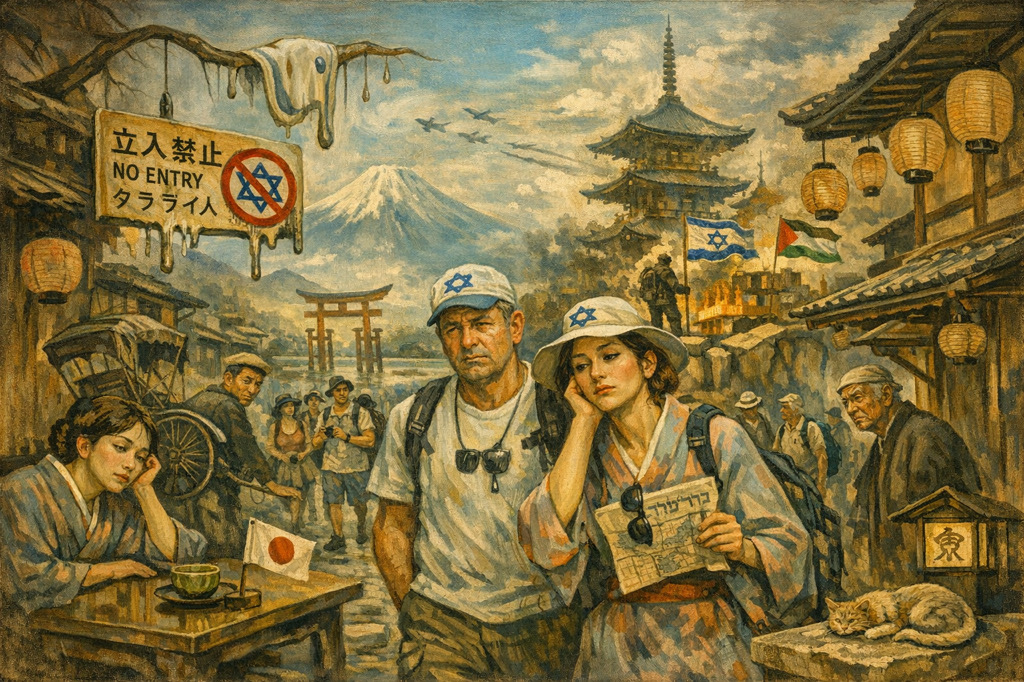
Rotterdam – You walk through a Japanese street and you feel the precision before you see it. The way people move, the way signs hang, the way the city breathes in a rhythm that seems engineered to avoid friction. It is a place where order is not just a rule but a cultural instinct, something that lives in the bones of the city. Yet even in a place built on harmony, you notice the small cracks where global politics seep through. When a few hotels decide to refuse Israeli guests, the tension becomes visible, not because Japan suddenly changed its laws, but because the world has become too interconnected for any gesture to remain local. What happens in a lodge in Nagano or a guesthouse in Kyoto doesn’t stay daar; it becomes part of a larger conversation about identity, law, and the way nations read each other.
The Law Is Clear, but Reality Has Its Own Rhythm
Japan’s legal framework leaves little room for interpretation. The Hotel Business Act states that hotels cannot refuse guests based on nationality, and Japan’s commitments under international conventions reinforce that principle. But the absence of a broad anti‑discrimination law for services creates a space where some businesses act as if they can improvise their own rules. That is how a lodge in Nagano ends up telling an Israeli group they are not welcome, not because of safety concerns but because the owner disagrees with their government. It is a decision that exposes the gap between written law and lived practice, a gap that becomes more visible when global tensions rise. You see how a country that values harmony can still struggle with the messy reality of international politics entering its private spaces.
Advertisement


Diplomacy That Moves Quietly but Hits Hard
Israel responds with a style of diplomacy that feels familiar to anyone who knows the directness of a port city. It is firm without being theatrical, precise without being aggressive. The Israeli ambassador sends formal protest letters to prefectures, not to shame Japan but to remind it of its own standards. The language is measured, but the message is unmistakable: discrimination is unacceptable, and Japan’s own laws confirm that. What makes this approach effective is that it aligns with Japan’s cultural preference for order and reputation. When a prefecture receives such a letter, it reacts quickly, opening investigations, issuing warnings, and instructing hotels to correct their behavior. It is not enforcement through punishment but through alignment, a kind of diplomatic aikido where pressure is applied exactly where it will create movement.
Public Opinion Shifts While Governments Hold Their Line
The Japanese government maintains a stable, pragmatic relationship with Israel, built on decades of cooperation in technology, trade, and innovation. But the mood on the street has shifted since 2023. Demonstrations, critical statements from progressive politicians, and debates about Gaza have created a more polarized atmosphere. It is not a tidal wave, but it is enough to influence how incidents are perceived. When a hotel refuses an Israeli guest, some see it as a political statement rather than a legal violation. That shift in perception matters, because it shapes the environment in which businesses make decisions and in which governments must respond. Japan’s leadership continues to balance its strategic interests with the changing tone of public discourse, trying to maintain stability while acknowledging the emotional undercurrents that shape the national conversation.

Why Small Incidents Carry Global Weight
A refusal at a single hotel might seem insignificant, but in a world where every action is amplified through social media and diplomatic channels, it becomes a symbol. Japan has spent decades cultivating an image of hospitality, precision, and international openness. Incidents like these threaten that image, not because they represent national policy but because they suggest inconsistency. Israel understands this dynamic and uses it effectively. By framing the incidents as violations of Japan’s own values, it encourages a response that protects both countries’ interests. The result is a series of swift corrections, not because Japan fears Israel, but because Japan fears reputational erosion. In a global economy built on perception, even small cracks can become costly.
Soft Enforcement With Sharp Edges
Japan’s enforcement style is subtle. There are no dramatic penalties, no public punishments, no sweeping legal reforms. Instead, there are conversations, warnings, and administrative guidance. In many countries, this would seem insufficient, but in Japan it carries weight. A prefectural warning is not just a bureaucratic gesture; it is a signal that a business has stepped outside the boundaries of social expectation. That kind of pressure can be more effective than fines, because it appeals to a sense of collective responsibility. Israel’s diplomatic strategy fits neatly into this system. By prompting these soft corrections, it ensures compliance without forcing Japan into a defensive posture. It is a reminder that power in international relations is not always loud; sometimes it is the quiet nudge that changes the course.
A Relationship Built on Pragmatism, Not Sentiment
Japan and Israel are not bound by emotional alliances. Their relationship is built on mutual benefit: technology, innovation, trade, and strategic positioning. Japan sees Israel as a hub of high‑tech expertise, while Israel sees Japan as a stable partner with global influence. This pragmatic foundation makes the relationship resilient, but it also means that public opinion can create friction. When Japanese citizens become more critical of Israel, the government must navigate carefully, maintaining cooperation while acknowledging domestic sentiment. The hotel incidents highlight this tension, showing how individual actions can become diplomatic signals. Yet the underlying partnership remains strong, because both countries understand that their interests align more than they diverge.
What These Moments Reveal About Global Power
The speed with which Japan responds to Israeli concerns reveals something important about the modern world. Nations no longer interact only through formal channels; they respond to each other’s cultural sensitivities, reputational vulnerabilities, and domestic pressures. Israel knows that Japan values order and international respect, so it frames its concerns in those terms. Japan knows that Israel is sensitive to discrimination and global perception, so it reacts quickly to avoid escalation. This mutual awareness creates a form of diplomacy that is less about force and more about understanding. It shows how global power operates today: through subtle signals, through the management of image, through the ability to influence without confrontation.
The Street-Level Reality Behind the Politics
When you bring all of this back to the level of everyday life, you see how global politics touches ordinary spaces. A hotel lobby becomes a diplomatic arena. A booking refusal becomes a test of national values. A conversation between a guest and a receptionist becomes part of a larger narrative about identity and belonging. It is a reminder that international relations are not abstract; they are lived in the bodies of travelers, in the decisions of business owners, in the quiet corrections of local officials. The world is connected in ways that make even small gestures meaningful, and Japan’s response to these incidents shows how seriously nations take the politics of hospitality.


 Dutch Echo
Leave a comment