

Rotterdam – You are not just watching a war unfold. You are being pulled into a narrative machine that tells you what to fear, who to blame, and what to believe before the smoke even settles. That is the real undercurrent beneath the current Israel-Iran confrontation and the expanding American role around it. The missiles, drones, military bases and oil chokepoints form the visible surface, but underneath it all sits something even heavier: the way power rewrites reality for the public in real time.
From the first coordinated strikes on Iranian military and nuclear targets to the retaliatory missile waves aimed at Israel and American assets in the Gulf, the conflict has already outgrown the language of “limited escalation.” What you are seeing now is the transformation of a shadow war into a direct, multilayered regional confrontation. Yet the battlefield is not only physical. It runs through your screens, your conversations, your timelines, your gut instincts, and the old historical fears that political actors know exactly how to trigger.
The moment war becomes a permanent headline, the first casualty is rarely truth itself. It is your ability to distinguish strategy from storytelling. You are fed clean beginnings, heroic motives and neat timelines, while the reality on the ground remains fragmented, contradictory and soaked in uncertainty. That gap between what is said and what is actually happening is where modern conflict lives.
Advertisement


The Promise of a Short War and the Reality You Now Face
You have heard this rhythm before. Leaders promise speed, precision and control. The enemy is said to be crippled. Their command structures are supposedly broken. Their air defenses are framed as gone, their supply lines destroyed, their retaliation capacity nearly finished. Then the days turn into weeks, the weeks into months, and the same enemy keeps launching missiles, drones and surprise strikes.
That contradiction is central to how this war is being understood by the public. On paper, the early objectives sounded familiar: disable Iran’s nuclear infrastructure, remove senior leadership, weaken military command and force strategic paralysis. In practice, Iran’s continued ability to strike Israeli cities, pressure American positions and threaten shipping lanes tells a different story. The discrepancy between public messaging and battlefield endurance changes how you interpret every future claim.
This is where the street-level perspective matters. People do not experience war through defense briefings or think tank diagrams. You experience it through rising fuel prices, fear-driven headlines, new enemies being named every week and the quiet normalization of permanent instability. When leaders say a conflict will be over in two weeks and it still dominates the world months later, what collapses is not just military credibility. It is public trust.
The Old Habit of Searching for Hidden Masters
Whenever wars become messy, expensive and morally confusing, societies often reach for simplified explanations. The temptation is always the same: there must be a secret group behind it all, a hidden elite, a small ethnic or religious network supposedly steering the chaos. That instinct is politically useful, emotionally satisfying and historically dangerous.
You should be alert to that pattern precisely because it appears whenever geopolitical reality becomes too complex to process. The current conflict has already generated narratives that collapse state interests, lobbying networks, business elites, ideological alliances and historical grievances into ethnic blame. That is where analysis stops and scapegoating begins.
The reality is harsher and less cinematic. States act from overlapping strategic interests: security doctrine, domestic politics, regional deterrence, energy routes, alliance pressure, election cycles and military-industrial incentives. That complexity does not fit neatly into the old myth that a single people or faith group “controls the West.” Those narratives are not explanations. They are shortcuts built from fear.
Once the public accepts ethnic blame as analysis, every failure in war can be outsourced onto a symbolic enemy. That is how societies avoid confronting institutions, leaders and policy choices. It becomes easier to blame “the Jews,” “the bankers,” “the oligarchs,” or any other convenient label than to examine how governments, corporations, intelligence alliances and military interests actually function. History has shown repeatedly where that road leads.
Why Historical Memory Keeps Haunting This Conflict
The shadow of Iraq in 2003 still hangs over every discussion of Iran today, and you can feel that memory shaping public skepticism. The language is familiar: existential threats, weapons programs, urgent intervention, promises of rapid stabilization, claims that regime pressure will produce regional transformation. The public has learned to recognize the choreography.
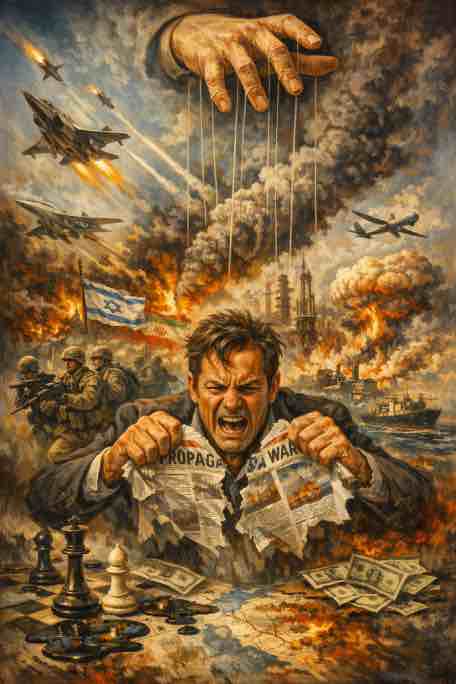
Historical figures who once promoted the Iraq invasion as necessary and beneficial remain deeply tied to current rhetoric around Iran. That continuity matters because it teaches you something about how geopolitical framing works. The names may remain the same, but the deeper mechanism is broader: identify a threat, magnify it into civilizational danger, sell intervention as defensive necessity, and compress the timeline into a promise of swift success.
You are not wrong to hear echoes. But historical parallels should push you toward sharper scrutiny, not toward ethnicized blame or collective suspicion. The lesson from Iraq is not that one people orchestrates wars. The lesson is that states, leaders and allied interests can repeatedly overstate certainty, underestimate consequences and rely on the public’s emotional memory to justify escalation.
Russia, China and the Machinery Behind Prolonged Conflict
One reason this war resists the fantasy of quick closure is that it sits inside a much wider geopolitical architecture. Russia’s role in intelligence sharing, technical support and long-term military cooperation with Iran, alongside China’s quieter support through trade, energy purchases, dual-use technology and navigation systems, gives the conflict a durable backbone.
That does not necessarily mean direct battlefield alliances in the conventional sense. What it means for you is simpler and more unsettling: wars now survive through ecosystems. Intelligence feeds, chips, sensors, logistics chains, sanctions evasion routes, maritime insurance loopholes, satellite alternatives and proxy networks all allow conflicts to continue long after the public was told victory was near.
This is why the language of “winning” often feels detached from what you can actually observe. A side may dominate airspace while still failing to suppress mobile missile systems. Another side may lose infrastructure while retaining enough asymmetrical capability to keep cities, ports and oil routes under pressure. The conflict becomes less about decisive victory and more about strategic exhaustion.
Oil, Hormuz and the Way War Reaches Your Kitchen Table
The closure or disruption of the Strait of Hormuz is not an abstract geopolitical talking point. It is the point where the war enters your everyday life. Energy routes are among the fastest ways distant military decisions become domestic economic pressure. Once tankers are threatened and insurance costs spike, households across Europe, the Caribbean and Suriname feel the tremor.
This is where the Rotterdam energy of the story hits hardest. A port city understands something instinctively: routes are power. Whoever controls the chokepoints controls tempo, pressure and bargaining leverage. That logic applies at the level of empires and at the level of your grocery bill. You may not see the drones over the Gulf, but you will feel the cost when logistics convulse.
The war therefore stops being “their problem” the moment maritime arteries tighten. The battlefield extends into trade, inflation, transport and public anxiety. That is how modern war reaches people who never chose to be part of it.
The Most Dangerous Battlefield Is the One Inside Public Perception
The hardest truth in all of this is that the conflict is not only fought with missiles, satellites and intelligence. It is fought through interpretation. You are constantly being asked to decide whether the war is nearly over or only beginning, whether a strike was strategic success or narrative theater, whether allies are acting independently or converging from shared interests.
This is why public discourse becomes so vulnerable to emotional shortcuts. Once fear rises, people search for clean villains and hidden masterminds. But reality is usually more systemic and less mythological. Power in the West, as elsewhere, is distributed across governments, corporations, lobbying structures, intelligence communities, military contracts, party politics and economic dependencies. That is not a secret cabal. It is a visible system, though often an opaque one.
Your responsibility as a reader is not to become cynical. It is to resist the seduction of simple enemies. The moment complexity becomes uncomfortable, propaganda offers relief. It hands you a face, a people, a symbol and says: blame this. That is where journalism must push back.
The real story of this war is not that one ethnicity controls events. It is that multiple states with overlapping interests, historical grievances, strategic fears and political incentives are driving a conflict whose consequences now spill into global life. The danger lies not only in the bombs, but in the narratives that teach you to misunderstand why the bombs fall in the first place.


 Dutch Echo
Leave a comment