
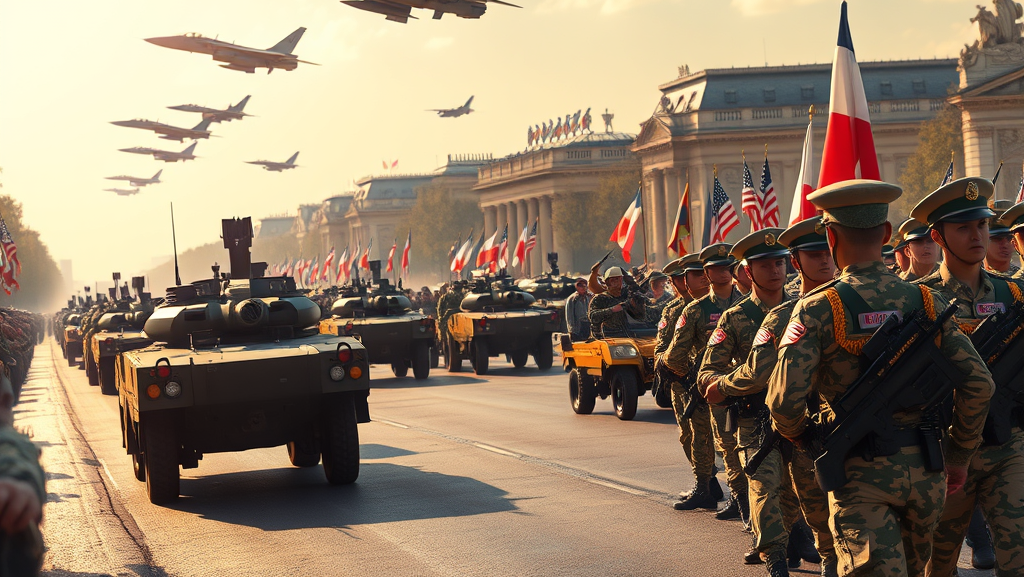
Paris — The Champs-Élysées once again served as the grand stage for France’s annual Bastille Day military parade, a tradition deeply rooted in revolutionary symbolism, national pride, and increasingly, international cooperation. What began as a celebration of liberty now doubles as a potent diplomatic message — spotlighting France’s military strength and its global network of strategic partners in a world where conflict and fragmentation are on the rise.
Historic Roots, Modern Motives
Bastille Day commemorates July 14, 1789, the storming of the Bastille prison that ignited the French Revolution. Today’s parade honors those republican ideals — liberty, equality, fraternity — but with a distinctly modern twist. The event, held since 1880, now also serves as a live showcase of France’s evolving military capabilities and its role on the world stage.
Advertisements
This year’s display was striking in its scale and symbolism. More than 7,000 personnel, dozens of armored vehicles, aircraft, and cavalry units lined the avenue. But beyond the spectacle lay a narrative of strategic positioning and global solidarity.
Marching Side by Side: International Forces Join the Parade
In a deliberate show of unity, military personnel from over nine countries joined French troops in the parade — including soldiers from the Netherlands, Germany, Japan, the United Kingdom, Indonesia, and the United States. Their coordinated march reflected France’s ties across continents, underscoring both NATO collaboration and broader Indo-Pacific outreach.
Of particular note was the participation of Indonesian soldiers — a rare appearance for a non-Western nation and a clear nod to strengthening bilateral ties. France and Indonesia have in recent years ramped up military cooperation, including a major deal involving Rafale fighter jets, shared training programs, and joint maritime exercises aimed at promoting Indo-Pacific stability.
Rafales, Drones, and Signals of Strength
The parade also included a commanding aerial show featuring the sleek Rafale jets — France’s crown jewel in defense exports — soaring over Paris in precise formation. Drones and other tech-forward platforms took part, illustrating France’s commitment to modern warfare and cyber capabilities.
At night, a drone light show above the Eiffel Tower depicted scenes of unity and revolution, blending tradition with innovation in visually stunning style.

While the parade’s overt tone was celebratory, its undertone was unmistakably assertive. France’s military posture — especially amid the ongoing war in Ukraine, unrest in parts of West Africa such as Burkina Faso, and rising tensions with Iran — has become more proactive. Officials have increasingly used the Bastille Day parade as an opportunity to affirm the nation’s readiness in the face of global instability.
Macron’s Message: Readiness in a “Dangerous World”
President Emmanuel Macron, in his speech at the Tomb of the Unknown Soldier, emphasized the need for vigilance, resilience, and collaboration. He described the current geopolitical climate as “dangerous and uncertain,” echoing concerns voiced by defense analysts about Europe’s vulnerability and France’s need to solidify its alliances.
The inclusion of non-European powers was interpreted by many as part of France’s pivot to a more multipolar approach to diplomacy. With traditional alliances tested by war, resource competition, and ideological divides, Macron’s government appears intent on reinforcing its influence across regions that go beyond the Western sphere — particularly Southeast Asia and Africa.
Symbolism vs Realpolitik
While Bastille Day remains a national holiday filled with pride and pageantry, its meaning continues to evolve. What was once a purely internal celebration of revolution has become a platform for international signaling. Some critics argue that the increasing militarization of the parade — especially amid controversial arms deals and global unrest — risks overshadowing the day’s historical spirit.
Others defend the shift, noting that France’s global influence depends on visible demonstrations of strength and solidarity. In today’s fragmented world order, parades such as this serve as soft-power instruments just as much as traditional diplomacy.
Bridging Cultures, Building Alliances
For spectators lining the Parisian boulevard, the event delivered both awe and reflection. Seeing Indonesian troops in ceremonial formation beside European forces reminded viewers of France’s widening diplomatic horizon. It also raised questions about how countries use symbolic events to strengthen policy agendas.
Moreover, with Burkina Faso recently shifting its diplomatic allegiances away from France and toward Russia and China, the parade offered an indirect rebuttal — showcasing partnerships that reinforce France’s relevance on the continent and beyond.
Bastille Day by the Numbers
- Participants: Over 7,000 military personnel
- Aircraft: 11 Rafale jets, helicopters, support planes
- International troops: Representatives from more than 9 nations
- Spectators: Tens of thousands, including foreign dignitaries
- Budget and resources: An estimated €15 million for logistics and security
As dusk settled over Paris, the festivities wound down — but the message endured. France’s 2025 Bastille Day parade was not just a tribute to its revolutionary past. It was a declaration of resolve, cooperation, and influence in an age defined by uncertainty.


 Dutch Echo
Leave a comment