
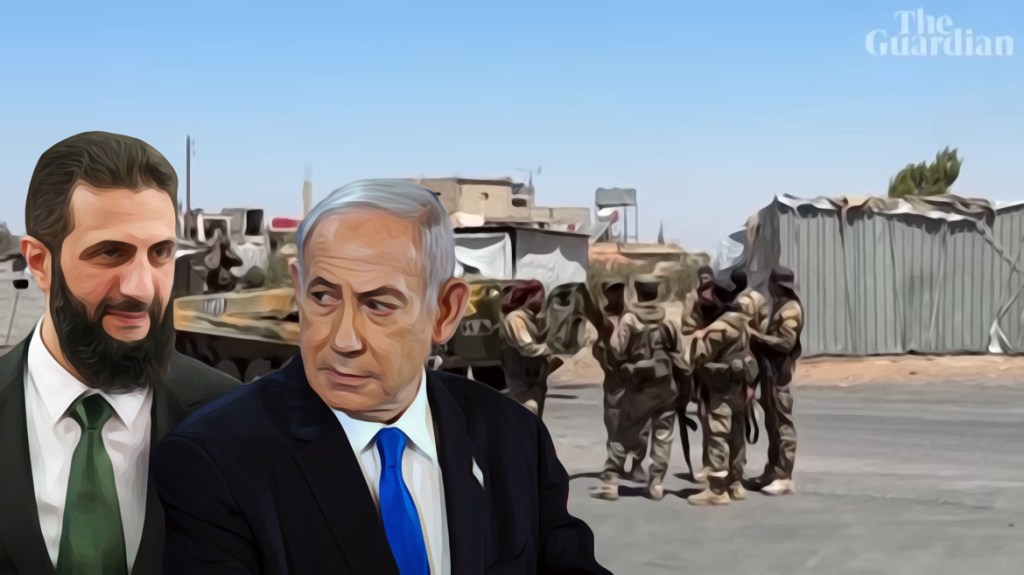
Damascus — In a dramatic escalation of regional tensions, Israel has launched a series of airstrikes on key military and governmental targets in Damascus, Syria’s capital. The strikes, which hit the Syrian army headquarters and areas near the presidential palace, come amid violent clashes in the southern province of Sweida between Druze militias and Sunni Bedouin factions. Israel claims its intervention is aimed at protecting the Druze minority from persecution by Syria’s new ruling force, Hay’at Tahrir al-Sham (HTS). But critics argue that the operation may reflect deeper strategic ambitions, including territorial influence and regional dominance.
🕊️ Background: Syria’s New Power Structure
Following the collapse of Bashar al-Assad’s regime in December 2024, Syria has been under the control of HTS, a jihadist group with origins in Al-Qaeda. Led by Ahmed al-Sharaa (also known as Abu Mohammed al-Julani), HTS seized Damascus and declared a transitional government. While the group has attempted to present itself as reformist, reports of religious purges, extrajudicial killings, and the exclusion of minorities have raised alarm across the region.
Advertisement

In Sweida, a predominantly Druze province, tensions have erupted into open conflict. Druze militias have resisted HTS-aligned Sunni Bedouin groups, leading to deadly confrontations. According to the Syrian Observatory for Human Rights, over 500 people have been killed in Sweida alone, including civilians and children.
🇮🇱 Israel’s Justification: Protection of the Druze
Israel’s official stance is that its airstrikes are a defensive measure to protect the Druze community in Syria. Defense Minister Israel Katz stated, “The Syrian army must withdraw from Sweida, or the strikes will continue.” Prime Minister Benjamin Netanyahu added, “Israel will not stand by while our brothers in faith are slaughtered.”
The Druze have long been considered loyal citizens of Israel. Since 1956, Druze men have been subject to mandatory military service, and many hold high-ranking positions in the Israeli Defense Forces (IDF), police, and government. The spiritual leader of the Druze in Israel, Sheikh Muafak Tarif, called for military intervention, describing the situation in Sweida as “an existential threat.”
🧭 Strategic Motives Beyond Protection
While Israel emphasizes humanitarian motives, analysts suggest that the strikes may serve broader strategic goals. The choice of targets—central military and government facilities in Damascus—raises questions about whether the operation is truly focused on Sweida.
Strategically, Israel may be aiming to:
- Establish a buffer zone in southern Syria near its border.
- Position itself as a regional protector of minorities, gaining international legitimacy.
- Distract from domestic political crises, including corruption investigations against Netanyahu.
- Politically divide the Druze community in Syria, increasing reliance on Israeli support.

📖 The Druze as a Narrative Lever
Israel’s use of the Druze as a justification for military action fits into a broader pattern of leveraging religious minorities for geopolitical purposes. Historically, Israel has sought alliances with Maronite Christians in Lebanon and Kurds in Iraq. By portraying itself as a defender of vulnerable groups, Israel can legitimize military operations and weaken Arab unity.
Some analysts point to the Oded Yinon Plan, a controversial strategic document from the 1980s that proposed fragmenting Arab states along sectarian lines to enhance Israeli security. In this context, support for the Druze may serve not only humanitarian ends but also strategic fragmentation of Syria.
🗺️ The “Greater Israel” Vision: Myth or Blueprint?
Another layer of critique centers on the historical writings of Theodor Herzl, founder of political Zionism. In his diaries, Herzl envisioned a Jewish state stretching “from the brook of Egypt to the Euphrates”—a vast territory encompassing parts of Egypt, Syria, Iraq, Jordan, and Lebanon.
While this vision is not official policy, it has appeared in military insignia, political rhetoric, and conspiracy theories. Critics argue that Israel’s current actions in Syria—especially the occupation of parts of southern territory—may reflect a long-term strategy of territorial expansion. By framing its intervention as protection of the Druze, Israel can gain ground without formal annexation.
🌍 International Response: Cautious and Divided
Global reactions to Israel’s strikes have been mixed. The United States has significantly reduced its military presence in Syria but continues to monitor the situation. The European Union has partially lifted sanctions on Syria to support reconstruction but urges restraint and protection of minorities.
The United Nations has called on Israel to act proportionally and avoid using humanitarian justifications for geopolitical gain. At the same time, there is widespread concern for the Druze, who have historically been caught between warring factions and marginalized by dominant powers.
🧬 The Druze: Religious Identity and Political Vulnerability
The Druze are a unique religious minority with esoteric beliefs rooted in Islam, Christianity, and ancient philosophy. Their faith is closed—conversion is not permitted—and only a small group of initiates (uqqal) have access to sacred texts. The Druze believe in reincarnation and spiritual purity, and their communities are tightly knit.
In Syria, the Druze number around 700,000, mostly in Sweida. In Israel, approximately 130,000 Druze live primarily in Galilee and the Carmel region. While many Israeli Druze serve in the military and identify as loyal citizens, tensions have arisen over laws like the 2018 Nation-State Law, which defines Israel as a Jewish state.
In the Golan Heights—territory captured from Syria in 1967—Druze communities are divided. Some have accepted Israeli citizenship, while others remain loyal to Syria. The current conflict has deepened these divisions, with some Druze welcoming Israeli support and others fearing exploitation.
🔥 The Cost of Conflict
The violence in Sweida has claimed over 500 lives, according to human rights monitors. Hospitals are overwhelmed, and civilians are trapped in besieged areas with limited access to food and medical care. Israeli airstrikes have killed several Syrian soldiers and damaged critical infrastructure in Damascus.
Reports of summary executions, looting, and abuse by HTS-aligned forces have intensified calls for international intervention. However, the complexity of the conflict—sectarian, geopolitical, and ideological—makes resolution elusive.
🧠 Conclusion: A War of Motives and Narratives
Israel’s airstrikes on Damascus are not just a military maneuver—they are a statement of intent, a projection of power, and a test of international tolerance. While the protection of the Druze is a compelling narrative, the choice of targets, timing, and broader context suggest that strategic expansion and regional influence are also at play.
For the Druze, the situation is paradoxical: they are protected, yet politicized. For Syria, it marks another chapter of fragmentation. And for the world, it is a reminder that in the Middle East, humanitarian motives and geopolitical ambitions are often intertwined.


 Dutch Echo
Leave a comment