
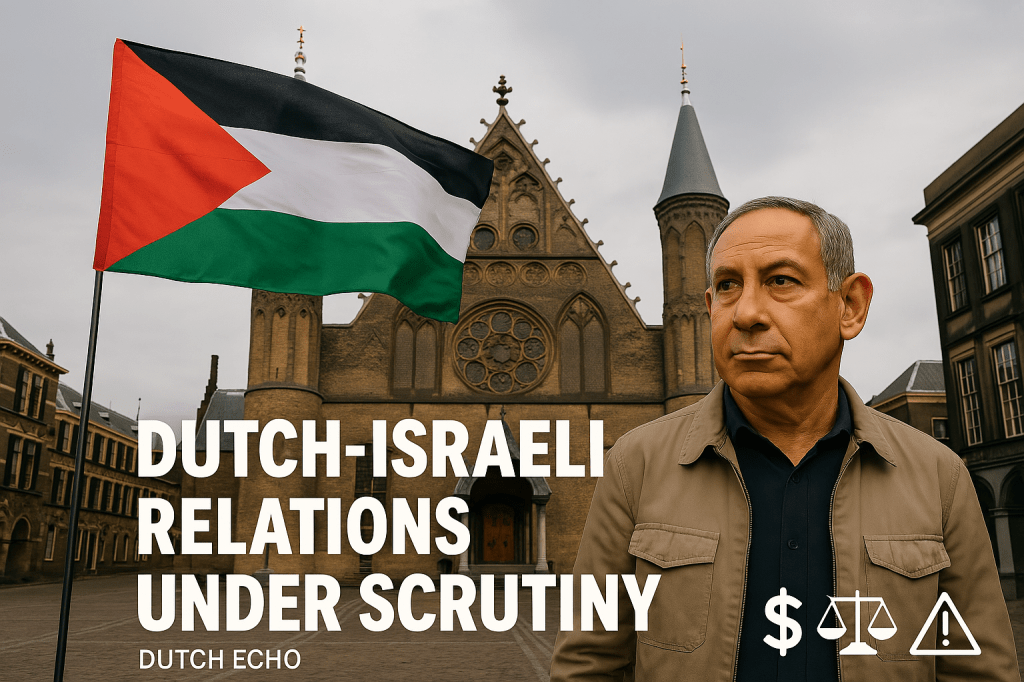
For decades, the Netherlands has maintained a strong and seemingly unwavering relationship with Israel — rooted in shared democratic values, significant bilateral trade, and symbolic post-war solidarity. Yet today, cracks are showing. Recent developments, including a controversial national security report and growing public dissent, have prompted calls for change. Questions about ethics, international law, and national identity are intensifying, leading many to wonder: Is the Dutch government doing enough to align its policy with the moral convictions of its citizens?
📉 Tensions Rise: Israel Named as a Security Risk
In a stunning move, the Dutch National Coordinator for Counterterrorism and Security (NCTV) released a report in June 2025 identifying Israel as a potential threat to the Netherlands’ national security. It cites attempts to influence Dutch public opinion and political processes through disinformation and diplomatic pressure.
Among its concerns:
- Unauthorized diplomatic memos linking Dutch citizens to terrorist groups.
- Israeli threats aimed at the International Criminal Court (ICC), headquartered in The Hague.
- Increased surveillance and use of Israeli-made spyware, sparking alarm in Dutch intelligence circles.
This marks the first time Israel has been officially named as a state-level risk by the Dutch government — a symbolic turning point in bilateral relations.
Advertisement
🧭 Public Opinion vs Political Restraint
Despite rising tensions, the Dutch government’s formal policies remain cautious. Officials express concern over Israeli conduct, especially regarding the conflict in Gaza, but stop short of taking concrete action such as sanctioning arms exports or freezing trade.
This tepid approach contrasts sharply with public sentiment:
- A Pew Research study shows that 78% of Dutch citizens hold a negative view of Israel, the highest in Europe.
- Over half believe the government should take a tougher stance on Israel’s human rights record.
- Political parties such as GroenLinks, D66, and the Socialist Party actively call for Palestinian state recognition — yet such proposals have repeatedly stalled in parliament.
The discord raises fundamental questions about the Dutch democratic model: Is the government truly representing its people on matters of foreign policy?
💰 Economic Ties: Lucrative but Controversial
Economically, the Netherlands is deeply intertwined with Israel:
- As of 2023, Dutch investors poured €49 billion into Israeli enterprises, making the Netherlands Israel’s largest foreign investor.
- Simultaneously, Israel invested approximately €47 billion into the Netherlands, particularly through tax structures and holding companies.
Many of these deals benefit from favorable tax laws and financial loopholes, which critics say enable impunity and fund illegal settlements in the West Bank. Human rights watchdogs such as SOMO and Amnesty International argue that continued Dutch investment violates international humanitarian law, especially clauses within the Genocide Convention and EU regulations.
Still, the Dutch government hesitates. Officials claim that solo economic sanctions would be “diplomatically risky” and stress the need for EU-wide consensus.
🇪🇺 Europe’s Mixed Signals
The Netherlands is not alone in reconsidering its position on the Israeli–Palestinian conflict. In recent months:
- France, Ireland, Norway, Slovenia, and Canada have formally recognized Palestine as a state.
- EU debates over suspending the EU-Israel Association Agreement have intensified.
- Horizon Europe, the EU’s scientific collaboration program, suspended Israeli participation pending human rights evaluations.
Yet the EU remains divided, particularly due to pushback from Germany, Hungary, and the Czech Republic — countries historically aligned with Israel.
The Dutch government argues that meaningful progress requires continental unity, but many activists view this as a diplomatic excuse for inaction.
✝️ Religion and Political Influence
Another layer of complexity involves Dutch religious organizations with strong ties to Israel. Evangelical groups, such as “Christians for Israel,” have come under scrutiny for financial contributions to Israeli settlers, some of whom are engaged in violence against Palestinians.
Although most Dutch religious institutions uphold humanitarian values, critics argue that faith-based lobbying skews policy and delays accountability — especially when such organizations avoid transparency about their donations.
Public broadcasters like the EO (Evangelische Omroep) and legacy Christian political parties also face questioning, though no formal investigations or restrictions have been announced.
🗳️ Political Divide: Wilders vs Official Policy
Firebrand politician Geert Wilders, leader of the Party for Freedom (PVV), remains an unflinching supporter of Israel. A frequent visitor to the Israeli embassy and self-proclaimed ally of Prime Minister Benjamin Netanyahu, Wilders opposes Palestinian statehood and has proposed recognizing Jordan as the “true Palestinian homeland.”
His stance diverges sharply from the Dutch government’s official backing of a two-state solution and fuels internal friction. Other parties criticize Wilders for undermining Dutch diplomacy and aggravating tensions in fragile regions.
⚖️ Diplomacy vs Decency
The central dilemma remains: Should the Netherlands prioritize its moral and legal obligations, or maintain status quo diplomacy?
So far, the government has chosen the latter — issuing statements of concern, condemning human rights abuses, and barring a few Israeli ministers entry into the country. But critics argue these are symbolic gestures that do little to end complicity or prevent further suffering.
Humanitarian organizations urge more:
- Full suspension of arms trade with Israel.
- Formal recognition of Palestine.
- Freezing financial investments tied to illegal settlements.
- Public calls for international legal accountability.
Yet ministers warn that such measures could undermine future peace talks, damage Dutch global standing, and hurt domestic economies.
🔚 Conclusion: Trading Values for Valuables?
As the Netherlands grapples with its identity — both as an ethical nation and a trade hub — its response to the Israeli–Palestinian conflict may define its international legacy. With growing public dissent, heightened legal scrutiny, and the collapse of Gaza’s civil society, calls for meaningful policy change will only intensify.
Whether the Dutch government continues to walk the line between commerce and conscience, or finally steps up with decisive action, remains to be seen. But one thing is clear: the “Dutch trading spirit” may no longer be enough to justify silence.

 Dutch Echo
Leave a comment