

What if stupidity isn’t about intelligence at all—but about surrendering the will to think? That unsettling question lies at the heart of the viral video “The Terrifying Theory of Stupidity You Were Never Meant to Hear” by Philosophy Coded. Drawing on the forgotten insights of German theologian Dietrich Bonhoeffer, the video offers a chilling diagnosis: stupidity is more dangerous than malice, because it resists reason and cannot be corrected through argument.
Bonhoeffer observed how intelligent people in Nazi Germany became complicit in collective madness. He argued that stupidity is not a lack of intellect, but a moral and social condition—one in which individuals relinquish their critical faculties to ideology, authority, or group pressure. The video suggests that this “functional stupidity” is still rampant today, from algorithm-driven echo chambers to political slogans and the ease with which people conform to the crowd.
Viewer comments echo this concern. One user shared how deleting social media helped them rediscover clarity and creativity. Another admitted they joined a protest without knowing what they were protesting, simply because “everyone else was doing it.” A recurring theme emerges: critical thinking requires effort; going along with the crowd requires none.
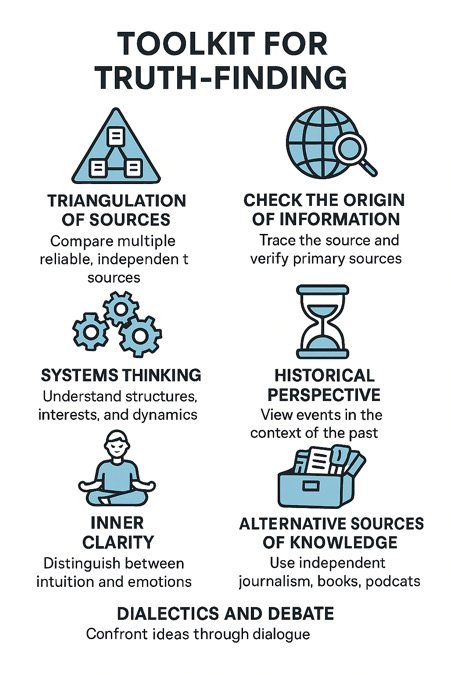
This video is more than a philosophical reflection—it’s a wake-up call. And it aligns perfectly with the Toolkit for Truth-Finding, a visual and conceptual guide designed to help individuals resist manipulation, misinformation, and mental laziness.
🔺 Triangulation of Sources: Truth as a Mosaic
The first principle of the toolkit is deceptively simple: compare multiple reliable, independent sources. In an age where algorithms curate our reality, actively seeking diverse perspectives is essential.
Triangulation means not relying on a single news outlet or platform, but consulting alternative media, international reports, and local testimonies. Truth doesn’t emerge from one voice—it’s a mosaic of many. Bonhoeffer might say: “To trust only one source is to abandon your own judgment.”
🔍 Check the Origin of Information: Trace the Roots
In a world of viral content and AI-generated text, tracing the origin of information is more crucial than ever. Who created this message? What was their intent? Is it a primary source or a recycled narrative?
The Bonhoeffer video exemplifies this principle. It quotes original texts, provides historical context, and invites viewers to reflect. This stands in stark contrast to superficial posts or politicized summaries that strip away nuance. Truth-finding demands that we look beyond headlines and hashtags—to the story behind every claim.
⚙️ Systems Thinking: See the Bigger Picture
Truth is rarely linear. It’s embedded in systems—economic, political, cultural, psychological. Systems thinking invites us to ask: What structures underlie this issue? Who benefits? What dynamics are at play?
Bonhoeffer’s analysis of stupidity is itself a form of systems thinking. He recognized how social structures condition people into passivity. Today, we see this in how algorithms shape behavior, how media framing influences perception, and how groupthink suppresses dissent. Systems thinking helps us recognize patterns and expose power.
⏳ Historical Perspective: Context Is Everything
Every event has a backstory. Every opinion has ancestors. Historical perspective helps us resist the tyranny of the present and understand today’s issues as part of longer arcs.
Bonhoeffer’s warning emerged from his experience in Nazi Germany, but it remains strikingly relevant. The video shows how his insights apply to modern phenomena like populism, conspiracy theories, and ideological polarization. Understanding history allows us to avoid repetition—and to recognize when we’re heading down familiar paths.
🧘 Inner Clarity: Know Thyself
Truth-finding isn’t just external—it’s internal. Inner clarity means recognizing our own emotions, intuitions, and biases. It’s the difference between reacting and reflecting.
The video emphasizes that stupidity often stems from fear, laziness, and the desire to belong. Inner clarity allows us to identify those impulses and rise above them. It takes courage to say “I don’t know,” and even more courage to think independently when others don’t.
🧰 Alternative Sources of Knowledge: Beyond the Mainstream
Mainstream media has its strengths—but also its blind spots. Alternative sources like independent journalism, books, podcasts, and community voices offer fresh angles and deeper analysis.
The Bonhoeffer video is itself an example of such an alternative source. It reaches millions outside traditional channels and stimulates critical thought. In cities like Rotterdam, alternative knowledge flows through spoken word, activist blogs, intercultural music, and grassroots initiatives. Truth-finding means expanding our sources—not narrowing them.
💬 Dialectics and Debate: Truth Through Dialogue
Finally, truth is not a monologue—it’s a dialogue. Through respectful debate, we test ideas, confront contradictions, and refine our understanding.
Bonhoeffer advocated for dialogue, even in times of repression. The video invites viewers to engage in conversation—about power, responsibility, and the role of the individual within the collective. Dialectics is the art of holding tension between opposing views. In a polarized world, it’s not just a method—it’s a lifeline.
🌍 Why This Toolkit Matters—Especially Now
We live in an era where independent thinking is an act of resistance. Bonhoeffer’s theory of stupidity is not a pessimistic diagnosis—it’s a call to consciousness. The Toolkit for Truth-Finding offers seven keys to answer that call.
Whether you’re a student, educator, artist, policymaker, or curious citizen, this toolkit empowers you to:
- Resist manipulation and misinformation
- Cultivate empathy and nuance
- Make informed decisions
- Build bridges across differences
- Strengthen democratic culture
In times of populism, digital overload, and social fragmentation, truth-finding becomes an act of hope.
✨ A Call to Action
So what now? Watch the video. Share the toolkit. Apply it to your media habits, your conversations, your creative work. Use it in classrooms, workshops, and public forums.
And above all: stay curious. Truth is not a destination—it’s a journey. And on that journey, every question matters.
 Dutch Echo
Leave a comment