
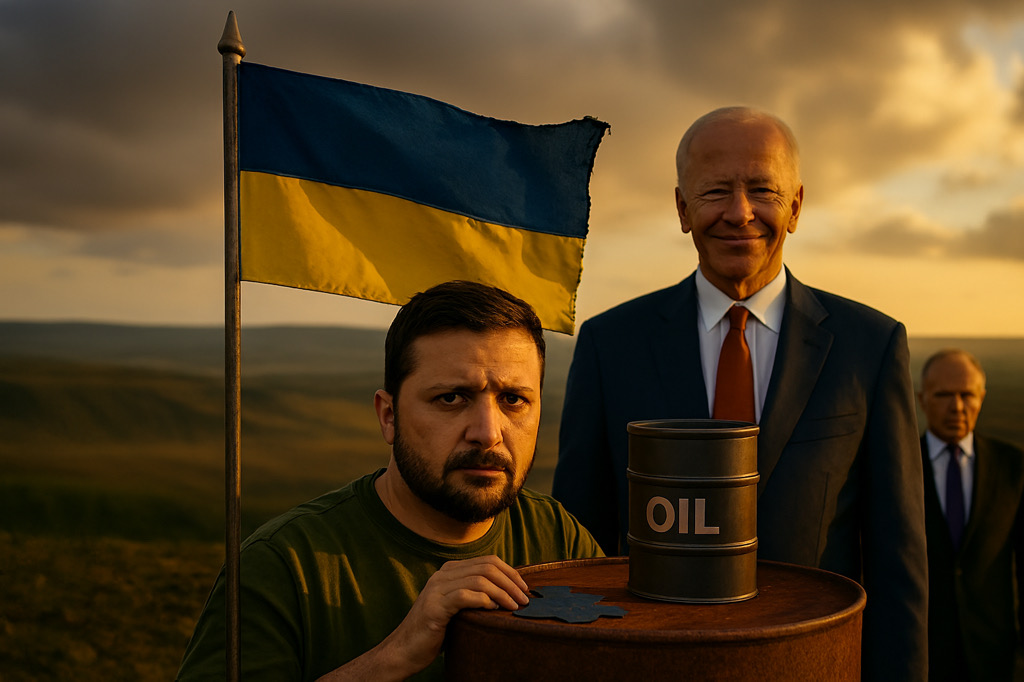
Three years into a brutal war, Ukraine finds itself at a pivotal moment in its modern history. With billions in foreign aid, mounting international pressure, and a treasure trove of natural resources beneath its soil, the country must now decide what kind of future it wants—and what kind of future it will be allowed to have.
Is Ukraine destined to become a resource colony, exploited for its strategic minerals and beholden to foreign powers? Or can it emerge as a fully integrated member of the European Union, with political autonomy, economic resilience, and a voice in shaping the continent’s future?
A Land Rich in Strategic Resources
Ukraine’s soil is among the richest in Europe—not just agriculturally, but geologically. The country holds significant reserves of lithium, cobalt, graphite, manganese, tantalum, niobium, and scandium. These minerals are essential for the global transition to green energy and digital infrastructure. From batteries and wind turbines to semiconductors and aerospace alloys, Ukraine’s underground wealth is a geopolitical prize.
Advertisement

Many of these resources lie in contested regions such as Donetsk, Luhansk, and Zaporizhzhia, making them not only economically valuable but strategically explosive. Control over these areas means control over the future of energy, technology, and military capability.
The American Investment—and Expectation
Since 2022, the United States has invested over $100 billion in Ukraine through military aid, humanitarian support, and financial assistance. Former President Donald Trump, who recently re-entered the diplomatic stage, has been vocal about expecting a return on that investment.
In 2025, a joint U.S.-Ukraine investment fund was established to develop and extract critical minerals. Both countries contribute 50% to the fund and share profits equally. American companies have secured access to mining concessions for lithium, uranium, and other rare earth elements. Washington views this as both a strategic partnership and a form of economic recognition for its wartime support.
Trump initially demanded that Ukraine repay the U.S. with $500 billion worth of mineral exports—a proposal that was ultimately dropped under international pressure. Still, the underlying expectation remains: the U.S. wants more than gratitude; it wants a stake in Ukraine’s future.
Europe’s Principled but Cautious Approach
The European Union has also poured over €150 billion into Ukraine, supporting military defense, refugee assistance, reconstruction, and institutional reform. Unlike the U.S., Europe has not demanded direct economic returns. Instead, it has focused on helping Ukraine meet the criteria for EU membership.
A strategic partnership for critical minerals was signed in 2021, giving European companies access to Ukrainian resources. However, there is no formal profit-sharing agreement. Europe’s primary interest lies in reducing dependence on China and Russia for rare earths, and Ukraine offers a promising alternative.

EU leaders have emphasized that Ukraine must not be forced into territorial concessions and that peace should not reward aggression. Yet, as the U.S. takes a more transactional approach, Europe risks being sidelined in the geopolitical negotiations.
Zelensky’s Balancing Act
President Volodymyr Zelensky began his term as a reformer and peace-seeker. Since the invasion, he has become the face of Ukrainian resistance. His mission is clear: defend sovereignty, pursue EU integration, and secure long-term peace.
But Zelensky operates within a complex web of influences. Domestically, he relies on advisors like Andriy Yermak and his party, Servant of the People. Internationally, he must navigate the expectations of Washington, Brussels, and other global players.
He has repeatedly stated that Ukraine will not surrender territory without security guarantees and that peace must be just, not merely expedient. His leadership is a constant negotiation—between ideals and realities, between national pride and international pressure.
What Does Ukraine Actually Keep?
Politically, Ukraine retains its sovereignty, though its future borders remain uncertain. Economically, it owns its resources but must share profits and decision-making with foreign investors. Socially, the toll is immense: millions displaced, widespread trauma, and a generation growing up in conflict.
Ukraine’s external debt now exceeds €150 billion. Repayment is deferred until 2027, but interest continues to accrue. From 2033 onward, Ukraine will begin a 37-year repayment schedule to the EU. This means that much of its future revenue—from minerals, agriculture, and industry—will be used to service debt.
Resource Colony or EU Member?
The comparison is stark. The Democratic Republic of Congo is rich in minerals but poor in governance, exploited by foreign powers and plagued by corruption. Poland, on the other hand, joined the EU in 2004 and transformed into a modern economy with political influence and rising living standards.
Ukraine could go either way.
If it fails to reform, allows corruption to fester, and loses control over its resources, it risks becoming a resource colony—rich in soil, poor in sovereignty. If it completes its reforms, maintains transparency, and negotiates wisely, it could become a full-fledged EU member with a seat at the table and a stake in Europe’s future.
The Road Ahead
Ukraine’s future is not yet written. The choices made in the coming months—by Kyiv, Washington, Brussels, and Moscow—will determine whether the country becomes a pawn or a player.
The soil beneath Ukraine is valuable. But the true wealth lies in its institutions, its leadership, and its people. If those are nurtured, Ukraine can rise not just from war, but into a new era of prosperity and influence.
And that, more than any mineral, is worth fighting for.


 Dutch Echo
Leave a comment