
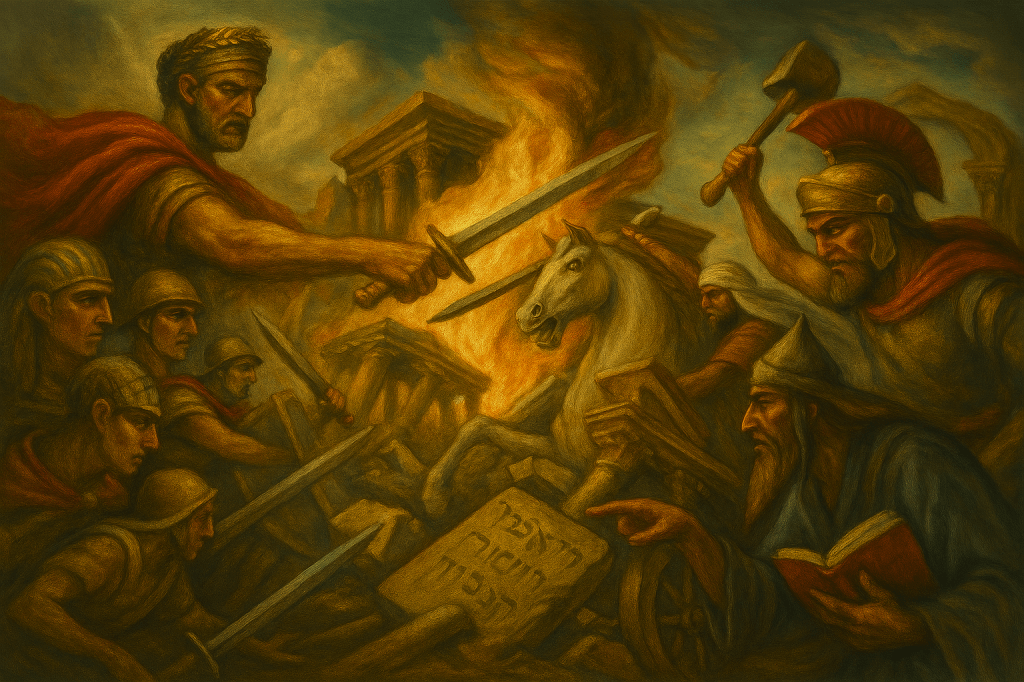
Let’s be real: most of us grew up hearing about the Israeli-Palestinian conflict as if it were some ancient feud between two totally different peoples. Jews vs. Arabs. Religion vs. religion. Good vs. evil—depending on which news outlet your parents watched. But what if that whole framing is wrong? What if the people fighting over land, identity, and survival in the Middle East are actually… cousins?
That’s the uncomfortable truth explored in Palestine Part 1 – From Ancient Roots to 1948, a powerful video lecture by Dr. Roy Casagranda. It’s not just a history lesson—it’s a wake-up call. Casagranda doesn’t tiptoe around colonialism, Zionism, or Western hypocrisy. He dives straight into the tangled roots of Semitic identity and shows how centuries of migration, assimilation, and religious transformation have created a paradox: Semitic peoples killing other Semitic peoples, often without realizing how deeply connected they are.
This essay breaks down that paradox, tracing the evolution of Semitic languages and cultures, the rise of imperial powers, and the ideological machinery that turned shared ancestry into political warfare. It’s written for anyone who wants to understand the deeper story—especially young adults in Rotterdam who know that identity is never simple, and history is never neutral.
What Even Is “Semitic”?
Let’s start with the basics. “Semitic” isn’t a race. It’s not a religion. It’s a linguistic family—a group of languages that evolved from a common ancestor called Proto-Semitic, spoken around 3000 BCE somewhere in the Levant or Arabian Peninsula. From that root language came Hebrew, Arabic, Aramaic, Amharic, and others.
So yes: Jews and Arabs speak languages that are cousins. Hebrew and Arabic share grammar, vocabulary, and even the same triliteral root system (like K-T-B for “writing”). That’s not just linguistic trivia—it’s cultural DNA.
But over time, language became a tool of division. European scholars in the 19th century twisted “Semitic” into a racial category, using it to justify antisemitism and colonial hierarchies. Suddenly, being Semitic wasn’t about language—it was about blood, suspicion, and exclusion.
Palestine Before the Partition
Long before Israel existed, Palestine was a mosaic of Semitic peoples. Canaanites, Hebrews, Arameans, and later Arab tribes lived, traded, and worshipped across the region. Under Islamic rule, Jews and Christians were protected as “People of the Book.” Many Jews lived peacefully in cities like Hebron and Jerusalem, and some converted to Islam or Christianity over generations.
Here’s the twist: many modern-day Palestinians are descendants of those ancient Jewish communities. Through centuries of assimilation, they became Arab Muslims or Christians—but their genetic and cultural roots are deeply intertwined with the very people now claiming exclusive rights to the land.
Casagranda argues that some Palestinians are “more Jewish” than the European Jews who arrived in the 20th century under the banner of Zionism. That’s not a dig—it’s a historical observation. Zionism, born in Europe as a response to antisemitism, brought in Jews from Russia, Poland, and Germany—many of whom had little direct connection to Palestine beyond religious texts.
Zionism and the Colonial Machine
Zionism wasn’t just a spiritual movement—it was a political project. Theodor Herzl, its founder, considered multiple locations for a Jewish homeland, including Uganda. Palestine was chosen not because it was empty (it wasn’t), but because it had symbolic weight.

The British Empire, eager to control the Middle East after World War I, issued the Balfour Declaration in 1917, supporting a Jewish homeland in Palestine. But this wasn’t about protecting Jews—it was about managing them. Britain, like much of Europe, wanted Jews out. Supporting Zionism was a way to export the “Jewish problem” while securing imperial influence.
The result? A colonial setup where one Semitic people (European Jews) were empowered to displace another Semitic people (Palestinian Arabs), all under the guise of historical justice.
The Semitic Paradox
So here we are: a region where Semitic languages are native, Semitic religions were born, and Semitic peoples have lived for millennia. And yet, the dominant narrative treats Jews and Arabs as fundamentally opposed.
It’s a paradox. Israeli soldiers speak Hebrew. Palestinian protesters speak Arabic. Both languages come from the same root. Both peoples share ancestry. But ideology, nationalism, and trauma have built walls that language alone can’t break.
Casagranda’s video doesn’t just highlight this paradox—it exposes the machinery behind it. He shows how Western powers used antisemitism to justify Zionism, how Zionist militias collaborated with Nazis to evacuate Jews from Europe, and how the Holocaust became a political tool to silence criticism of Israeli policies.
It’s heavy stuff. But it’s necessary.
Why This Matters in Rotterdam
You might be wondering: what does this have to do with us, here in Rotterdam?
Everything.
Rotterdam is one of the most diverse cities in Europe. We live side by side with people from Morocco, Turkey, Syria, Israel, and Palestine. We hear Arabic and Hebrew on the metro. We see protests in front of city hall. We read headlines about Gaza and West Bank, and we feel the tension in our communities.
Understanding the Semitic paradox helps us see beyond the headlines. It reminds us that identity is layered, that history is messy, and that solidarity requires nuance. It challenges us to ask better questions: Who benefits from division? What stories are we not being told? How do we build bridges without erasing pain?
The Power of Knowing
Casagranda’s work is part of a growing movement to reclaim history from propaganda. It’s not about choosing sides—it’s about understanding systems. Colonialism. Nationalism. Religious manipulation. These forces shape how we see ourselves and each other.
By learning that Palestinians might have Jewish ancestry, we don’t erase their struggle—we deepen it. We see the tragedy not just as a land dispute, but as a family torn apart by ideology. We recognize that being Semitic isn’t a badge or a curse—it’s a shared heritage that’s been weaponized.
And maybe, just maybe, we start to imagine a future where that heritage becomes a bridge instead of a battlefield.
Final Thoughts
History isn’t neutral. It’s written by victors, shaped by empires, and filtered through ideology. But we have the tools to challenge it. Videos like Palestine Part 1, platforms like Dutch Echo, and conversations in cafés and classrooms across Rotterdam—they’re part of a new archive. One that’s messy, honest, and human.
So next time someone says “Jews vs. Arabs,” ask them what they mean. Ask them if they know that both groups speak Semitic languages. Ask them if they’ve heard of the Palestinians who descend from ancient Jewish families. Ask them if they’ve watched Casagranda’s lecture.
Because the truth isn’t simple. But it’s there. And it’s ours to uncover.
 Dutch Echo
Leave a comment