
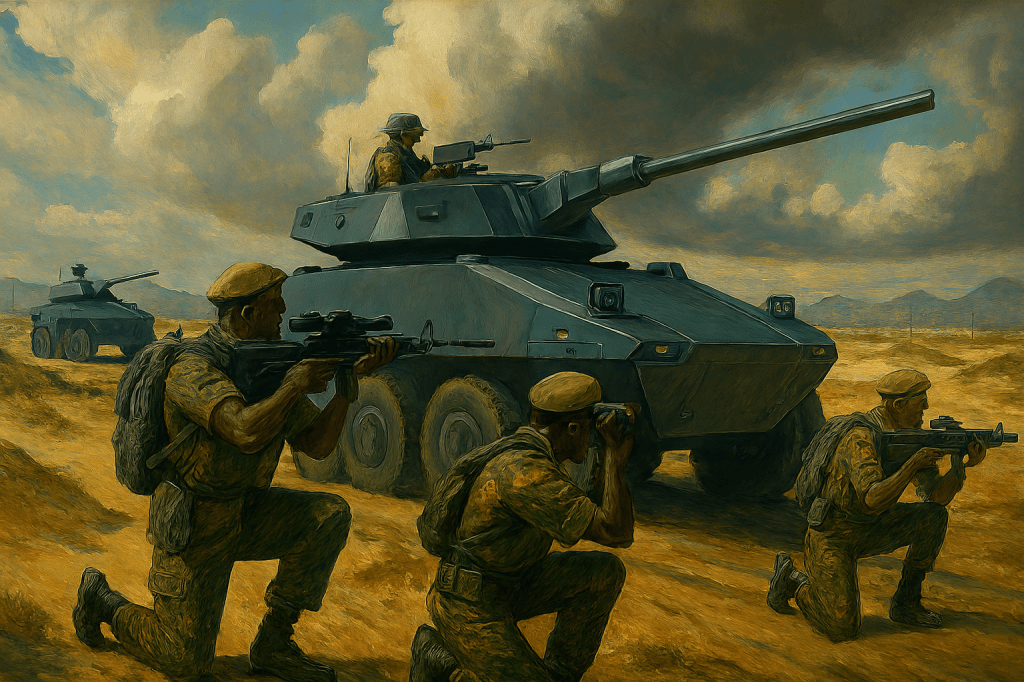
📍 Berrechid, Morocco — India just opened its first-ever defence manufacturing facility on African soil. Not in Delhi. Not in Mumbai. But in the industrial outskirts of Casablanca. The factory will produce armoured vehicles for the Indian Army—and for Morocco. And maybe, soon, for the rest of Africa.
This isn’t just a story about steel and strategy. It’s about power, trust, and the shifting tectonic plates of global influence. And yes, it’s about how young people in Rotterdam—whether you’re into politics, tech, activism or just trying to make sense of the world—are connected to what’s happening thousands of kilometres away.
Let’s break it down.
🛠️ From Ladakh to Casablanca: What’s Being Built?
The factory, spanning 20,000 square metres, is a joint venture between India’s Tata Advanced Systems and its Defence Research and Development Organisation (DRDO). It will produce the WhAP 8×8—a modular armoured vehicle that’s already in use by the Indian Army in Ladakh, a tense border region near China.
The WhAP isn’t a tank. It’s more like a Swiss Army knife on wheels. It can be configured as:
- An infantry fighting vehicle
- A troop transport
- A battlefield ambulance
It’s amphibious, heavily armoured, and equipped with a 30mm cannon and optional anti-tank missiles. Think: mobility meets firepower. Morocco will start receiving its own units next month, and the factory aims to produce up to 100 vehicles per year.
🌍 Why Morocco?
India could’ve kept production at home. But choosing Morocco is a strategic move. Here’s why:
- Geopolitical location: Morocco sits at the crossroads of Africa, Europe and the Atlantic. It’s a gateway to multiple continents.
- Infrastructure: Morocco has one of Africa’s most advanced industrial bases, with skilled labour and export-ready ports.
- Diplomatic ties: India and Morocco signed a new defence cooperation agreement, signalling long-term collaboration.
This isn’t just outsourcing. It’s embedding. India is planting roots in Africa—not just selling weapons, but building them there. That’s a whole different level of influence.
🤝 Weapons as Diplomacy
India’s move isn’t just about military tech. It’s about soft power through hard tools. By producing weapons in Africa, India is positioning itself as a reliable, cost-effective alternative to traditional arms suppliers like the US, Russia, China and Turkey.
Here’s what makes India’s approach different:
- Technology transfer: Morocco isn’t just buying; it’s building. That means jobs, skills and autonomy.
- Training and exercises: India is conducting joint naval drills with Tanzania and offering military training to African officers.
- No strings attached: India’s pitch is simple: “Make with friends, make for the world.” It’s not about debt traps or political leverage.
For many African nations, this is appealing. It’s a way to modernize defence without becoming dependent on superpowers with hidden agendas.
⚖️ Is This Good News?
Depends who you ask.
✅ The optimist says:
- More choice in the global arms market is a good thing.
- India’s democratic model and emphasis on partnership make it a safer bet than authoritarian suppliers.
- Local production empowers African nations and reduces reliance on imports.
⚠️ The sceptic says:
- Militarization can overshadow humanitarian and civil cooperation.
- India’s own internal politics—marked by rising nationalism and minority tensions—could complicate its image abroad.
- Once weapons start flowing, it’s hard to control where they end up.
India’s defence export strategy is still young. But it’s growing fast. And with growth comes complexity.
🇮🇳 India in BRICS: A Balancing Act
India is a key member of BRICS—a bloc that now includes Brazil, Russia, China, South Africa, and new entrants like Iran, Saudi Arabia and the UAE. BRICS is evolving from a symbolic alliance into a real geopolitical force.
India’s role? Bridge-builder.
It maintains strong ties with Russia, cooperates with China (despite tensions), and engages with the West through the Indo-Pacific Quad (with the US, Japan and Australia). India doesn’t pick sides. It builds platforms.
This makes India’s defence outreach in Africa even more significant. It’s not about choosing East or West. It’s about creating a third way—a multipolar world where influence is shared, not dominated.
🧠 Why Should Rotterdam Care?
You might be thinking: “Cool story, but what does this have to do with me?”
Here’s the thing:
- Rotterdam is a global port city. What happens in Africa, Asia or the Middle East affects trade, migration, and diplomacy here.
- Many of us have roots in countries that are directly impacted by India’s rise—Morocco, Suriname, India, Pakistan, Ghana, Egypt.
- The questions India’s move raises—about power, trust, and global cooperation—are the same ones we ask in our own communities.
Plus, let’s be real: we’re living in a time where the world feels more connected than ever, but also more fragmented. Understanding how countries like India are reshaping global dynamics helps us make sense of our own place in it.
🎯 Final Thoughts: A Factory as a Statement
India’s new defence plant in Morocco isn’t just about vehicles. It’s about vision. It’s a statement that India is ready to play on the global stage—not just as a buyer, but as a builder. Not just as a partner, but as a producer.
For Africa, it’s a chance to redefine defence partnerships. For Europe, it’s a signal that influence is shifting. And for young people in Rotterdam, it’s a reminder that global politics isn’t something that happens “over there.” It’s happening everywhere—including in the factories of Berrechid, the ports of Rotterdam, and the conversations we have about what kind of world we want to live in.
So next time you hear about a weapons deal or a defence pact, don’t tune out. Tune in. Because behind every armoured vehicle is a story about who gets to shape the future—and how.


 Dutch Echo
Leave a comment