

October 31st. The night when the veil between worlds thins. At least, that’s what the Celts believed over two millennia ago. Today, Halloween is a visual spectacle of pumpkins, costumes, and candy — from Brooklyn brownstones to the alleyways of Crooswijk. But how did this ritual begin? Why do we celebrate it in the Netherlands, a country with no historical Halloween tradition? And what does this evolving feast say about how we deal with memory, commerce, and collective imagination?
This isn’t a call to action. It’s a cultural deep dive — from ancient Ireland to modern Rotterdam, with stops in Suriname and Flanders. Because Halloween isn’t just spooky. It’s a mirror.
🔥 Samhain: The Celtic Origin Story
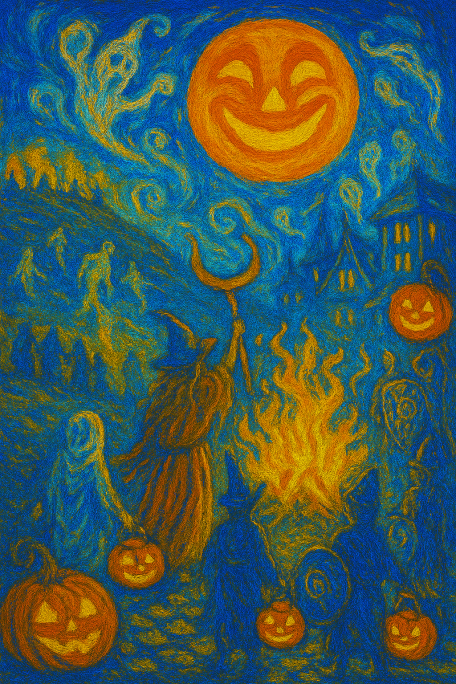
Long before Halloween became a commercial juggernaut, the Celts of Ireland and Scotland celebrated Samhain. Held at sunset on October 31st, Samhain marked the end of summer and the beginning of the dark half of the year.
The Celts believed that on this night, the boundary between the living and the dead grew thin. Spirits could return, and people dressed in animal skins or eerie disguises to ward off malevolent entities. Bonfires blazed on sacred hills, offerings were made, and druids — spiritual leaders — performed rituals to honor ancestors and prepare for winter.
Advertisements
Samhain wasn’t about horror. It was about transition. A moment to reflect, reconnect with the dead, and brace for the cold months ahead.
✝️ All Hallows’ Eve: Christianity’s Remix
As Christianity spread across Europe, missionaries didn’t erase Samhain — they absorbed it. In the 8th century, Pope Gregory III declared November 1st as All Saints’ Day. The evening before became All Hallows’ Eve — eventually shortened to Halloween.
Instead of banning the old rituals, the Church rebranded them. Spirits became souls. Bonfires turned into candlelit vigils. Masks remained, but gained religious undertones. The result? A hybrid celebration: part pagan, part Christian, fully mystical.
This fusion allowed Halloween to survive — not as a relic, but as a living ritual that adapted to new beliefs and power structures.
🇺🇸 The American Reinvention
In the 19th century, Irish and Scottish immigrants brought their Halloween customs to the United States. There, the feast underwent a radical transformation.
America secularized and commercialized Halloween. It became a holiday of:
- Trick-or-treating: Kids in costume knocking on doors for candy.
- Jack-o’-lanterns: Pumpkins carved with spooky faces.
- Costume parties: From sexy witches to blood-soaked zombies.
- Horror films and haunted houses: Halloween became a visual and emotional thrill ride.
Fueled by Hollywood and retail, Halloween in the U.S. became a celebration of fear, fantasy, and consumption. And it worked. The American version of Halloween spread globally — not through missionaries, but through media, marketing, and pop culture.
🌍 Back to Europe — and Into the Netherlands
Halloween didn’t return to Europe as a spiritual revival. It came back as a cultural export. In the Netherlands, the holiday began to surface in the 1990s and 2000s — first as a niche curiosity, then as a mainstream event.
Today, Halloween is everywhere in Rotterdam:
- In Crooswijk, neighborhood groups organize trick-or-treat routes.
- In Delfshaven, pumpkins are handed out at food banks as visual treats.
- In the city center, clubs, escape rooms, and cafés host Halloween parties.
- In schools, Halloween is used as a creative day — with face painting, storytelling, and costume design.
The Netherlands never had Samhain. No All Hallows’ Eve. But Halloween found fertile ground — not because of religion, but because of atmosphere, imagination, and connection.
🎭 What Does Halloween Look Like in the Netherlands?
Halloween in the Netherlands is a mix of childlike fun, visual expression, and adult escapism. Here’s how it plays out:
For kids:
- Costume parties at school
- Trick-or-treat routes in family-friendly neighborhoods
- Pumpkin carving and decorating
- Ghost stories and craft activities
For adults:
- Halloween parties in clubs and bars
- Horror movie marathons
- Escape rooms and haunted houses
- Costume contests with prizes
For businesses:
- Supermarkets sell Halloween-themed products
- Garden centers offer pumpkins and decorations
- Retailers tap into the visual hype with spooky displays
Halloween in the Netherlands isn’t religious. It’s cultural — a moment of creativity, commerce, and collective fantasy.
🧠 Why Does Halloween Work Here?
You might think: the Netherlands is pragmatic, rational, Protestant. Why would pumpkins and ghosts catch on?
Because Halloween taps into something universal:
- The need for imagination: In a world of deadlines and data, Halloween offers an escape.
- The power of visual storytelling: Costumes, pumpkins, and decorations make abstract themes tangible.
- The drive for connection: Halloween is a neighborhood event, a group activity, a moment of togetherness.
- The allure of darkness: Fear is thrilling. And in a safe context — like Halloween — even fun.
Halloween isn’t an American invasion. It’s a reflection of our times: visual, communal, and a little spooky.
🌎 Suriname and Flanders: Halloween’s Global Echo
In Suriname, Halloween is mostly visible in Paramaribo — among international schools and expat communities. Local entrepreneurs are catching on, hosting themed parties and selling decorations. But it’s not yet a national phenomenon.
In Flanders, Halloween is more established. Cities like Ghent, Antwerp, and Leuven host trick-or-treat routes, pumpkin markets, and horror nights. Flemish youth embrace Halloween as a creative celebration — detached from religion, but rich in atmosphere.
Across borders, Halloween adapts. It’s not a fixed ritual. It’s a flexible mirror — reflecting local culture, global trends, and generational shifts.
🌀 From Samhain to Dutch Echo: What Does Halloween Say About Us?
Halloween isn’t just a party. It’s a cultural lens.
- In Celtic times, it was a spiritual transition.
- In Christian times, a religious preparation.
- In American times, a commercial spectacle.
- In Rotterdam, it’s a visual ritual — a moment of connection, imagination, and play.
And at Dutch Echo? Halloween is a storytelling opportunity. A chance to explore tradition, transformation, and the power of image. A way to show how an ancient ritual finds new meaning — from Irish hills to Rotterdam streets.
🎬 Final Thoughts: What Lingers After the Masks Come Off?
Halloween isn’t a trend. It’s a phenomenon that keeps evolving. In the Netherlands, Suriname, and Flanders, it’s growing — not as a religious event, but as a ritual of imagination.
So whether you’re carving a pumpkin, putting on a mask, or just soaking in the vibe: Halloween belongs to you. To us. To anyone who dares to dance between light and shadow.
And tomorrow? It’s November. The start of winter. But tonight — tonight we celebrate the veil. Between worlds. Between people. Between past and future.
 Dutch Echo
Leave a comment