

Rotterdam is a city of contrasts. It’s bold and modern, yet deeply rooted in history. It’s international, yet unmistakably local. And if there’s one street that captures all of that — the grit, the soul, the flavor — it’s the 1e Pijnackerstraat in the Oude Noorden (Old North). Stretching just a few hundred meters, this street is a microcosm of Rotterdam itself: multicultural, resilient, and full of life.
For locals, it’s a familiar rhythm. For visitors, it’s a hidden gem. And for anyone with a connection to the Netherlands — whether you’re in Paramaribo, Antwerp, or New York — it’s a street worth knowing.
🕰️ A Street Built on History
The 1e Pijnackerstraat was officially named in 1889, part of a wave of urban expansion as Rotterdam grew into a major port city. It was built as a working-class neighborhood, with modest homes and minimal architectural regulation. That mix gave the street its unique look — a patchwork of facades, each with its own story.
But the street’s significance goes far beyond bricks and mortar. During World War II, the 1e Pijnackerstraat became a quiet center of resistance. In the building of the Dutch Reformed Church, a group called Geloof en Vrijheid (“Faith and Freedom”) met in secret. Led by Reverend Jacob Jan Hamelink, they distributed anti-Nazi pamphlets, sheltered Jewish families, and spoke out against fascism.
On October 18, 1942, the Gestapo raided the church. Hamelink and two others — Emanuel Zwitser and Teunis van Est — were arrested and later executed. Today, a bronze memorial by artist Loeki Metz hangs on the church wall, shaped like a torch, bearing their names. It’s a quiet reminder that resistance lives in ordinary places.
🍛 Ka-Yin: Surinamese Soul Food
If you ask anyone in the neighborhood where to eat, chances are they’ll point you to Ka-Yin, a Surinamese-Chinese restaurant at 1e Pijnackerstraat 83-C. It’s not flashy, but it’s legendary. The roti is rich and spicy, the moksi meti is packed with flavor, and the portions are generous.
What makes Ka-Yin special isn’t just the food — it’s the people. Surinamers from Tilburg, Den Bosch, Dordrecht, and even Amsterdam travel to Rotterdam just to eat here. It’s a place of reunion, of storytelling, of shared heritage. You’ll hear Dutch, Sranan Tongo, and laughter echoing through the dining room.
Ka-Yin isn’t just a restaurant. It’s a cultural anchor.
🍷 Tosca: Mediterranean Vibes at Brancoplein
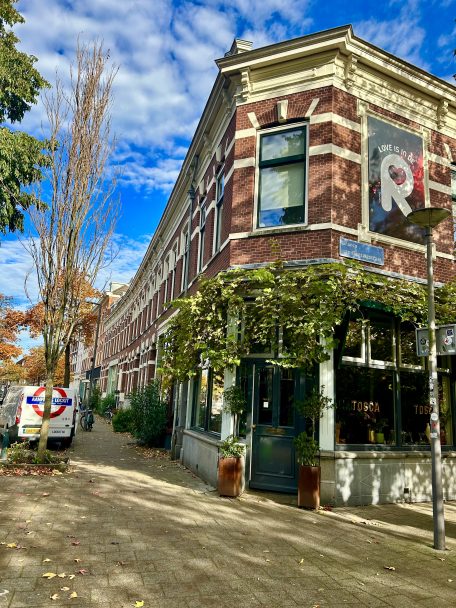
A few doors down, near the Brancoplein, sits Restaurant Tosca — a Mediterranean escape in the middle of the Old North. Run by Akko Dallinga and Céline Maessen, Tosca offers a menu inspired by Italy, Spain, Portugal, and France. Think fresh pasta, seasonal vegetables, and wines that make you linger.
The terrace is shaded by grapevines, the vibe is relaxed, and the food is elegant without being pretentious. It’s the kind of place where locals celebrate birthdays, couples share quiet dinners, and artists sketch between courses.
Tosca is proof that the Old North isn’t stuck in the past — it’s evolving, beautifully.
🌿 De Huyskamer: Quality and Calm
For those seeking a different kind of experience, there’s De Huyskamer, a coffeeshop at 118-A. Known for its high-quality cannabis, De Huyskamer attracts a loyal crowd. Yes, the prices are a bit higher than average, but the product and service make it worth it.
What’s interesting is the clientele: not just locals, but visitors from across the Netherlands. Surinamers from other cities often stop by before heading to Ka-Yin or Café De Toekomst. The vibe is chill, respectful, and welcoming — a far cry from the chaotic coffeeshops in the city center.
De Huyskamer is where you go to unwind, reflect, and feel at home.
🍺 Two Cafés, Two Cultures
The 1e Pijnackerstraat is home to two iconic cafés, each with its own flavor:
- On the Zwart Janstraat side, there’s a classic Rotterdam bruincafé — likely Café Centraal. It’s old-school, with wooden stools, billiards, and regulars who’ve been coming for decades. The conversations are in thick Rotterdam dialect, the humor is dry, and the beer is cold.
- On the Zaagmolenstraat end, you’ll find Café De Toekomst. This is a Surinamese hotspot, where people from all over the country gather. The music is lively, the atmosphere warm, and the sense of community is strong. It’s not unusual to see people dancing, debating, and sharing stories late into the night.
Together, these cafés represent the duality of Rotterdam: traditional and multicultural, nostalgic and vibrant.
🧠 Care and Community: Antes and Pameijer
The street isn’t just about food and fun — it’s also a place of care and recovery. At 102–106, you’ll find Antes, a residential facility offering intensive support for people with mental health challenges. Residents live in private rooms, share common spaces, and receive daily guidance from trained staff.
Next door, at 100B, is Pameijer, a center for daytime activities and social support. Known as Het Nieuwe Spoor, it’s a place where people come to connect, create, and grow. Whether it’s art, conversation, or simply a cup of coffee, Pameijer offers a safe space for healing.
These institutions remind us that urban life includes vulnerability — and that community means caring for each other.
💻 Eric from KaayPC: Tech with a Human Touch
And then there’s Eric van der Kaay, the man behind KaayPC at 138a. Eric is a self-taught computer expert who’s been fixing laptops, building gaming rigs, and solving tech mysteries for years. His shop is small, but his reputation is big.
What sets Eric apart is his personal approach. He doesn’t talk in jargon. He listens, explains, and treats every customer with respect. Whether you’re a gamer, a student, or a retiree, Eric makes tech feel human.
KaayPC is more than a repair shop — it’s a neighborhood institution.
🧭 A Street That Reflects Rotterdam
So what does the 1e Pijnackerstraat tell us about Rotterdam?
- It’s multicultural: Surinamese, Dutch, Italian, Chinese — all living, eating, and working side by side.
- It’s resilient: From wartime resistance to modern recovery, the street has seen it all.
- It’s creative: From Tosca’s cuisine to Eric’s tech wizardry, innovation thrives here.
- It’s connected: People come from across the country to visit, meet, and celebrate.
This street isn’t curated for tourists. It’s lived in, loved, and layered. It’s where Rotterdam’s soul shows itself — not in skyscrapers, but in stories.
🌍 Why It Matters Beyond Rotterdam
For readers outside the Netherlands — especially in Suriname, Belgium, and the Dutch Caribbean — the 1e Pijnackerstraat is a reminder of how diaspora and identity shape cities. It’s a place where cultures meet, where heritage is preserved, and where new traditions are born.
Whether you’re a Surinamese student in Groningen, a Belgian artist in Amsterdam, or a Dutch expat in Curaçao — this street speaks to you. It’s about belonging, about roots, and about the everyday magic of urban life.
📌 Final Thoughts
The 1e Pijnackerstraat isn’t famous. It’s not in guidebooks. But it’s real. It’s where people live, laugh, struggle, and thrive. It’s where history whispers from the walls, and where the future is being quietly built — one meal, one repair, one conversation at a time.
So next time you’re in Rotterdam, skip the skyline. Walk down the 1e Pijnackerstraat. Listen. Taste. Feel. Because this street doesn’t just represent the city.
It is the city.


 Dutch Echo
Leave a comment