
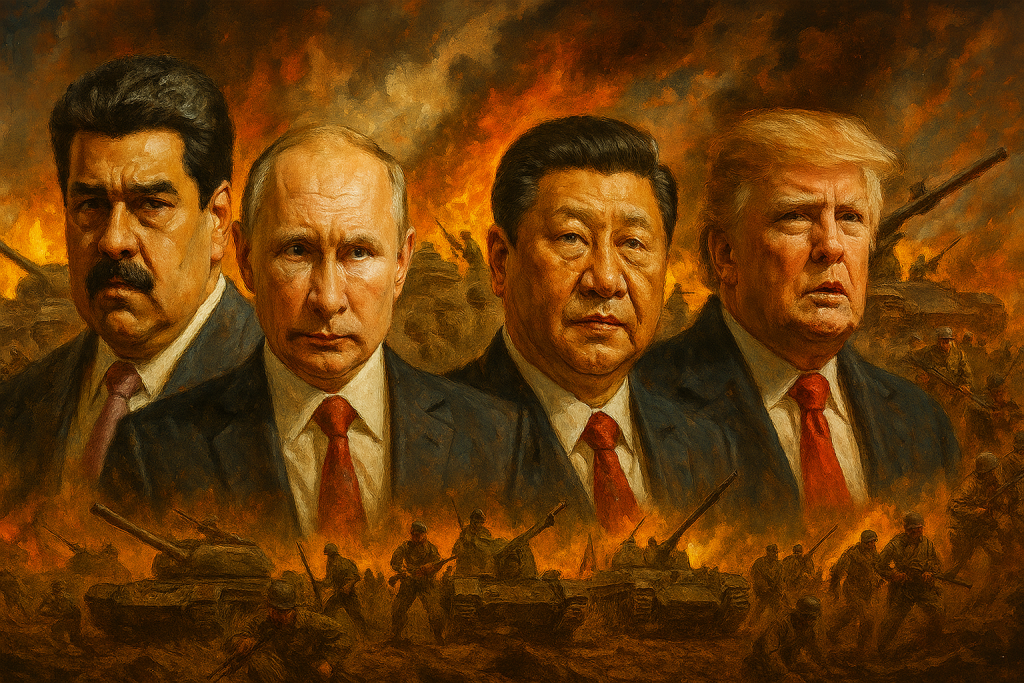
Walk through Rotterdam on a rainy evening and you’ll hear conversations about music, housing, climate, and sometimes—politics far beyond Europe. For many of us, the United States feels like a distant stage where dramas unfold that still shape our lives. Right now, one of those dramas is playing out in Latin America, and it says a lot about the state of American power in the world.
Donald Trump, back in the White House, has been talking tough about Mexico’s drug cartels. He’s hinted at military action, drone strikes, and treating cartels like terrorist organizations. At first glance, it sounds like a straightforward “war on drugs.” But if you look closer, it’s tangled up with Venezuela, China, Russia, and the fading glow of America’s old dominance.
This isn’t just about cocaine routes or fentanyl labs. It’s about whether the United States still calls the shots in the Western Hemisphere—or whether we’re watching the last convulsions of a superpower that once believed the Monroe Doctrine gave it ownership of Latin America.
The Monroe Doctrine: From Glory to Ghost
Back in 1823, the Monroe Doctrine declared that Europe should stay out of the Americas. For nearly two centuries, Washington used it to justify interventions, coups, and regime changes across Latin America. From Guatemala to Chile, from Nicaragua to Panama, the U.S. acted like the hemisphere was its backyard.
Advertisements

But fast forward to today, and the picture looks very different. China is now the biggest trading partner for many Latin American countries. Russia is shipping weapons and sending military advisors to Venezuela. And the U.S.? It’s struggling to keep its grip.
Trump’s threats against Mexico’s cartels sound tough, but they also reveal weakness. If America really had uncontested power, it wouldn’t need to shout. The fact that Trump is talking about drone strikes across the border shows desperation more than dominance.
Mexico: More Than Just Cartels
Let’s be real: Mexico’s cartels aren’t just gangs with guns. They’re woven into the fabric of politics, local economies, and even communities. In some regions, cartels provide jobs, protection, and social services that the state fails to deliver.
That means fighting cartels isn’t just about sending in soldiers. It’s about confronting corruption, poverty, and the blurred line between government and organized crime. If the U.S. tried to “defeat” the cartels militarily, it would also be fighting parts of the Mexican state itself.
And Mexico isn’t exactly eager to invite American troops. President Claudia Sheinbaum has already made clear that U.S. military action without Mexico’s consent is unacceptable. For ordinary Mexicans, American intervention feels less like help and more like a violation of sovereignty.
So when Trump talks about “taking out” the cartels, it sounds naïve. The U.S. has the firepower, sure. But the problem is political, social, and economic. Bombs don’t fix corruption. Drones don’t erase poverty.
Venezuela: The Real Target?
Here’s where things get interesting. While Trump talks about Mexico, analysts suspect the real focus is Venezuela.
Venezuela has been a thorn in Washington’s side for years. Under Nicolás Maduro, the country has resisted U.S. pressure, survived sanctions, and leaned heavily on allies like China and Russia. For Trump, Venezuela represents both a challenge and an opportunity: topple Maduro, and America reasserts its dominance in the hemisphere.
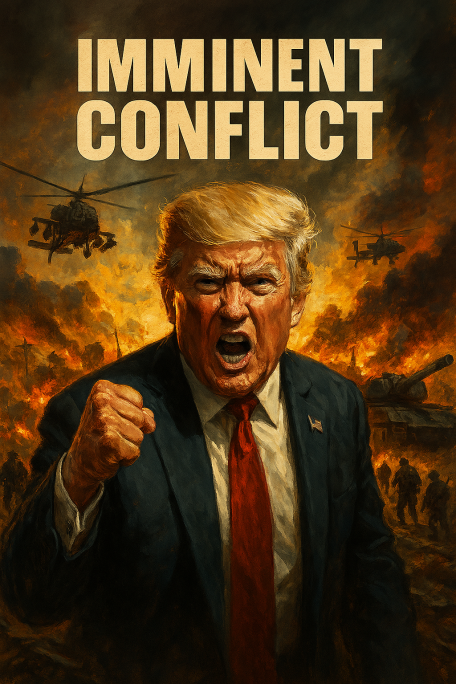
But regime change is messy. So instead of saying outright “we want Maduro gone,” Trump frames it as part of the war on drugs. Venezuela is accused of being a hub for cocaine trafficking. By linking Venezuela to the same narrative as Mexico’s cartels, Trump can justify military pressure without admitting it’s about geopolitics.
It’s a classic move: use the language of crime and security to mask the reality of power politics.
China and Russia: New Players in the Game
While Trump flexes, China and Russia are quietly reshaping the map.
- China has poured billions into Venezuela’s oil industry. It installed a floating oil platform in Lake Maracaibo and now buys more than 90% of Venezuela’s exports. For Beijing, Venezuela is both an energy source and a geopolitical foothold near the U.S. border.
- Russia has stepped in with military support. Wagner mercenaries have been spotted in Caracas. Russian transport planes have delivered equipment. And Moscow has promised to repair Venezuela’s fighter jets and upgrade its radar systems.
Together, China and Russia give Maduro the lifeline he needs to survive. And they send a clear message: the Monroe Doctrine is dead. Latin America is no longer America’s exclusive playground.
The U.S. vs. the Cartels: Could They Win?
Let’s imagine Trump actually orders military strikes against Mexico’s cartels. Could the U.S. win?
Militarily, yes. The U.S. has drones, satellites, special forces, and overwhelming firepower. Cartels wouldn’t stand a chance in open battle.
But wars aren’t just about battles. They’re about politics, legitimacy, and what comes after. Destroy one cartel, and another rises to take its place. Arrest a leader, and lieutenants fight for control. As long as the demand for drugs in the U.S. stays high, supply will find a way.
And if American bombs fall on Mexican soil, the backlash could be huge. Anti-American sentiment would spike. Mexico’s government might resist cooperation. The region could destabilize.
So yes, the U.S. could “win” militarily. But it wouldn’t solve the problem. It might even make it worse.
Europe’s View: Time to Look After Ourselves
From Rotterdam, this all feels both far away and strangely close. Europe has long relied on the U.S. for security through NATO. But if Trump is busy with Mexico and Venezuela, and if America’s power is fading, what does that mean for us?
It means Europe has to think seriously about autonomy. About building its own defense capacity. About securing energy without relying on unstable geopolitics. About shaping its own narrative instead of reacting to Washington’s.
For young adults in Rotterdam, this isn’t abstract. It’s about the world we’ll inherit. A world where the U.S. is no longer the unquestioned leader, and where Europe has to step up.
Trump: Naïve or Strategic?
So is Trump naïve, or is he playing a deeper game?
- Naïve: He talks as if cartels can be bombed out of existence, ignoring the complexity of Mexico’s reality.
- Strategic: By framing everything as a war on drugs, he creates a cover for pressuring Venezuela and countering China and Russia.
Maybe it’s both. Maybe Trump’s rhetoric is simplistic, but the underlying strategy is about reasserting American power in a world where that power is slipping.
America’s Last Convulsions?
In the end, Trump’s threats against Mexico and Venezuela look less like confident policy and more like the last convulsions of a fading empire.
The U.S. still has unmatched military strength. But strength doesn’t equal control. Latin America is no longer America’s backyard. China and Russia are inside the fence. Mexico resists intervention. Venezuela survives sanctions.
For young people in Rotterdam, the lesson is clear: we’re living in a multipolar world. The U.S. is still powerful, but not all-powerful. And when Trump shouts about cartels, it may be less about solving problems and more about masking decline.
Final Thoughts
Think of it this way: the Monroe Doctrine once made America the sheriff of the hemisphere. Today, that sheriff is old, tired, and facing rivals who don’t play by his rules. Trump’s war on drugs is less about cocaine and more about clinging to influence.
Whether you’re in Rotterdam, Caracas, or Los Angeles, the story is the same: power is shifting. The U.S. is no longer the sole conductor of the global orchestra. And the noise coming from Washington may be the sound of an empire trying to hold on to a tune that’s slipping away.


 Dutch Echo
Leave a comment