
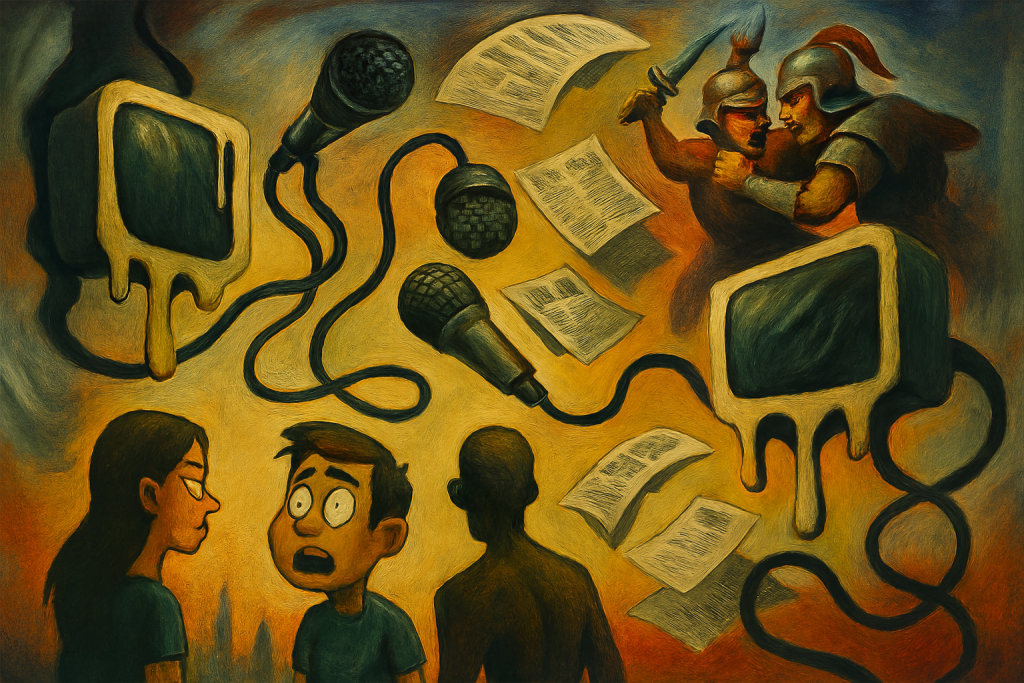
Rotterdam – Walk through Rotterdam and you’ll feel the tension between tradition and modernity, between provincial codes and urban freedom. For young adults today, life is shaped not just by jobs, housing, or nightlife, but by the deeper structures of upbringing, media, and authority. To understand how we got here, you need to rewind: back to the cartoons, the after-school programs, and the managers who redefined what power meant.
📺 Childhood on Screen: From Common Sense to Competition
In the 1970s and 1980s, afternoons were filled with shows like Bassie & Adriaan, the Berenboot, or reruns of the Flintstones. These weren’t just entertainment; they were lessons in problem-solving. The message was simple: use common sense, work together, and you’ll find a way out.
By the mid-1990s, the vibe shifted. Kids tuned into SpongeBob SquarePants, drenched in neurotic humor and exaggerated flaws. Johnny Bravo turned disrespect toward women into a running gag. Dexter’s Laboratory thrived on rivalry. And then came the wave of action-driven series: Dragon Ball Z, Pokémon, and the Teenage Mutant Ninja Turtles. These shows celebrated competition, conflict, and the idea that violence could be justified if it led to growth or victory.
The shift mirrored a broader cultural change: from pedagogy to spectacle, from collective problem-solving to individual triumph.
Advertisement

🏫 After-School Care and the Rise of the Manager
Around the same time, after-school care became a structural part of Dutch society. Kids spent more time outside their family homes, shaped by institutions rather than parents. Most parents themselves came from smaller families—two or three children at most—so the collective upbringing of earlier generations was already fading.
Then, in the early 2000s, came the care manager. This wasn’t a teacher or caregiver but a bureaucratic authority with power over teams. In practice, it often meant toxic leadership: inserting at least one disruptive team member to ensure constant crisis, fostering mistrust, and keeping groups unstable.
For children, this translated into daily exposure to environments where adults didn’t trust each other, where crisis was normal, and where authority felt manipulative rather than protective.
⚠️ What That Did to Us
The effects are visible today:
- Authority lost its automatic respect. Where adults once ended conflicts simply by stepping in, now their presence can escalate tension.
- Group pressure dominates. In large groups, individual responsibility dissolves. The crowd decides, and the crowd can turn violent.
- Stress became normalized. Growing up in constant crisis environments made anxiety and burnout more common.
- Self-protection over trust. Instead of relying on groups, many learned to rely only on themselves.
One chilling example: in the past, if parents intervened in a fight between teenagers, the teens would back down. Today, there are cases where parents themselves are attacked by groups of 15 or more teenagers, simply for trying to protect their child. That’s not just a story of violence—it’s a story of how authority has been redefined.
🌆 Province vs. City: Different Codes, Same Friction
The divide between provincial life and urban life adds another layer. In the province, group loyalty is absolute. Together out, together home. If you’re in, you’re all in—even in conflict. You can’t have a fight without the whole group backing you, because otherwise you wouldn’t have been accepted in the first place.

In Rotterdam, things are looser. You can leave early, switch circles, or decide not to get involved. Identity isn’t locked into one group. But when provincial codes enter the city, friction is inevitable. Imagine being woken up at night by a neighbor complaining that your toilet flush disturbed their sleep. Or having a guest over, only to be interrupted by a neighbor hinting that their child needs quiet to sleep. In the city, that feels intrusive. In the province, it’s normal.
🗣️ Public Voices and Their Weight
This is where figures like Jan Roos and Bender come in. Jan’s cynical style—his constant “zeiken”—can cut through hypocrisy, but it risks clashing with a generation raised in a different context. Bender, on the other hand, shows he’s willing to learn, to reflect, and that resonates more with audiences who crave authenticity.
The point isn’t whether cynicism or reflection is better. It’s that satire and commentary have to adapt to a generation shaped by after-school care, toxic leadership, and media repetition. Irony doesn’t land the same way when your upbringing taught you to distrust authority and question every slogan.
📺 Media Repetition and the Loss of Critical Thought
Turn on the TV or scroll through social media, and you’ll see it: slogans repeated endlessly, soundbites recycled until they lose meaning. This isn’t just politics—it’s advertising, entertainment, even news. The repetition dulls critical thinking. Instead of stimulating the mind, it floods it with noise.
For young adults in Rotterdam, this is the backdrop of daily life. You’re not just navigating jobs, housing, or relationships—you’re navigating a media environment that constantly tells you what to think, while rarely encouraging you to think deeper.
🌍 Beyond Rotterdam: The Dutch and Flemish Context
The same tension exists across the Netherlands and in Flanders: provincial traditions colliding with urban modernity, institutions shaping childhood more than families, and media saturating daily life with repetition.
Everywhere, the pattern repeats: young adults growing up in systems where authority is questioned, media is repetitive, and upbringing is fragmented between family and institutions.
🔑 The Bigger Picture
So what does all this mean? It means that the generation walking Rotterdam’s streets today isn’t simply “different” from their parents. They’re the product of a cultural shift:
- From problem-solving to competition.
- From parental authority to institutional management.
- From respect for adults to confrontation with them.
- From critical thought to media repetition.
It’s not about blaming parents, teachers, or even cartoons. It’s about recognizing that the structures shaping childhood have changed—and those changes echo into adulthood.
📝 Closing Thoughts
Rotterdam is a city of contrasts: provincial newcomers, urban natives, and young adults shaped by global media. To understand the energy of this generation, you have to see the layers: the cartoons that taught competition, the after-school care that normalized crisis, the managers who redefined authority, and the media that repeats slogans until they lose meaning.
This isn’t nostalgia for Bassie & Adriaan or condemnation of SpongeBob. It’s a reminder that upbringing, media, and power aren’t neutral. They shape how we see authority, how we handle conflict, and how we trust—or don’t trust—the world around us.
And in Rotterdam, you feel that every day.


 Dutch Echo
Leave a comment