
Introduction
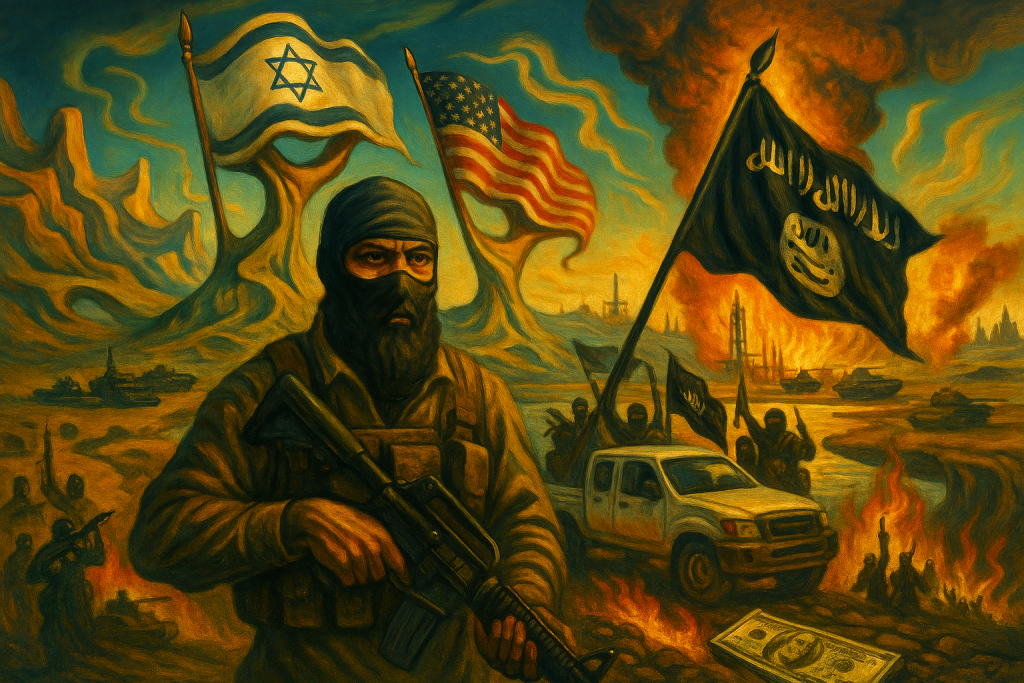
Rotterdam – Scroll through your feed and you’ll see the same images over and over: masked fighters waving rifles, convoys of shiny Toyota trucks, propaganda clips filmed on iPhones, and dollar bills changing hands in dusty warzones. The narrative is familiar—jihadist groups claiming to fight for faith, freedom, or resistance. But look closer, and the patterns start to feel off.
Why do groups like Hamas or Hay’at Tahrir al‑Sham (HTS) spend most of their energy fighting regimes already targeted by the West, while rarely striking at Israel or Western capitals? Why do Western-made weapons and vehicles keep showing up in their arsenals? And why do their actions so often end up justifying Western interventions or Israeli expansion?
This isn’t about conspiracy theories—it’s about recognizing contradictions. When ideology and practice don’t line up, suspicion grows. And in today’s hyper-connected world, those suspicions spread fast.
The Jolani Paradox
Take Abu Mohammad al‑Jolani, the Syrian jihadist leader who once headed al‑Nusra Front, later rebranded as HTS. His rhetoric painted Israel and the West as enemies. Yet in practice, his fighters focused almost entirely on Assad’s regime and rival groups inside Syria.
Advertisement


Fast forward to today: Jolani is trying to reinvent himself as a local opposition leader in Idlib. Western think tanks and media outlets have even interviewed him, presenting him as a pragmatic figure rather than a global terrorist.
It’s a paradox that leaves many uneasy. Thousands of civilians—mostly Muslims—died in battles involving HTS. Yet Jolani now enjoys a degree of recognition, not because he changed his past, but because his current role aligns with Western interests: weakening Assad without directly threatening Israel.
Hamas as a Convenient Enemy
In Gaza, Hamas plays a different but equally paradoxical role. Their rocket attacks and militant operations are framed as resistance. But each strike provides Israel with justification for new military campaigns, tighter blockades, and further territorial control.
For Israel, Hamas is both a threat and a tool. Their existence legitimizes harsh responses. Their actions, however destructive for Palestinians, often strengthen Israel’s geopolitical position.
It’s a cycle that repeats itself: Hamas fires rockets, Israel retaliates, the world watches, and the map shifts a little more in Israel’s favor.
Dollars, Weapons, and Tech
Look at the details and the contradictions sharpen:
- US Dollars: Fighters from Europe and beyond were often paid in dollars. It’s the global currency, but its dominance in warzones raises eyebrows.
- Western Weapons: Rifles, vehicles, and even armored gear of Western origin ended up in jihadist hands. Sometimes through direct supply to “moderate rebels,” sometimes through black markets.
- Toyota Trucks: Reliable, durable, and strangely ubiquitous. Convoys of brand-new pickups became the symbol of jihadist mobility.
- iPhones and Filters: Propaganda videos weren’t grainy underground tapes. They were slick productions, edited with Western tech, designed to shock and spread globally.
These aren’t random coincidences. They point to organized flows of money, goods, and technology. And they reinforce the suspicion that jihadist groups, intentionally or not, serve Western agendas.
Nigeria and the French Connection
In West Africa, similar accusations surface. Nigerian and Nigerien leaders have claimed that France indirectly supports Boko Haram. The evidence is murky, but the suspicion is strong.

What is clear: Boko Haram and its offshoot ISWAP rely on foreign funding. Smuggling, ransom, and informal financial networks keep them alive. That France is singled out reflects broader tensions—Niger and Burkina Faso have cut ties with France and leaned toward Russia. Accusing France of financing jihadists fits that narrative.
Whether true or not, the claim highlights a recurring theme: jihadist groups thrive in geopolitical fault lines, where accusations of hidden support are as powerful as bullets.
Echoes of 9/11
The distrust surrounding jihadist groups mirrors the skepticism around 9/11. Official investigations concluded that the Twin Towers collapsed due to plane impacts and fires. Yet alternative theories persist: videos showing explosions without planes, claims that the aircraft looked oversized, and suspicions of controlled demolition.
Whether you believe those theories or not, the point is clear: when events reshape global politics, people look for hidden agendas. The wars in Afghanistan and Iraq, surveillance laws, and expanded Western military presence all flowed from 9/11. That scale of consequence makes skepticism inevitable.
Cees Hamelink’s Warning
Dutch scholar Cees Hamelink once said there are more professional liars serving political and economic interests than there are journalists. His words resonate here.
Think of the “incubator babies” story in Kuwait, used to justify war in 1990. Or Colin Powell’s UN speech about weapons of mass destruction in Iraq, later exposed as false. These weren’t fringe lies—they were central narratives, broadcast globally, shaping history.
Against that backdrop, it’s no wonder people suspect that jihadist groups are pawns in a larger game.
Proxy Wars and Hidden Agendas
From Libya to Syria, jihadist groups often fight regimes already on Western hit lists. Their funding flows through Gulf states, smuggling networks, and sometimes Western-backed channels.
The result? Regimes weaken, chaos spreads, and Western powers step in. Israel benefits from destabilized neighbors. The West benefits from weakened adversaries. And the groups themselves, while claiming independence, end up serving interests far beyond their stated goals.
Why It Feels Suspicious
- Ideology vs. Reality: Groups declare Israel and the West as enemies but rarely attack them directly.
- Funding Sources: Money often comes from allies of the West.
- Media Narratives: Jihadist violence dominates headlines, overshadowing deeper issues like occupation or systemic injustice.
- Repetition: The same cycle plays out in Afghanistan, Iraq, Syria, and Gaza.
Suspicion isn’t paranoia—it’s pattern recognition.
Living With Contradictions
For those of us scrolling through news in Rotterdam, Berlin, or New York, these contradictions aren’t abstract. They shape the way we see politics, trust media, and interpret global events.
It’s not about being clairvoyant. It’s about noticing when ideology and practice don’t match, when enemies seem too convenient, and when wars produce outcomes that align neatly with Western interests.
Conclusion
Are Hamas and HTS marionettes of the West? Officially, no. Functionally, often yes. Their actions weaken regimes, justify interventions, and reinforce Israeli and Western power.
That doesn’t mean they’re controlled directly. It means their existence and behavior fit into a geopolitical puzzle where their enemies’ enemies benefit most.
In a world of professional liars, propaganda, and endless wars, recognizing these patterns is essential. Not to act, but to understand. Because understanding is the only way to cut through the smoke and see the fire beneath.



 Dutch Echo
Leave a comment