
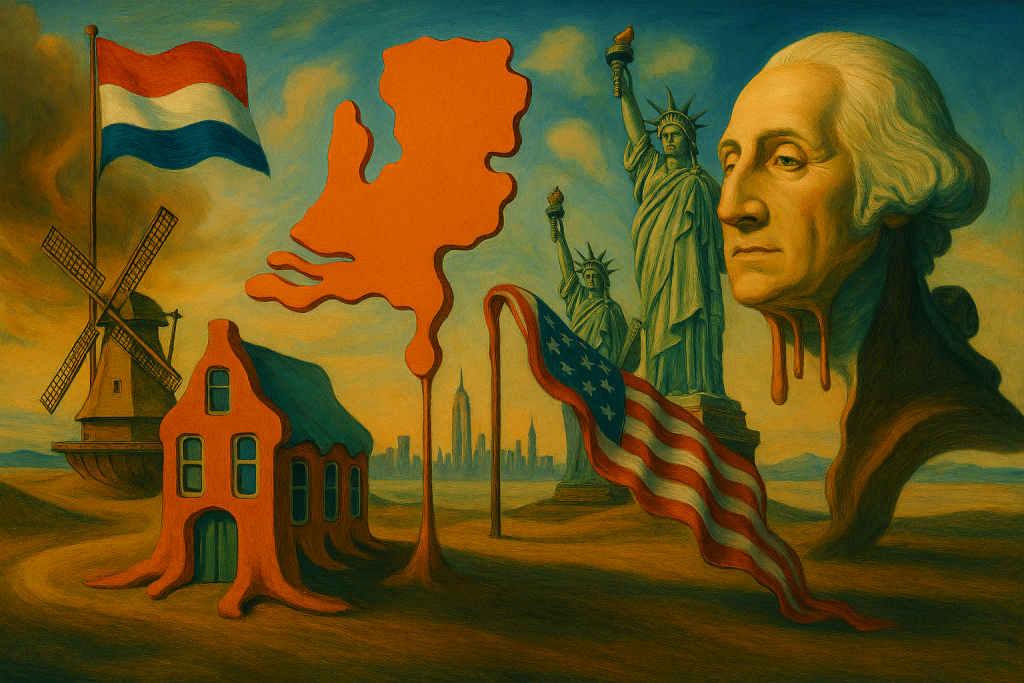
Walk through the streets of New York City and you’ll find traces of Rotterdam, Haarlem, and Vlissingen hidden in plain sight. Brooklyn, Harlem, and Flushing aren’t just quirky names—they’re living reminders of a time when Dutch ships crossed the Atlantic, carrying ambitions, trade goods, and a vision of a world connected by commerce. The story of Nieuw-Nederland, the Dutch colony in North America, is more than a footnote in history. It’s a chapter that ties the Netherlands to the rise of the United States, woven together with the ambitions of Spain, France, England, and other European powers.
This isn’t about nostalgia or national pride. It’s about understanding how a small republic on the North Sea played a role in shaping the global order, and how echoes of that influence still ripple through today’s world.
The Dutch Compass: From Rotterdam to the Hudson
In 1609, Henry Hudson sailed under the flag of the Verenigde Oost-Indische Compagnie (VOC), searching for a passage to Asia. Instead, he found a wide river that would later bear his name. That moment planted the seed for Dutch claims in North America. By 1624, the West-Indische Compagnie (WIC) established settlements along the Hudson and Delaware rivers, creating the colony of Nieuw-Nederland.
The Dutch approach was pragmatic. They weren’t chasing gold like the Spaniards or building grand missions like the French. They wanted trade—beaver pelts, timber, and access to waterways. Nieuw-Amsterdam, founded at the southern tip of Manhattan, became the beating heart of this experiment. It was a city of merchants, sailors, and migrants, a place where languages mixed and cultures collided.
A Patchwork of Powers
To understand Nieuw-Nederland, you have to see the bigger picture. The 17th century was a global chessboard, and North America was one of its contested squares.
Advertisements
- Spain had already carved out vast territories, from Florida to California, building forts and missions to secure its empire.
- France claimed Canada and the Mississippi Valley, weaving alliances with Indigenous nations and trading furs from Quebec to New Orleans.
- England was pushing hard along the Atlantic coast, from Virginia to Massachusetts, hungry for land and resources.
- The Dutch, though smaller in population and military might, punched above their weight thanks to their fleets, financial systems, and sheer determination.
Nieuw-Nederland sat right in the middle of English ambitions. For the Dutch, it was a bridge between Europe and America. For the English, it was an obstacle.
Life in Nieuw-Nederland
The colony wasn’t a monolithic Dutch outpost. It was diverse, messy, and surprisingly modern. Settlers came not only from the Netherlands but also from Germany, Scandinavia, and Africa. Enslaved people were brought in to work fields and households, while Indigenous nations traded and sometimes fought with the newcomers.
Nieuw-Amsterdam itself was a city of contrasts. Wooden houses lined muddy streets. Merchants haggled over pelts and grain. Churches and taverns stood side by side. The colony’s leaders, from Peter Minuit (famous for the purchase of Manhattan in 1626) to Peter Stuyvesant (the strict governor who ruled with an iron hand), tried to impose order, but the spirit of trade and tolerance often won out.
The English Move In
By the 1660s, England had grown impatient. King Charles II granted his brother, the Duke of York, the right to claim Nieuw-Nederland. In 1664, English warships sailed into the harbor of Nieuw-Amsterdam. Stuyvesant wanted to resist, but the settlers—tired of his authoritarian style and wary of destruction—chose surrender. The colony passed into English hands almost without a fight.
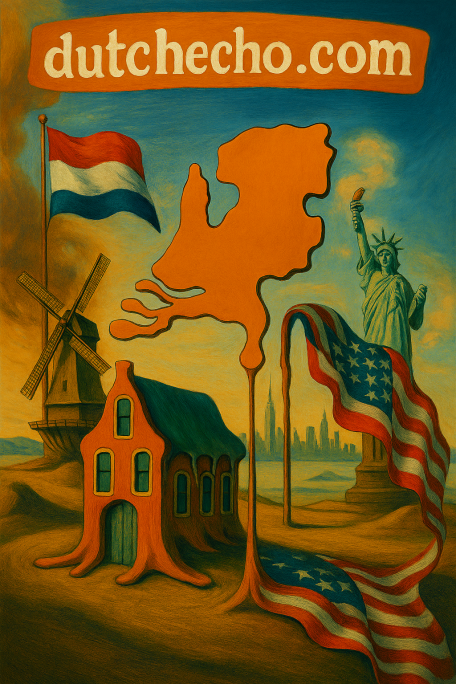
Nieuw-Amsterdam became New York, named after the Duke. For the Dutch, it was a bitter loss. Yet the story didn’t end there. In 1673, during the Third Anglo-Dutch War, the Netherlands briefly retook the city, renaming it Nieuw-Oranje. But the victory was short-lived. The Treaty of Westminster (1674) sealed the deal: New York would remain English, while the Dutch focused on Suriname and their Asian trade empire.
Why the Dutch Lost
The reasons were clear:
- Military weakness: Nieuw-Nederland had few soldiers and fortifications.
- Internal division: Colonists weren’t united behind Dutch rule. Many preferred English governance.
- Global priorities: The Dutch Republic valued its Asian trade routes and Caribbean plantations more than a North American colony.
It wasn’t defeat in battle—it was a strategic retreat.
French and Spanish Shadows
While the Dutch faded from the American stage, France and Spain continued to shape the continent.
- France fought England in the French and Indian War (1754–1763), losing most of its North American territories. The Louisiana Territory eventually passed to Spain, then back to France, before being sold to the United States in 1803.
- Spain held onto Florida, Texas, California, and the Southwest, leaving behind missions, forts, and cities that still carry Spanish names. Their empire stretched thin, but their cultural imprint remains strong.
Together, these powers created a mosaic of influences—Dutch names, French architecture, Spanish missions—that still define the American landscape.
The American Revolution: Europe’s Fingerprints
When the thirteen English colonies rose against Britain in 1775, they didn’t fight alone. France, eager to weaken its old rival, sent troops, ships, and money. Spain joined the war against Britain, striking in the south. Even the Dutch, though officially neutral, provided loans and supplies. Without European involvement, the revolution might have failed. With it, the United States emerged as a new nation.
Expansion and Empire
The 19th century saw the United States expand westward, often at the expense of Indigenous nations and neighboring powers.
- Louisiana Purchase (1803): France sold a vast territory to the U.S., doubling its size.
- Mexican-American War (1846–1848): The U.S. seized California, Texas, and the Southwest.
- Spanish-American War (1898): Spain lost Cuba, Puerto Rico, Guam, and the Philippines to the U.S., marking America’s arrival as a global power.
Each step carried echoes of earlier European ambitions, reshaped by American expansion.
Echoes in Today’s World
So what does this history mean now? Walk through New York and you’ll see it. Brooklyn, Harlem, and Staten Island carry Dutch names. Louisiana and Quebec carry French heritage. California and Florida pulse with Spanish culture. The United States is a patchwork stitched together by centuries of European rivalry, migration, and ambition.
For the Netherlands, Nieuw-Nederland may seem like a lost colony. But its legacy is alive in the DNA of America’s biggest city. The Dutch emphasis on trade, tolerance, and multiculturalism helped shape New York into the global hub it is today.
Rotterdam’s Reflection
From Rotterdam’s docks to Manhattan’s skyline, the story is one of connection. Rotterdam was the compass point for Dutch sailors, a city built on migration and resilience. Nieuw-Nederland was their experiment across the ocean. Today, Rotterdam and New York share more than trade routes—they share a history of openness, diversity, and reinvention.
Conclusion: A Shared Story
The tale of Nieuw-Nederland isn’t about winners and losers. It’s about how small actions—Hudson’s voyage, Minuit’s purchase, Stuyvesant’s surrender—shaped the trajectory of nations. It’s about how Spain, France, England, and the Netherlands carved pieces of a continent, leaving behind names, cultures, and ideas that still resonate.
America’s story is global. And the Dutch chapter, though brief, is unforgettable. It reminds us that history isn’t locked in museums or textbooks. It’s alive in the streets we walk, the names we speak, and the connections we continue to build.


 Dutch Echo
Leave a comment