
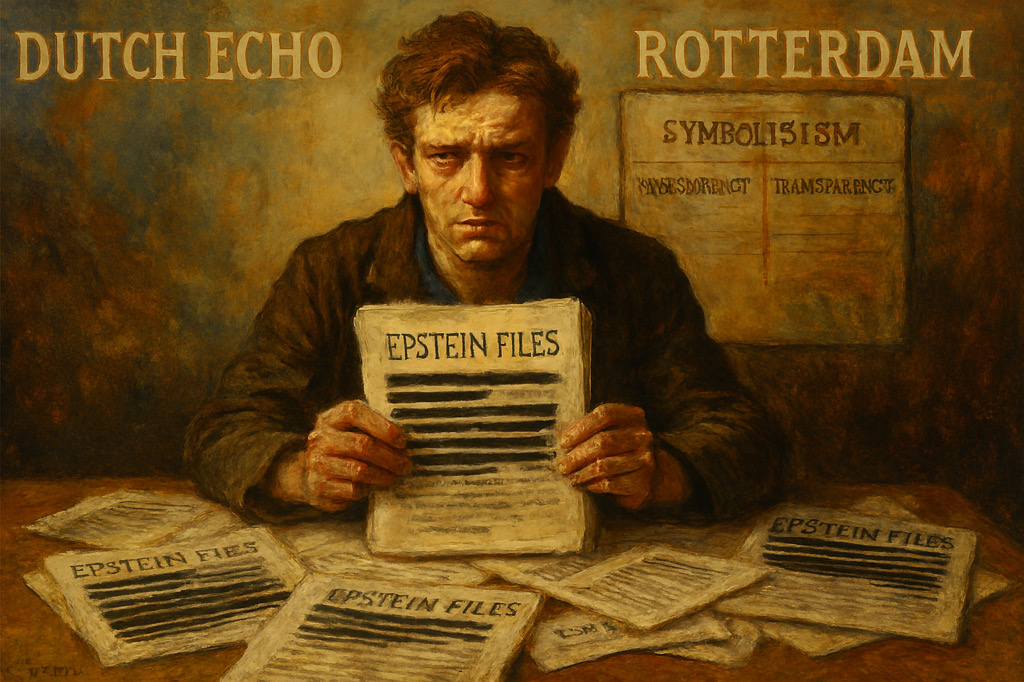
Rotterdam – The United States government promised transparency. They opened the vaults, released thousands of pages, and told the people: here is the truth. But what the people received was not truth. It was a theatre script, a performance of openness, with black ink covering the names, the faces, the networks. The Epstein files, far from illuminating, became a mirror of how power protects itself.
This is not just about one man, Jeffrey Epstein, and his crimes. It is about the machinery of politics, the choreography of secrecy, and the way governments feed their citizens bread and games while hiding the real feast behind closed doors.
The Arrest and the End
Epstein’s story is already infamous. First arrested in 2007, he cut a deal that allowed him to serve a mere thirteen months, mostly outside prison walls. That deal was a scandal in itself, a sign that wealth and connections could bend justice.
In 2019, he was arrested again, this time with stronger evidence: photographs, testimonies, financial trails. He was placed in the Metropolitan Correctional Center in New York. Within weeks, he was found unconscious once, placed under suicide watch, then removed from it. On August 10, 2019, he was dead. Officially, suicide by hanging. Unofficially, a storm of suspicion. Cameras failed, guards slept, and the man who could have named names was gone.
Advertisements

His death closed the criminal case but opened a chasm of doubt. Victims were left with civil suits, the public with speculation, and the government with the burden of explaining why transparency always arrives with black bars across the page.
Victims in the Shadows
The victims are the heart of this story. Dozens have spoken publicly, hundreds remain anonymous. Their names are protected, their testimonies redacted. They are both visible and invisible, present in the media yet erased in the official record.
For them, the release of the files was supposed to be vindication. Instead, it became another wound. They see the government shielding the powerful, while their own pain is hidden under the excuse of privacy. They continue their civil claims, they speak on social media, they demand recognition. But the black ink stands between them and justice.
Trump’s Absence and the Blacked‑Out Names
One detail struck the public like a hammer: Donald Trump’s name, despite photographs and known connections, barely appears in the released files. His absence is not silence; it is a statement. If his name is missing, then surely others are missing too.
This is the logic of censorship: protect the powerful, redact the inconvenient, and leave the people with fragments. The absence of Trump becomes symbolic. It tells us that the files are not about truth but about control. If he is absent, then so are other men, other women, other networks. The files confirm and deny at the same time, leaving the public in a fog.
Symbolic politics: Bread and Games
The release of the files is symbolic politics in its purest form. The government says: look, we are transparent. They hand the people thousands of pages, a banquet of paper. But the meal is hollow. It is bread and games, distraction and spectacle.
The people read, the media report, the social networks buzz. But the truth remains hidden. The gesture is symbolic, the substance absent. This is how power operates: give the crowd something to chew on, while the real meat is eaten in private rooms.
Chantable Politics
The Epstein files reveal not only crimes but vulnerabilities. Politicians appear in photographs, in testimonies, in whispers. They are exposed, but not fully. They are visible enough to be compromised, invisible enough to be protected.
This is the essence of chantable politics: leaders who can be pressured, manipulated, controlled, because someone holds the files, the photographs, the secrets. The public sees the shadows but not the puppeteers. The politicians are chantable, the chanteurs remain hidden.
This is why the files matter. They show us that politics is not only about laws and debates but about leverage, about who holds the knife behind the curtain.

Netanyahu and the American Stage
Sometimes, the chanteurs reveal themselves indirectly. Look at how Benjamin Netanyahu is received in Washington. Republicans and Democrats, usually at war, stand together to applaud him. In a polarized country, such unity is rare.
This reception is not just diplomacy. It is a signal of influence. It tells us that American politicians, across parties, are aligned with interests that go beyond their voters. For the public, it looks like chantability in action: leaders who are not free, but bound by invisible strings.
Netanyahu’s tone toward Trump’s Middle East policy adds another layer. He praises when Trump supports Israel, warns when Trump turns toward Saudi Arabia. He pushes for confrontation with Iran, while Trump hesitates. This dance shows us that American wars are not always about America. They are about allies, industries, and balances of power.
Whose Interest Is Served?
The question becomes unavoidable: whose interest does American policy serve? Not Europe’s, not Qatar’s. The beneficiaries are closer and clearer: Israel, Saudi Arabia, the Gulf networks, and the industries of weapons and finance.
For ordinary Americans, these wars and deals bring little benefit. For victims of Epstein, the files bring little justice. For the public, the transparency brings little truth. The interests served are those of the powerful, not the people.
Victims and Their Chances
Despite the censorship, victims continue their struggle. They file civil suits against Epstein’s estate, against banks, against airlines. They speak in interviews, they testify in Congress, they share their stories online.
Their chances depend on the courts, on the willingness of judges to pierce the black ink. Politically, they have more support than before. Public opinion is with them. But legally, the path is narrow. Without full disclosure, their cases remain fragile.
Still, their presence matters. They remind us that behind the files are human lives, not just political games. Their struggle is the real measure of justice.
The Politics of Shadows
The Epstein files are not just documents. They are symbols of how power operates in shadows. They show us the mechanics of secrecy, the choreography of censorship, the theatre of transparency.
They confirm what many already suspected: that politics is chantable, that leaders are vulnerable, that the real puppeteers remain unseen. They deny the people the full truth, while pretending to give it. They feed the crowd bread and games, while hiding the feast.
Global Story
From Rotterdam, with its street energy and its direct tongue, this story resonates. It is about justice denied, about power protected, about victims silenced. It is about the fury against exploitation, the passion for freedom, the lust for life that refuses to be erased.
The Epstein files are not just an American scandal. They are a mirror of global politics, of how governments everywhere perform transparency while practicing secrecy. They remind us that justice is not given but withheld, that truth is not shared but censored.
Conclusion: The Unfinished Story
The story of Epstein did not end with his death. It continues in the files, in the victims, in the politics of shadows. It is unfinished, unresolved, unspoken.
For the people, the files are both confirmation and denial. They show that crimes happened, that networks existed, that victims suffered. But they also hide the names, the faces, the connections. They give the illusion of transparency, while protecting the powerful.
This is the paradox of our time: governments promise openness, but deliver censorship. Politicians are chantable, but the chanteurs remain unseen. Victims fight for justice, but the files deny them. The people are fed bread and games, while the truth is eaten elsewhere.
And so the story continues, not in the courts, not in the files, but in the streets, in the voices, in the fury of those who refuse to forget.
 Dutch Echo
Leave a comment