
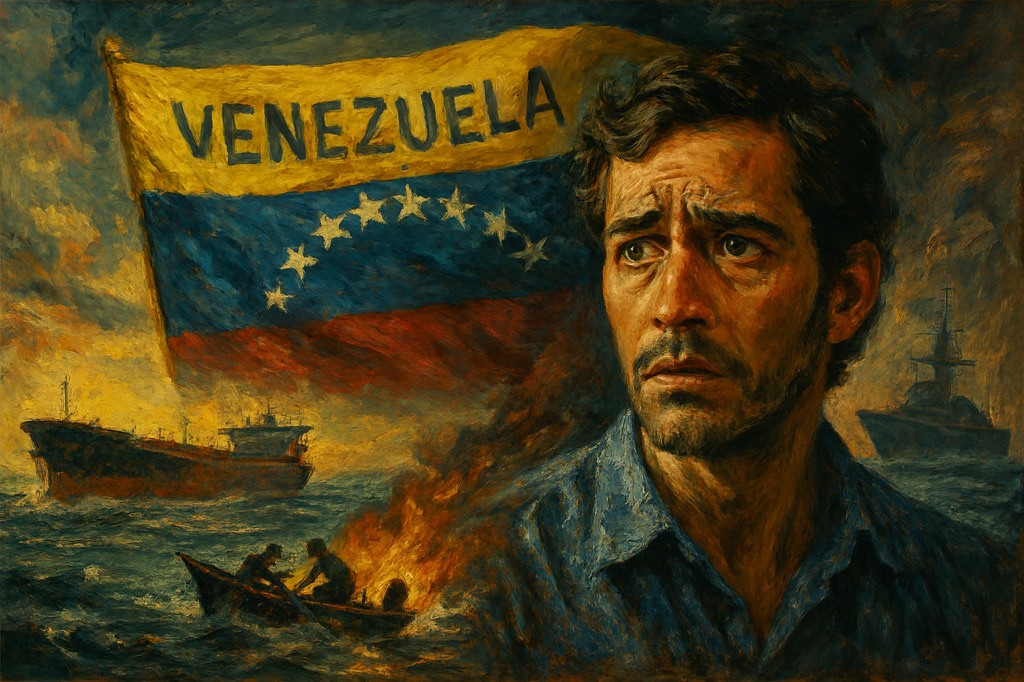
Rotterdam – We begin on the waves of the Caribbean, but the rhythm feels like Rotterdam’s streets under our feet. The story unfolding there is not distant—it echoes in every port city, every marketplace, every corner where survival and dignity are contested.
The United States has placed its fleet off the Venezuelan coast. Oil tankers, loaded with millions of barrels, are intercepted. The first big catch was the Centuries, destined for a Chinese energy company. Washington called it enforcement of sanctions. Beijing called it piracy. Caracas called it an assault on sovereignty.
And then Venezuela responded. Not with silence, not with surrender, but with its own navy. Warships escorted tankers out of port. And suddenly, the American fleet did nothing. They watched. They barked, but they did not bite.
Advertisement


Barking Dogs, Silent Teeth
You know the image. A dog barking loud, showing its teeth, but when someone stands firm, the dog retreats. That is the metaphor now circling the seas. The United States, with its superior fleet, strikes small boats but hesitates when Venezuelan escorts appear.
The contrast is sharp. Big tankers sail away under protection. Small boats are destroyed. Ten of them since September. The death toll ranges from 46 to 69, depending on which report you trust. And on October 17, something happened that cannot be erased: two survivors of an attack were later killed. Filmed. Documented. A war crime, say jurists. A violation of human rights, say organizations. But in Washington? Silence.
The Small Boats: Victims of a Narrative
The Americans call them “narco‑terrorist boats.” They claim drugs were hidden in the hulls. But who were the dead? Fishermen. Workers. Small smugglers. Not cartel bosses. Not the powerful. Ordinary people, trying to survive poverty and exploitation.
And here lies the fury. Because you know what it feels like to be labeled a problem, a threat, when all you want is to live. That is what happened on the sea. Small boats destroyed, without proof, without trial. Survivors denied even the chance to breathe.
The Minister of War
In Washington sits Pete Hegseth, appointed in January 2025 as Secretary of Defense. His nomination was controversial, his reputation stained. Yet he commands the largest fleet in the world. Trump even called him “Minister of War.” And war is what he wages—not against equals, not against escorted tankers, but against small boats.
That is hypocrisy laid bare. Real power is tested against equals. But here we see a superpower striking the weakest, and retreating when faced with resistance.

The Caribbean Drama: Symbolism and Reputation
This is more than oil and ships. It is symbolism. It is reputation. It is the image of a superpower bluffing but not biting. And that image spreads fast. Venezuela uses it to show defiance. China uses it to claim the United States cannot stop its trade. And what remains in the public mind? Not the sanctions, not the technicalities. What remains is the barking dog.
And reputation matters. It matters more than weapons, more than fleets. Because once the world sees you as a dog that barks but does not bite, your power is questioned.
The War Crime of October 17
We return to that day. October 17. Two survivors, filmed, alive. And then dead. No trial. No protection. No rights. That is a war crime. That is a violation of the Geneva Conventions. And yet, no prosecution follows.
Human rights groups demand investigation. Venezuela shows the footage at the United Nations. But in the United States? No indictment. No hearing. No prosecutor stepping forward. Silence. And that silence is deafening.
Street Energy and the Ordinary Voice
Why tell this story with passion, with body, with the rhythm of Rotterdam? Because this is not only about geopolitics. It is about justice, freedom, dignity. It is about the ordinary person, the worker, the fisherman, the student.
You feel it. You know how it feels to be dismissed, to be treated as a threat, while you are simply trying to live. That is the mirror this story holds up. Superpowers barking at equals, biting at the weak. And the weak pay the price.
Rotterdam Under Our Feet
I write this with Rotterdam beneath me. With the harbor in my lungs, with the street in my voice. Because here, in this city, we know what ships mean, what trade means, what reputation means. And that is why the Caribbean feels close. The waves there crash against the quays of Delfshaven.
Rotterdam is a city of energy, of life, of hunger for freedom. And that is why we must understand this story. Not to act, not to march, but to know. To see how power behaves, how justice bends, how reputation is built and broken.
The Soap Opera Called Geopolitics
And so we return to the beginning. This is not a dry report. This is an episode of a soap opera. A series where superpowers play their roles, where fishermen and workers are tragic extras, where reputation and symbolism are the true weapons.
The title of this series? Geopolitics. And we are the audience. We watch, we feel, we understand the hypocrisy. And we know this story will not end with one tanker, one minister, one war crime. It will continue, scene after scene, episode after episode.
Conclusion
This was the story of oil tankers, escorts, barking dogs, small boats, war crimes, and reputation. A story unfolding on the sea, but resonating in the streets of Rotterdam, Paramaribo, Antwerp, and Willemstad.
And as always, remember: this report is for entertainment purposes, part of the soap opera called geopolitics.


 Dutch Echo
Leave a comment