
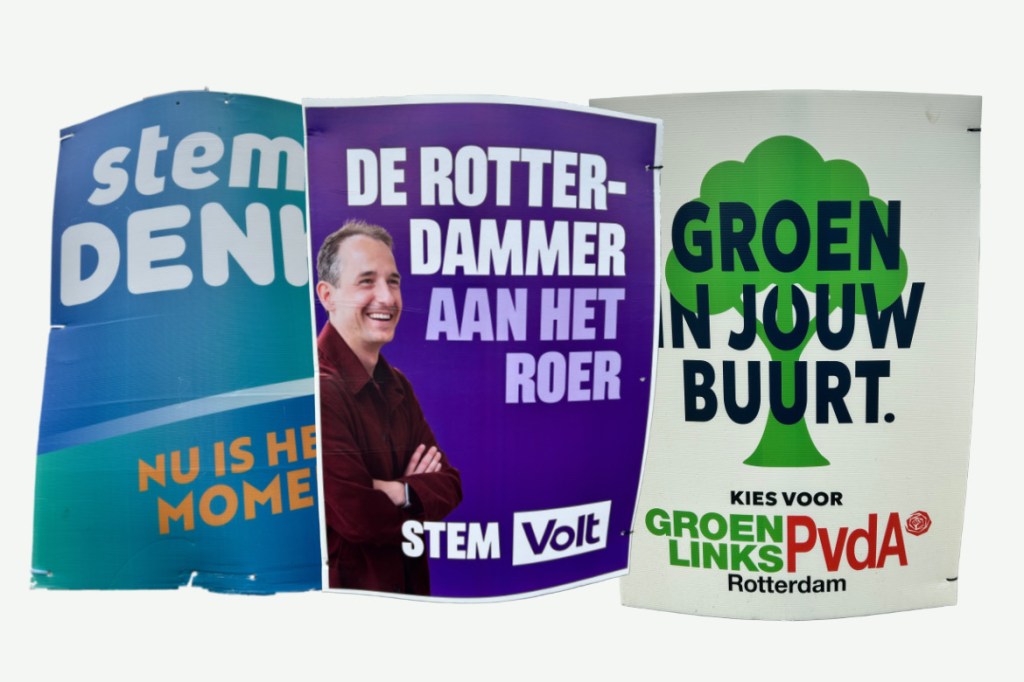
Rotterdam – You feel it before you name it. That quiet tension in the air when an election approaches, the way the city seems to lean forward, listening. Rotterdam knows that feeling well. The streets carry it in the tram rails, in the echo of scooters cutting through the wind, in the conversations that drift out of cafés where people argue about politics without ever raising their voices. And if you’re voting for the first time—whether you grew up here or arrived years later with a suitcase full of hope—you feel that tension in your body. Not as pressure, but as presence. Because the moment you step into that voting booth, the city shifts a little to make room for you.
You don’t need to pretend you understand everything. Nobody does. Elections are messy, loud, contradictory, and full of promises that sound clean until they hit the pavement. But the act of voting is simple. You bring your stempas, your ID, and your sense of what matters in your daily life. You walk into a school gym or a community center that smells faintly of floor polish, and you make a mark with a red pencil. That’s it. No ceremony. No spotlight. Just you and a piece of paper that suddenly feels heavier than it looks.
The Streets Don’t Care About Theory, Only About Impact
You’ve probably noticed how politics gets talked about online. Big statements, big emotions, big claims about who’s destroying what and who’s saving whom. But the streets don’t care about theory. The streets care about whether your rent is rising, whether your neighborhood feels safe, whether your bus still runs after 20:00, whether your kid has a playground that isn’t falling apart. That’s why municipal elections matter more than people admit. National politics gives speeches; local politics fixes—or fails to fix—the things you touch every day.
Advertisements
When you look at the parties, you see the same patterns repeating. The VVD talks about safety, clean streets, and keeping local taxes low. GroenLinks–PvdA pushes for affordable housing, social infrastructure, and a government that treats people like humans instead of case numbers. The CDA leans into community, family, and neighborhoods that feel like they belong to everyone. D66 talks about education, opportunity, and cities that grow without losing their soul. The Partij voor de Dieren wants greener streets, fairer systems, and a future that doesn’t burn itself out.
These are not abstract ideas. They’re the things you notice when you walk home at night or when you open your mailbox and see another rent increase. They’re the things you feel in your bones when you try to find a place to live, when you look for work, when you raise your kids, when you try to build a life that feels stable.
For Young Voters: Your Reality Is Already Political
If you’re young, you’ve grown up in a world where everything is fast, everything is loud, and everything is public. You’ve seen how media shapes opinions before people even realize they’re being shaped. You’ve watched how narratives spread, how fear travels, how hope gets drowned out unless someone fights to keep it alive. You’ve learned to read between the lines because the lines themselves don’t always tell the truth.
Voting isn’t about choosing a hero. It’s about choosing the conditions under which you want to live. You don’t need to know every detail of every party program. You only need to know what affects you. Housing. Education. Safety. Climate. Opportunity. The things that determine whether you can build a future without constantly looking over your shoulder.
You don’t vote because you’re supposed to. You vote because the world you’re stepping into is already shaped by decisions you didn’t make. This is your chance to shape back.
For Immigrants: Your Voice Is Part of the City’s Rhythm
If you weren’t born here, you already know what it means to navigate systems that weren’t designed with you in mind. You know how it feels to translate not just language, but culture, expectation, and bureaucracy. You know how it feels to build a life in a place where you’re both inside and outside at the same time.
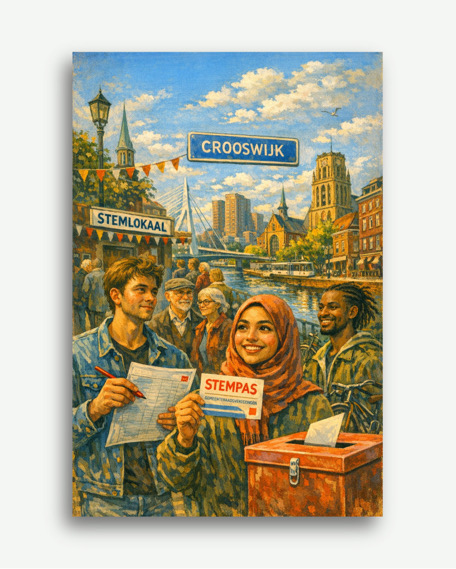
Municipal elections are one of the few political spaces where your voice enters the room without needing permission beyond residency. If you’re from the EU, you vote. If you’re from outside the EU and you’ve lived here legally for five years, you vote. You don’t need a Dutch passport to shape the neighborhood you walk through every day.
And that matters. Because cities like Rotterdam are built by people who arrived from everywhere. The rhythm of the city is a mix of accents, cuisines, memories, and ambitions. When you vote, you’re not asking to belong. You’re showing that you already do.
The Booth Is Small, but the Decision Is Wide
When you step into the voting booth, it’s quiet. No notifications. No commentary. No algorithm pushing you toward outrage. Just a giant paper full of names you may or may not recognize. It’s normal to feel unsure. Everyone does. But uncertainty isn’t a weakness. It’s a sign that you’re taking the moment seriously.
You don’t need to overthink it. You don’t need to pretend you’re choosing the fate of the world. You’re choosing the direction of your street, your neighborhood, your city. You’re choosing who gets to sit at the table when decisions are made about the things you live with every day.
And the beauty of municipal politics is that your vote actually moves the needle. Local elections are decided by small margins. A handful of votes can shift a seat. A single seat can shift a coalition. A coalition can shift the entire atmosphere of a city.
The City Remembers Who Shows Up
Cities have long memories. They remember who participates, who stays silent, who pushes for change, who resists it. When new voters show up—young people, immigrants, first‑timers—the city feels it. Not because politicians suddenly become saints, but because power recalibrates itself around whoever is present.
You don’t need to be loud to matter. You don’t need to be an expert to be relevant. You only need to show up with your stempas, your ID, and your lived experience. The rest is just a red pencil and a moment of clarity.
The Future Doesn’t Arrive Fully Formed; It Arrives Through Choices
People talk about the future as if it’s something that happens to us. But cities don’t evolve on their own. They evolve through decisions—small ones, local ones, the kind that don’t make headlines but do make neighborhoods livable. When you vote, you’re not predicting the future. You’re participating in its construction.
And whether you’re eighteen or forty‑eight, whether you were born in Rotterdam or arrived here after crossing oceans, whether you’ve been politically active for years or you’re stepping into this for the first time, your vote carries the same weight as anyone else’s. That’s the quiet power of democracy at street level.
The city is listening. Not for perfection. Not for certainty. Just for presence.
 Dutch Echo
Leave a comment