

At the end of August, a hazy kind of light hung over the city of Amsterdam, wrapping its streets and squares in a warm glow. For Leo, however, this time of year felt different, as if the slow approach of autumn awakened a vague longing inside him. After seven patient weeks working in the payroll department of Tetterode BV, a subsidiary of Buhrman—the printing company behind the country’s well‑known weekly and monthly magazines—he realized he no longer felt part of anything meaningful. The monotony of his tasks, the endless input of time sheets, the constant stream of numbers in spreadsheets, had once given structure to his days, but now stirred a quiet restlessness in his mind. What kind of life was this, he wondered. Was this what work was supposed to be? Something in him had begun to shift, a desire for creativity and humanity that this mechanical routine simply could not offer.
The smell of paper and ink filled the office building, a constant reminder of the printing presses shaping the world outside while he functioned like a tiny cog in the machine, without a spark of creativity. The days blended into a grey mass in which his identity seemed to fade. In that final week in payroll, he felt a mental emptiness swelling—not born from fatigue, but from a deeper frustration. This was not how he wanted his worth as a human being to be measured.
One afternoon, as his eyes lingered on the computer screen and his fingers hovered above the keyboard, a sharp thought cut through the fog: Is this what working means? Twenty years later, that moment would still echo in his mind. Only then would he understand that this numb inner state had not been simple boredom, but the first sign of a pattern of narcissistic abuse in the workplace—something he would only learn to recognize much later.
Advertisements

But in that moment, while the late‑summer warmth wrapped around him like a promise of new possibilities, Leo felt his mind opening. He had always longed to work with children, and now, in after‑school care, that longing finally seemed within reach. The idea of focusing on the group he had missed for so long felt like a release. His years of experience as a family counselor in youth care felt like a solid foundation. For eight years he had supported families under pressure due to intellectual disabilities. His task had been clear: keep the family together, support where possible. But the role had drained him, slowly hollowing out his creative spirit.
Now, standing on the schoolyard surrounded by curious children, he felt a light tension in his chest, but also something like coming home. This was the opportunity he had dreamed of—the work that offered space for energy, creativity, and humanity. He felt free, like a bird stretching its wings after a long confinement.
The first days at the after‑school program felt like a fresh breeze in his life, full of potential and inspiration. Leo was assigned a group of twenty children, aged four to eight. It felt natural, effortless. His earlier experience with children had prepared him for this moment; friends and family had always called him the “favorite uncle,” the one who could blend playfulness with safety. This was what he had always wanted.
Together with Bettine, a colleague with whom he immediately found a good rhythm, he worked on building a safe, stimulating environment. Leo believed children needed space to grow, explore, and play. Wilma, the group assistant, added a different dynamic to the team, though not all interactions felt like an enhancement. She was kind, but her energy sometimes felt off, like a shadow dimming the sunlight.
The team dynamics kept rubbing—Leo and Bettine on the side of inspiration, while Wilma’s structured approach acted as a counterforce. Setting the table for the children gave her a sense of control, and although Leo understood her need for structure, he began to question her place in the team. Her role as logistical coordinator didn’t seem to harmonize with the playful spirit he valued so deeply.
Whenever Leo had to leave the room to help a child with a problem, or when Bettine did, Wilma watched over the group, something that gave her a sense of authority. But the friction began to bother him, like a thin layer of grease forming on a pot of soup. He slipped into a rhythm of fear and unease; the shadow Wilma cast over the team made him restless. It wasn’t resentment—he simply couldn’t connect her presence with the spark of creativity he cherished.
Late August, in the warm afterglow of summer, felt like the perfect time to let the children play outside, move freely, and enjoy the open air. He took them to Balboaplein as often as possible, to the playground across the street where they learned crucial lessons about independence. He believed children learned most from each other—that they didn’t need adults to constantly steer them, but needed space to collide, negotiate, and develop social skills. He and Bettine were there to guide, not to direct.
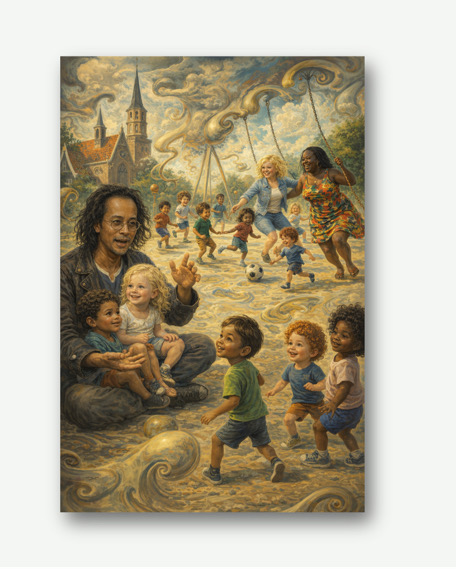
Wilma followed at a safe distance, carrying bags full of drinks like an awkward spectator. It was her task: logistics, cups, thirst. Tragically, he noticed that this role also became part of her identity. The children had to go to her if they wanted something to drink, and although he valued everyone’s contribution, his concerns about the usefulness of her role felt like a gift that wasn’t truly appreciated. Leo began to wonder whether Wilma could be more than a logistical coordinator.
The days passed as the children explored their play and Leo guided them with patience and care. Wilma still followed, a budding shadow at the edge of their dynamic. Although he didn’t see her as unworthy, he couldn’t deny that her presence sometimes created imbalance. The biggest challenge was that, driven by his desire for harmony, he began to reconsider the roles within the team.
As late summer exhaled its final breath and autumn arrived with cooler breezes and shorter days, Leo sensed something deeper at play. The group’s dynamic shifted, just like the season itself. He had come to know the children well. He had discovered their strengths and weaknesses and had become their trusted adult. But there was an undeniable tension in the air, a change he couldn’t yet name. It felt as if their collaboration was built on a foundation that seemed solid, but might be more fragile than he thought.
Autumn entered with change. The leaves felt the first signs of decay, and Leo knew he, too, had to shed old experiences. The wings that had once been clipped would slowly grow back. At the same time, new dynamics would unfold in the shadows of their team structure—something that would only become clear to him many years later.
Memories of his previous jobs resurfaced. The period in which he worked with children with intellectual disabilities felt like yesterday. He had functioned as a caregiver—always active, always directive. The pressure, the tension: those moments had drained his creativity and energy so deeply that they had touched his soul. Here, he had found the freedom he needed: the role of a friend rather than a caretaker.
Leo began to realize he was finally reclaiming more of life. He could help the children with their discoveries, give them space to test their boundaries. It was in his energy, in his way of seeing. The days seemed to fly by as the children embraced the freedom of their play. The promise of a new direction formed the foundation for Leo’s longing for an accessible, fulfilling future.

 Dutch Echo
Leave a comment