
A country celebrating, a people mourning — same sky, different histories
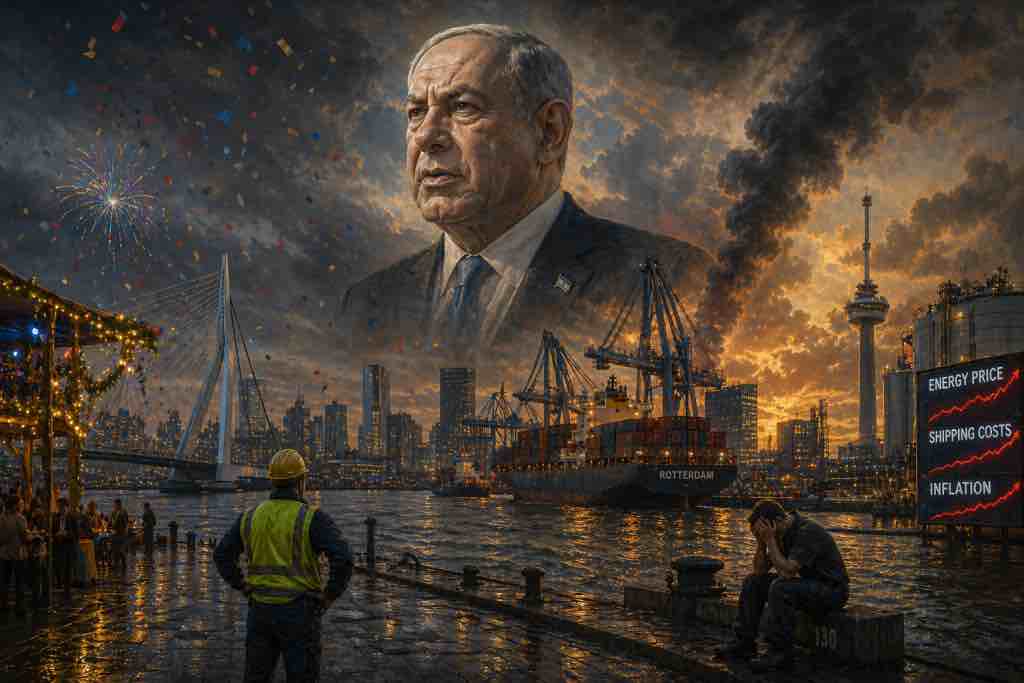
Rotterdam – The shift happens fast. One moment the sirens cut through the air, the kind that make traffic freeze mid-lane and conversations collapse into silence. The next, fireworks crack open the night sky. That’s the rhythm of Yom Ha’atzmaut in Israël — a hard pivot from grief to celebration that feels almost mechanical, like a port crane switching containers without pause.
From a distance — from cities like Rotterdam where ships move day and night and everything is measured in throughput — it looks surreal. A nation mourning its dead in the morning and throwing a party by evening. But zoom in, and the contrast becomes sharper, heavier. Because while Israelis celebrate independence, Palestinians mark the Nakba — their loss, their displacement, their unfinished history.
Same timeline. Same land. Two completely different realities running parallel, like freight lines that never intersect.
Advertisements
Netanyahu’s message: strength, survival, and permanent alert
At the center of this year’s narrative stood Benjamin Netanyahu, delivering a message that didn’t drift far from his established line. Whether during memorial ceremonies or in his recorded Independence Day address, the tone stayed consistent: Israel is under threat, but it is strong — stronger than ever, he said — and ready to fight.
This wasn’t just ceremonial language. It was strategic framing. Netanyahu positioned the current conflicts not as isolated incidents, but as part of a broader, ongoing confrontation with what he described as an Iranian-led axis. In his telling, this isn’t a phase. It’s a long-term reality.
For people watching from Europe, that framing matters. Because when a leader defines conflict as existential, compromise becomes secondary. Policy hardens. Military spending rises. And the ripple effects travel far beyond the region — into energy markets, shipping routes, and ultimately into everyday costs.
That’s where the distance between the Middle East and a port city like Rotterdam shrinks fast. Oil prices shift, insurance for shipping routes tightens, logistics chains feel the pressure. What sounds like geopolitics lands as a higher bill, a delayed shipment, a tighter job market.
The choreography of memory and power
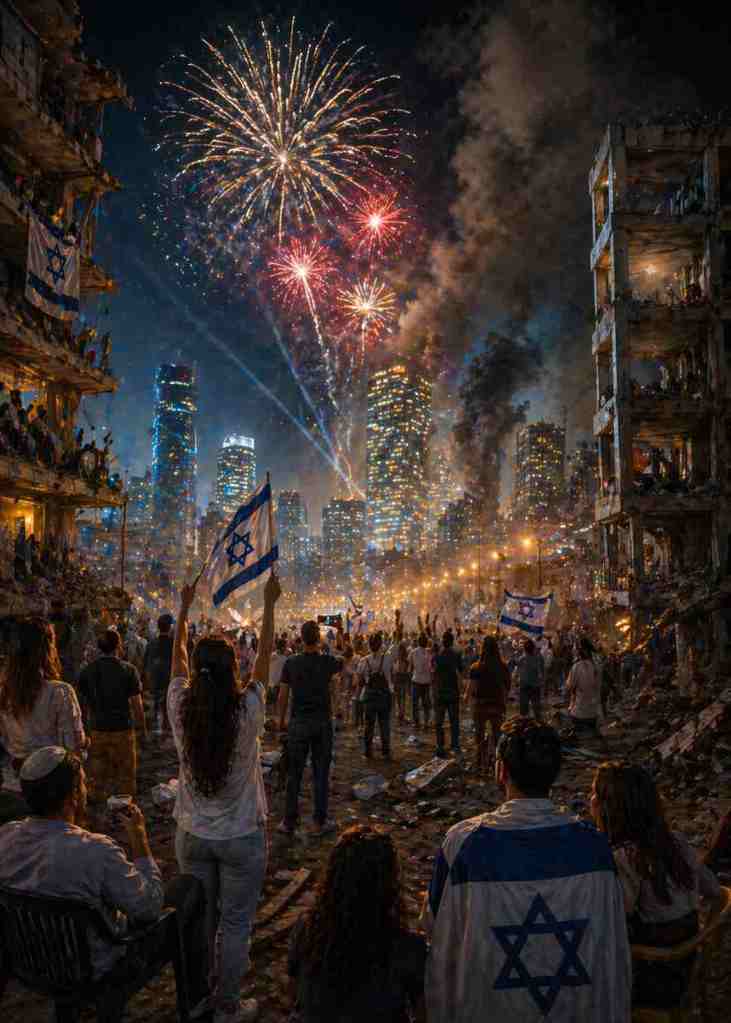
The structure of the day itself tells a story. First comes Yom Hazikaron — a national moment of silence for fallen soldiers and victims of violence. Sirens sound. People stop. Entire highways stand still. It’s disciplined, almost industrial in its precision.
Then, as the sun drops, the mood flips. Torches are lit. Music rises. Flags flood the streets. The state celebrates its existence.
That choreography isn’t accidental. It links sacrifice directly to sovereignty. The message is clear: independence came at a cost, and that cost justifies its defense.
But across the divide, Palestinians are not part of that narrative. Their memory runs in the opposite direction. While Israelis mark survival, Palestinians mark loss. While one side sees a state being born, the other sees homes abandoned, villages erased, futures displaced.
This is where the tension becomes more than political. It becomes structural. Two histories occupying the same geography, each refusing to dissolve into the other.
Geography matters — but separation runs deeper
It’s easy to imagine this as two groups standing a few kilometers apart, one celebrating, the other mourning. And sometimes, physically, that’s not far from the truth. But the real distance isn’t measured in kilometers.
It’s built into checkpoints, borders, legal systems, and daily life. In some places, these worlds are separated by concrete and steel. In others, they exist within the same cities but rarely intersect in meaningful ways.
Even inside Israel, Palestinian citizens experience the day differently. While national celebrations unfold, there are also quiet acts of remembrance, alternative narratives, and internal tensions that don’t always make it into official broadcasts.
From the outside, it might look like a clean split. On the ground, it’s layered, fragmented, and often uncomfortable.
A global audience, divided reactions
Internationally, the day lands differently depending on where you stand. Western governments largely recognize and support Israel’s independence, often framing it through the lens of post-World War II history and the Holocaust. Diplomatic messages flow. Flags are raised. Statements emphasize democracy and resilience.
But that’s only part of the picture.
In Palestinian communities and across parts of the Arab world, the focus is on the Nakba. Protests, memorials, and political messaging highlight displacement and unresolved grievances. The tone is not celebration, but resistance and remembrance.
Then there’s a third layer — countries that have normalized relations with Israel in recent years, often taking a pragmatic stance. Trade, security cooperation, and regional strategy shape their approach more than ideology.
For European cities, including Rotterdam, this global divide doesn’t stay abstract. It shows up in protests, political debates, and community tensions. It shapes how people talk, what they post, how they vote.
War as background noise — or constant reality
What stood out in Netanyahu’s message this year is how central the concept of ongoing war remains. Not as an emergency, but as a baseline condition. The idea that Israel is not just defending itself, but actively reshaping its strategic environment.
That has consequences.
When conflict becomes normalized, it changes expectations. Markets adjust. Governments align. Citizens adapt to a permanent sense of uncertainty. And for those outside the region, the fatigue sets in. Not just emotional fatigue, but economic and political fatigue.
There’s a point where distant conflicts stop feeling distant, not because they move closer geographically, but because their effects stack up — in energy costs, in security concerns, in the constant stream of headlines.
Rotterdam perspective: trade routes don’t ignore conflict
From a port city perspective, none of this is theoretical. Rotterdam runs on flow — oil, gas, containers, data, capital. Stability matters. Predictability matters.
When tensions rise in the Middle East, it’s not just a headline. It’s a variable in a system. Shipping routes get reassessed. Insurance premiums climb. Energy prices fluctuate. And that trickles down fast.
A conflict framed as long-term — as existential — signals volatility. And volatility has a price.
Advertisements
That’s where the narrative coming out of Israel intersects with daily life in Europe. Not in speeches or ceremonies, but in spreadsheets, contracts, and monthly bills.
One day, two truths that don’t cancel each other out
What makes this moment difficult to process — from any angle — is that both realities exist at the same time without canceling each other out.
For Israelis, Independence Day is real. It marks survival, statehood, continuity. For Palestinians, the Nakba is just as real. It marks loss, displacement, and an unresolved past.
These are not competing opinions. They are parallel experiences.
And when leaders frame the present through the lens of permanent conflict, those parallel lines don’t move closer together. They harden.
From a distance, it might be tempting to simplify. To pick a side, reduce the story, compress it into something manageable. But the reality on the ground resists that.
It’s complex. It’s layered. And it’s still unfolding.
 Dutch Echo
Leave a comment