
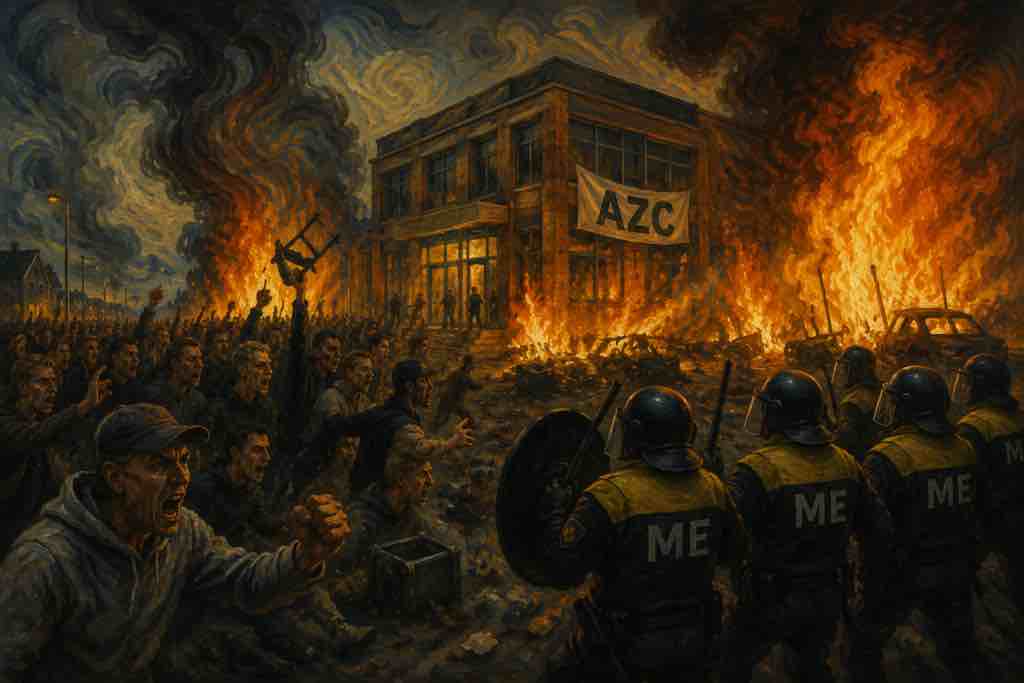
The Night Loosdrecht Changed the Conversation
Rotterdam – The wind coming off the water carried smoke through quiet Dutch streets that were never built for riot police, sirens, or national headlines. Loosdrecht is not Rotterdam South after midnight. It is not some hardened industrial district where chaos blends into concrete. This is postcard Netherlands. Calm roads. Detached houses. Boats tied to private docks. Families who built stable lives through work, taxes, and routine. Then suddenly the town became a frontline in the Dutch asylum debate.
Television cameras arrived after the escalation already started. By then the story had already been framed. Angry white protesters. Far-right tensions. Public disorder. Another chapter in Europe’s migration conflict. But people on the ground described something else entirely. They described ordinary residents pushed into a national political crisis they never asked for. Parents. Contractors. Small business owners. Retired dock workers. Logistics people. Families already struggling with rising bills, shrinking housing access, and a government that speaks in polished policy language while neighborhoods absorb the impact.
The Netherlands has always been a trading nation. Rotterdam understands this better than anyone. Ships come in. Containers move out. Goods flow through Europe like blood through arteries. But trade only works when balance exists. Pressure without structure cracks systems apart. That is exactly how many Dutch citizens now view asylum policy. Not as compassion versus hatred, but as a state system operating beyond capacity while politicians continue talking like spreadsheets matter more than neighborhoods.
Advertisements
Loosdrecht exploded because many residents believed decisions were imposed from above. Fast. Administrative. Detached. A former municipal building suddenly became emergency asylum shelter space. Locals felt bypassed. Public meetings turned emotional. Then came demonstrations. Then counter-demonstrations. Then riot police.
And after the clashes came something even more damaging: distrust.
The Media Narrative and the People Left Outside It
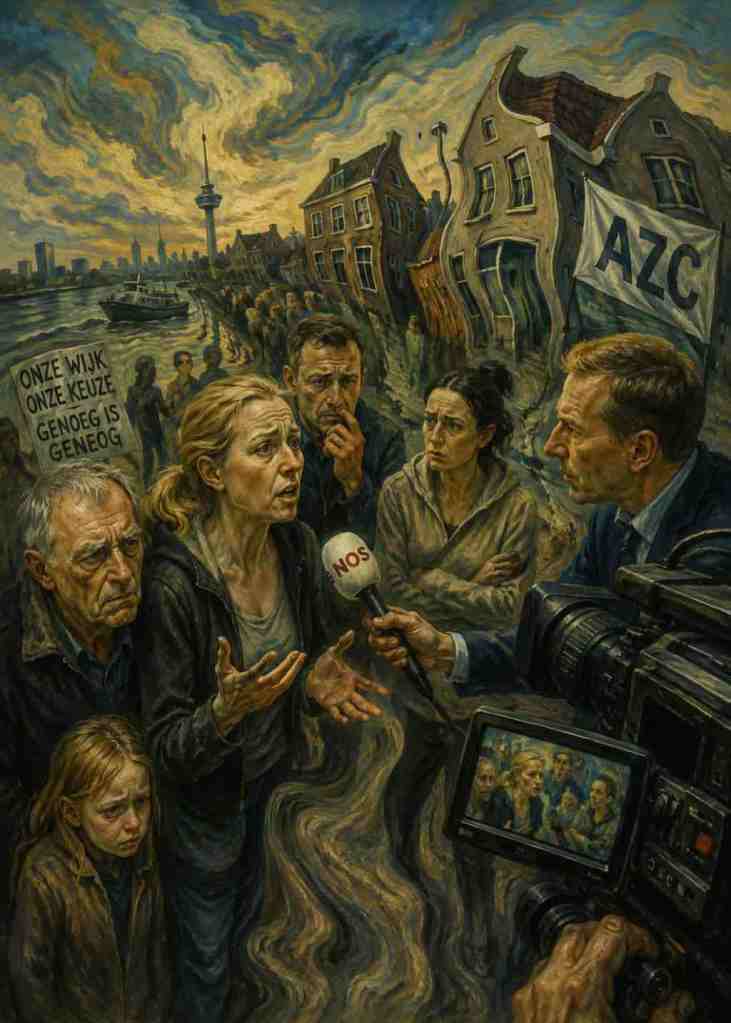
Many demonstrators believed they were instantly branded extremists the moment they opposed asylum expansion. That accusation hit especially hard because the crowds were more mixed than national coverage suggested. Residents noticed something the cameras rarely focused on: Dutch citizens from immigrant backgrounds also protesting against the current asylum system.
Moroccan Dutch citizens. Turkish Dutch citizens. Surinamese Dutch citizens. Working-class families who themselves struggled for years to secure stable housing or economic footing. Their argument was not always ideological. Often it was brutally practical. Waiting lists. Rent prices. School pressure. Healthcare access. Public safety concerns. Competition at the bottom of the economic ladder.
That complexity rarely survives modern news framing.
National media often compresses social tension into simplified moral categories because complexity does not move fast enough for headlines. Far-right. Populist. Xenophobic. Anti-migrant. The labels arrive quickly because modern political communication rewards clarity over nuance. But reality inside Dutch neighborhoods is messier than television segments allow.
In Rotterdam districts shaped by shipping, labor, migration, and economic struggle, people understand layered identities better than policy analysts in The Hague sometimes do. A dock worker with immigrant roots can oppose current asylum policy without suddenly becoming anti-immigrant. A working-class Dutch family can fear social decline without embracing extremism. Those distinctions matter, yet increasingly disappear from public discourse.
That disappearance fuels resentment.
The anger is not only about asylum seekers themselves. In many cases it is about hierarchy. Citizens feel the state reacts faster for newcomers than for people who have spent years inside the system already. The housing crisis sharpened this perception into something raw. Every unavailable apartment becomes political oxygen.
The Netherlands currently faces a structural housing shortage that affects nearly every social layer beneath the upper-middle class. Young adults remain stuck with parents longer. Working couples postpone children. Temporary contracts dominate sectors that once offered stability. Energy prices and inflation hollowed out purchasing power even before migration pressures intensified the political atmosphere.
In port cities and industrial regions, economic frustration rarely stays abstract. It lands directly in the wallet. Diesel costs. Grocery prices. Rent increases. Utility bills. Security concerns around neighborhoods already stretched thin. The Dutch social contract historically depended on predictability. Work hard, contribute, and stability follows. Many now feel that promise breaking apart.
Riot Police in Residential Streets
What deeply unsettled many viewers were not only the protests themselves, but the images that followed afterward. Riot police entering residential areas. Demonstrators pushed into side streets. Footage circulating online showing officers moving onto private property while chasing fleeing individuals.
For many Dutch citizens, that crossed an emotional line.
Whether legally justified or not under public order powers, the optics were devastating. In the Dutch imagination, private homes still symbolize a boundary between state authority and personal life. Once riot police appear inside gardens and residential spaces, trust damage spreads far beyond one demonstration.
Online speculation intensified quickly. Some protesters insisted the violence did not come from ordinary residents. Claims emerged about provocateurs and undercover escalation tactics. No public evidence confirmed theories that police intentionally triggered violence. Yet the fact such claims spread so rapidly reveals the scale of institutional distrust now present in parts of Dutch society.
That distrust did not emerge overnight.
Years of polarization around COVID restrictions, farmer protests, migration debates, energy costs, and declining faith in political institutions created fertile ground for suspicion. The Dutch consensus model once relied on negotiation and public trust. Increasingly that culture feels replaced by managerial governance from above while citizens below absorb the consequences.
Advertisements
Rotterdam understands institutional pressure better than most cities. The harbor never sleeps because pressure never stops. Logistics chains survive through precision and trust. Once communication breaks down, congestion spreads everywhere. Society works similarly. If citizens stop believing institutions listen honestly, even small crises can spiral into national confrontation.
The Asylum Debate Is No Longer Marginal
One of the biggest mistakes in Dutch elite circles has been treating migration criticism as socially fringe long after it became mainstream concern. The demonstrations across the country showed something important: opposition to current asylum policy now stretches across class lines, ethnic backgrounds, and political identities.
Not everyone protesting shares the same motivations. Some focus on housing shortages. Others on cultural cohesion. Others on public order. Others simply feel exhausted by political language that minimizes visible pressure on communities. But together these frustrations are creating a broader national mood.
And that mood is increasingly impossible to dismiss.
Municipal leaders themselves have openly admitted feeling trapped between national obligations and local anger. Several mayors criticized The Hague for pushing municipalities into impossible situations while failing to build long-term structural solutions. Some local authorities warned that forcing rapid asylum accommodation into already strained communities risked social instability.
That warning now looks less theoretical.
The Dutch state still presents itself internationally as organized, tolerant, and administratively efficient. Yet underneath that polished image, pressure is building inside ordinary neighborhoods. The issue is no longer only migration itself. It is whether citizens still believe democratic consent matters in policymaking.
When people feel unheard long enough, even calm towns can become politically combustible.
Rotterdam Sees the Pattern Clearly
In Rotterdam the atmosphere around these debates carries a different rhythm than inside parliamentary chambers. The city was rebuilt from destruction through labor, steel, trade, and endurance. People there often measure politics less through ideology and more through practical consequence. Can families still afford rent? Is the neighborhood stable? Are jobs secure? Is public order holding? Does government still speak honestly?
Those are harbor questions. Concrete questions. Questions shaped by cranes, fuel prices, container traffic, logistics contracts, and working-class survival.
That is why the asylum debate increasingly resonates beyond traditional political camps. For many citizens, it now represents a broader feeling that ordinary people absorb the strain while national leadership communicates through abstraction.
Meanwhile mainstream media struggles to fully capture the layered reality on the ground. The simplification continues because modern information systems reward outrage and symbolism over complexity. A protest becomes easier to explain if it can be morally categorized within seconds.
But Dutch streets are not Twitter timelines.
The Netherlands is entering a harder phase of this debate now. The pressure points are visible everywhere: housing, energy costs, demographic tension, overstretched municipalities, declining institutional trust, and growing social fragmentation. None of this automatically leads to extremism. But ignoring legitimate public frustration risks pushing more citizens into permanent alienation from political institutions.
Loosdrecht was not simply a local disturbance. It became symbolic because it exposed the collision between governance from above and resistance from below. Between administrative necessity and emotional reality. Between official narratives and lived experience.
And across the country, from quiet suburbs to the industrial heartbeat near the Maas, more people are beginning to feel that collision inside their own lives.
 Dutch Echo
Leave a comment