
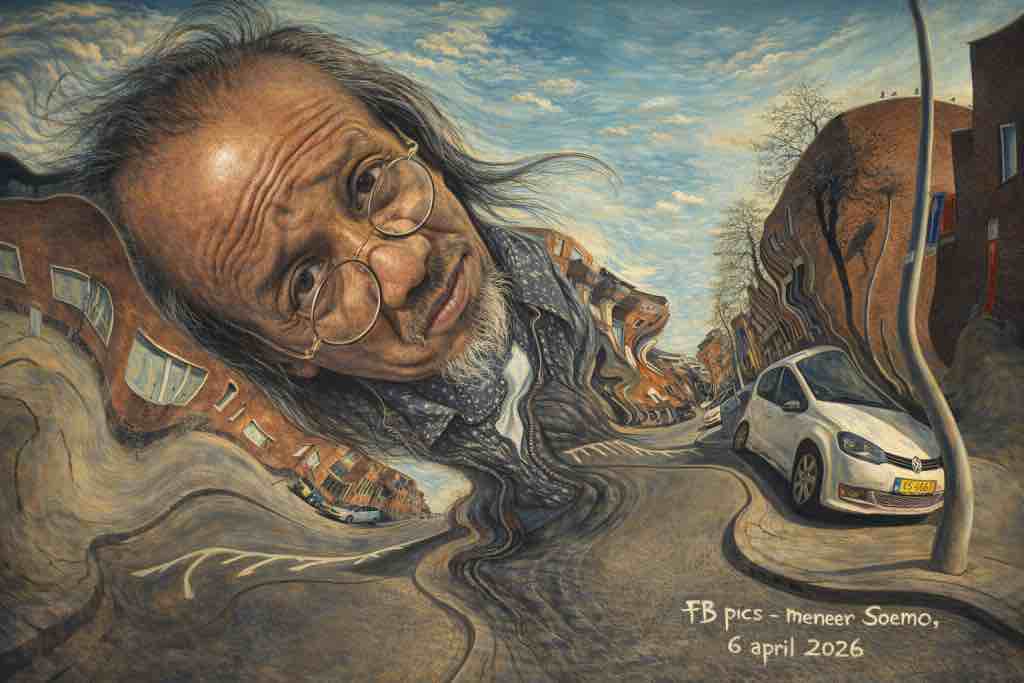
The City You Do Not Love for the View, But for the People
Rotterdam – If you live in or around Rotterdam, you already know something outsiders often miss: this city rarely wins your heart through postcard beauty alone. You do not fall for it because every corner is elegant, polished, or easy to explain. You fall for it because the people force the city into your bloodstream. What keeps you here is not the skyline first, not the bridges, not even the famous modern architecture, but the unmistakable human charge that moves through the streets, the stairwells, the tram stops, the port roads, and the front doors left half-open in neighborhoods where people still know one another by voice.
That is exactly why stories like Paul and Marieke’s resonate so deeply with you. Their move from Volendam, after years in Amsterdam, was not built on certainty. It was built on risk, instinct, and the strange kind of courage that only makes sense after you have already taken the leap. What began as a gamble on Rotterdam Zuid became something larger: proof that a city can feel rough on the outside and profoundly safe on the inside. When you read their experience, you do not simply recognize a couple discovering a new place. You recognize the deeper truth of what Rotterdam still offers those willing to look beyond surface impressions.
Rotterdam Zuid Teaches You to See Beyond the Surface
The beauty of Rotterdam Zuid has never depended on perfect angles. It asks more from you. It asks that you stay with the first impression long enough to discover the second. You may turn a wrong corner and suddenly face industrial silence, containers, concrete walls, railway sounds, or a forgotten patch of postwar urban scar tissue. Another city might lose you there. Rotterdam dares you to keep walking.
Advertisements
That is why the story of a half-forgotten 1930s house on the Hillevliet feels so recognizably Rotterdam. A property nobody wanted, left untouched for months, awkwardly divided, creatively advertised, and still somehow full of promise. The absurdity of buying such a place faster than buying butter says everything about the city’s rhythm. Rotterdam does not wait for perfection before it becomes livable. It lets people shape broken things into homes.
You see it especially in how neighborhoods reveal themselves through human contact rather than through urban planning brochures. A street only becomes meaningful when somebody on that street adopts you. The so-called “empress of the Hillevliet,” the neighbor who turns into guide, witness, and daily conversation partner, is not a side detail in such a story. She is the story. This is how Rotterdam works: places become real through people, and geography becomes intimacy through repetition.
The Rotterdam Character Lives in Everyday Encounters
What defines this city most clearly is not ideology, but interaction. The Rotterdam character survives in small moments that outsiders might dismiss as trivial. A quick exchange on the pavement. A joke shouted across bicycles. A blunt remark that lands not as insult but as social glue. You hear it in the dry humor, the immediate honesty, the refusal to decorate meaning with unnecessary softness.
That is why a scene like Marieke chasing her child while joking with two hard-looking boys on the street captures something essential. The exchange works because Rotterdam’s social code often rewards directness over performance. There is no time for ceremonial politeness when real life is unfolding in motion. The result is not coldness, but a different kind of warmth: one built on immediacy, truth, and mutual recognition.
For you as readers, this matters because it shows how trust in the city is often bodily before it is verbal. It is in the relaxed shoulders after a straight answer. It is in the confidence of knowing that people around you rarely hide their position for long. You may not always like what you hear, but you know where you stand. In a century full of filtered personas and strategic ambiguity, that kind of social honesty feels increasingly rare.
Why Change Does Not Automatically Destroy Identity
Rotterdam is modernizing at a relentless pace, and you feel it in every district. New residents arrive from elsewhere in the Netherlands, from abroad, from cities where the rhythm of life moves differently. Apartments rise where workshops once stood. Cafés appear where old storefronts used to sit in silence. The anxiety that comes with change is real, because identity is fragile when pace exceeds absorption.
Yet the deeper lesson from Rotterdam’s street culture is not that newcomers are the problem, but that the city has historically been strongest when its local code remains visible enough to be learned. Rotterdamness has never been bloodline alone. It is learned behavior, learned trust, learned bluntness, learned resilience. People from outside often absorb it faster than expected once they begin living among it rather than merely observing it.
This is why the city’s uniqueness survives modernization better than people fear. Its identity does not rely on visual sameness. It relies on a social grammar. The unwritten rules matter more than architecture: mind your business unless needed, speak plainly, protect your people, do not posture, and show up when it counts. When these codes remain intact, growth does not automatically erase character. It simply adds new accents to the same urban language.
The Street-Level Meaning of Safety and Loyalty
Much of Rotterdam’s lived reputation rests on a complicated but powerful relationship with safety, privacy, and neighborhood loyalty. You understand this best not through policy debates, but through stories told over fences, on corners, and in living rooms. The camera anecdote says more about the city’s moral texture than a stack of municipal reports ever could.
A resident installs cameras to protect property from vandalism and the unpredictability of youth testing limits. Another conversation follows about privacy, legality, and what may or may not be visible. Then, in a different context, authorities return asking whether footage exists that could help clarify wrongdoing elsewhere. What emerges in the telling is not simple defiance, but the old Rotterdam instinct to protect the social trust of the immediate environment before surrendering it too casually.
For readers, the meaning lies deeper than the anecdote itself. The point is that Rotterdam’s older mentality still places extraordinary value on neighborhood discretion, mutual recognition, and the idea that local trust must not be cheaply broken. This mentality can be misunderstood from the outside as stubbornness. From the inside, it often feels like a refusal to betray the fragile social agreements that keep dense urban life livable.
Advertisements
The Memory of Hardship Still Moves Through the Streets
Every modern city carries invisible layers of memory, but in Rotterdam those layers often feel unusually physical. The city’s history of destruction, rebuilding, labor, migration, and collective endurance still informs how people inhabit space. Even when nobody mentions the war, reconstruction, or the generations who rebuilt with hands instead of rhetoric, the mentality remains present in posture and tone.
That is why stories of protection, silence, and neighborhood solidarity carry such emotional weight. They tap into a longer memory of a city that survived because ordinary people made choices for one another under pressure. Whether the setting is wartime history, postwar rebuilding, or contemporary street life, the underlying ethic feels familiar: do not abandon the people around you when systems become uncertain.
You feel that continuity today in how Rotterdam combines hyper-modern surfaces with deeply old instincts. Towers rise, infrastructure expands, international business flows through the port, yet the social heartbeat often still belongs to the same raw ethic of survival and candor. Modernization changes the skyline faster than it changes the soul.
Why Rotterdam Remains a Global Example of Human Urbanism
What makes Rotterdam exceptional for a broader international audience is precisely that it proves a city can be globally connected without becoming emotionally anonymous. Many modern urban centers grow more efficient while becoming less human. Rotterdam often resists that fate through the stubborn presence of street-level familiarity.
Paul and Marieke’s story speaks to this in a universal way. They did not stay because the city marketed itself well. They stayed because the neighborhood made room for their children, their conversations, their music, their rituals, their humor, and their imperfections. The city became home not through branding, but through repetition of human warmth in rough surroundings.
For readers across the Netherlands and beyond, this is the deeper lesson: the future of urban life may not depend on designing ever more impressive spaces, but on preserving the kind of direct, embodied, everyday trust that lets strangers become neighbors and neighborhoods become belonging. Rotterdam shows you that a city’s greatness is not measured only in what you can see, but in how honestly people allow one another to live.
The Old Energy Still Holds the New City Together
Rotterdam keeps changing, and it should. Cities that stop moving lose their reason to exist. But what keeps this place from dissolving into generic urban sameness is the old energy still running underneath the new concrete. It is there in the sharp humor, the plain speech, the refusal to pretend, the instinctive loyalty to local reality over appearances.
That is why the city still feels safe to so many who understand its rhythm. Not because it is flawless, and certainly not because it is always easy, but because its people continue to offer something increasingly rare: social truth without euphemism. You know where you stand, and in a fractured world that certainty can feel almost luxurious.
Rotterdam’s modernization may redraw the skyline year after year, but the deeper force remains recognizably the same. The old mentality still grips the handrail in the tram, still leans in the doorway during neighborhood conversations, still watches the street from behind the curtain, still speaks in short sentences that mean exactly what they say. That is why the city endures not merely as a place to live, but as a way of being with one another.
 Dutch Echo
Leave a comment